Page 88 of 144
1 86 87 88 89 90 144

Too Little Access, Not Enough Learning: Africa’s Twin Deficit in Education

Por Kevin Watkins

Africa’s education crisis seldom makes media headlines or summit agendas and analysis by the Brookings Center for Universal Education (CUE) explains why this needs to change. With one-in-three children still out of school, progress towards universal primary education has stalled. Meanwhile, learning levels among children who are in school are abysmal. Using a newly developed Learning Barometer, CUE estimates that 61 million African children will reach adolescence lacking even the most basic literacy and numeracy skills. Failure to tackle the learning deficit will deprive a whole generation of opportunities to develop their potential and escape poverty. And it will undermine prospect for dynamic growth with shared prosperity.

If you want a glimpse into Africa’s education crisis there is no better vantage point than the town of Bodinga, located in the impoverished Savannah region of Sokoto state in northwestern Nigeria. Drop into one of the local primary schools and you’ll typically find more than 50 students crammed into a class. Just a few will have textbooks. If the teacher is there, and they are often absent, the children will be on the receiving end of a monotone recitation geared towards rote learning.

Not that there is much learning going on. One recent survey found that 80 percent of Sokoto’s Grade 3 pupils cannot read a single word. They have gone through three years of zero value-added schooling. Mind you, the kids in the classrooms are the lucky ones, especially if they are girls. Over half of the state’s primary school-age children are out of school – and Sokoto has some of the world’s biggest gender gaps in education. Just a handful of the kids have any chance of making it through to secondary education.

The ultimate aim of any education system is to equip children with the numeracy, literacy and wider skills that they need to realize their potential – and that their countries need to generate jobs, innovation and economic growth.

Bodinga’s schools are a microcosm of a wider crisis in Africa’s education. After taking some rapid strides towards universal primary education after 2000, progress has stalled. Out-of-school numbers are on the rise – and the gulf in education opportunity separating Africa from the rest of the world is widening. That gulf is not just about enrollment and years in school, it is also about learning. The ultimate aim of any education system is to equip children with the numeracy, literacy and wider skills that they need to realize their potential – and that their countries need to generate jobs, innovation and economic growth. From South Korea to Singapore and China, economic success has been built on the foundations of learning achievement. And far too many of Africa’s children are not learning, even if they are in school.

The Center for Universal Education at Brookings/This is Africa Learning Barometer survey takes a hard look at the available evidence. In what is the first region-wide assessment of the state of learning, the survey estimates that 61 million children of primary school age – one-in-every-two across the region – will reach their adolescent years unable to read, write or perform basic numeracy tasks. Perhaps the most shocking finding, however, is that over half of these children will have spent at least four years in the education system.

Africa’s education crisis does not make media headlines. Children don’t go hungry for want of textbooks, good teachers and a chance to learn. But this is a crisis that carries high costs. It is consigning a whole generation of children and youth to a future of poverty, insecurity and unemployment. It is starving firms of the skills that are the life-blood of enterprise and innovation. And it is undermining prospects for sustained economic growth in the world’s poorest region.

Tackling the crisis in education will require national and international action on two fronts: Governments need to get children into school – and they need to ensure that children get something meaningful from their time in the classroom. Put differently, they need to close the twin deficit in access and learning.

Why has progress on enrollment ground to a halt? Partly because governments are failing to extend opportunities to the region’s most marginalized children. Africa has some of the world’s starkest inequalities in access to education. Children from the richest 20 percent of households in Ghana average six more years in school than those from the poorest households. Being poor, rural and female carries a triple handicap. In northern Nigeria, Hausa girls in this category average less than one year in school, while wealthy urban males get nine years.

Conflict is another barrier to progress. Many of Africa’s out-of-school children are either living in conflict zones such as Somalia and eastern Democratic Republic of Congo, in camps for displaced people in their home country, or – like the tens of thousands of Somali children in Kenya – as refugees. Six years after the country’s peace agreement, South Sudan still has over 1 million children out of school.

The Learning Deficit

Just how much are Africa’s children learning in school? That is a surprisingly difficult question to answer. Few countries in the region participate in international learning assessments – and most governments collect learning data in a fairly haphazard fashion.

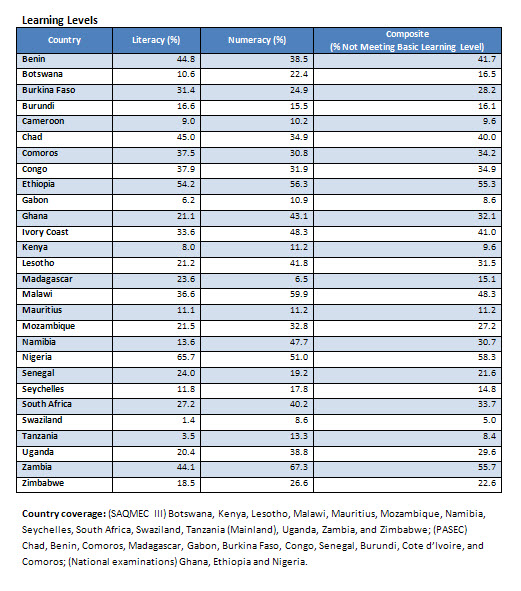
The Learning Barometer provides a window into Africa’s schools. Covering 28 countries, and 78 percent of the region’s primary school-age population, the survey draws on a range of regional and national assessments to identify the minimum learning thresholds for Grades 4 and 5 of primary school. Children below these thresholds are achieving scores that are so low as to call into question the value-added of their schooling. Most will be unable to read or write with any fluency, or to successfully complete basic numeracy tasks. Of course, success in school is about more than test scores.

It is also about building foundational skills in teamwork, supporting emotional development, and stimulating problem-solving skills. But learning achievement is a critical measure of education quality – and the Learning Barometer registers dangerously low levels of achievement.

The headline numbers tell their own story. Over one-third of pupils covered in the survey – 23 million children – fall below the minimum learning threshold. Because this figure is an average, it obscures the depth of the learning deficit in many countries. More than half of students in Grades 4 and 5 in countries such as Ethiopia, Nigeria and Zambia are below the minimum learning bar. In total, there are seven countries in which 40 percent or more of children are in this position. As a middle-income country, South Africa stands out. One-third of children fall below the learning threshold, reflecting the large number of failing schools in areas servicing predominantly low-income black and mixed race children.

Disparities in learning achievement mirror wider inequalities in education. In Mozambique and South Africa, children from the poorest households are seven times more likely than those from the richest households to rank in the lowest 10 percent of students.

Unfortunately, the bad news does not end here. Bear in mind that the Learning Barometer registers the score of children who are in school. Learning achievement levels among children who are out of school are almost certainly far lower – and an estimated 10 million children in Africa drop out each year. Consider the case of Malawi. Almost half of the children sitting in Grade 5 classrooms are unable to perform basic literacy and numeracy tasks. More alarming still is that half of the children who entered primary school have dropped out by this stage.

Adjusting the Learning Barometer to measure the learning achievement levels of children who are out of school, likely to drop out, and in school but not learning produces some distressing results. There are 127 million children of primary school age in Africa. In the absence of an urgent drive to raise standards, half of these children – 61 million in total – will reach adolescence without the basic learning skills that they, and their countries, desperately need to escape the gravitational pull of mass poverty.
learning levels

What is Going Wrong?

Rising awareness of the scale of Africa’s learning crisis has turned the spotlight on schools, classrooms and teachers – and for good reason. Education systems across the region urgently need reform. But the problems begin long before children enter school in a lethal interaction between poverty, inequality and education disadvantage.

The early childhood years set many of Africa’s children on a course for failure in education. There is compelling international evidence that preschool malnutrition has profoundly damaging – and largely irreversible – consequences for the language, memory and motor skills that make effective learning possible and last throughout youth and adulthood. This year, 40 percent of Africa’s children will reach primary school-age having had their education opportunities blighted by hunger. Some two-thirds of the region’s preschool children suffer from anemia – another source of reduced learning achievement.

Parental illiteracy is another preschool barrier to learning. The vast majority of the 48 million children entering Africa’s schools over the past decade come from illiterate home environments. Lacking the early reading, language and numeracy skills that can provide a platform for learning, they struggle to make the transition to school – and their parents struggle to provide support with homework.

Gender roles can mean that young girls are removed from school to collect water or care for their siblings. Meanwhile, countries such as Niger, Chad and Mali have some of the world’s highest levels of child marriage – many girls become brides before they have finished primary school.

School systems in Africa are inevitably affected by the social and economic environments in which they operate. Household poverty forces many children out of school and into employment. Gender roles can mean that young girls are removed from school to collect water or care for their siblings. Meanwhile, countries such as Niger, Chad and Mali have some of the world’s highest levels of child marriage – many girls become brides before they have finished primary school.

None of this is to discount the weaknesses of the school system. Teaching is at the heart of the learning crisis. If you want to know why so many kids learn so little, reflect for a moment on what their teachers know. Studies in countries such as Lesotho, Mozambique and Uganda have found that fewer than half of teachers could score in the top band on a test designed for 12-year-olds. Meanwhile, many countries have epidemic levels of teacher absenteeism.

It is all too easy to blame Africa’s teachers for the crisis in education – but this misses the point. The region’s teachers are products of the systems in which they operate. Many have not received a decent quality education. They frequently lack detailed information about what their students are expected to learn and how their pupils are performing. Trained to deliver outmoded rote learning classes, they seldom receive the support and advice they need from more experienced teachers and education administrators on how to improve teaching. And they are often working for poverty-level wages in extremely harsh conditions.

Education policies compound the problem. As children from nonliterate homes enter school systems they urgently need help to master the basic literacy and numeracy skills that they will need to progress through the system. Unfortunately, classroom overcrowding is at its worst in the early grades – and the most qualified teachers are typically deployed at higher grades.

Public spending often reinforces disadvantage, with the most prosperous regions and best performing schools cornering the lion’s share of the budget. In Kenya, the arid and semi-arid northern counties are home to 9 percent of the country’s children but 21 percent of out-of-school children. Yet these counties receive half as much public spending on a per child basis as wealthier commercial farming counties.

Looking Ahead – Daunting Challenges, New Opportunities

The combined effects of restricted access to education and low learning achievement should be sounding alarm bells across Africa. Economic growth over the past decade has been built in large measure on a boom in exports of unprocessed commodities. Sustaining that growth will require entry into higher value-added areas of production and international trade – and quality education is the entry ticket. Stated bluntly, Africa cannot build economic success on failing education systems. And it will not generate the 45 million additional jobs needed for young people joining the labor force over the next decade if those systems are not fixed.

Daunting as the scale of the crisis in education may be, many of the solutions are within reach. Africa’s governments have to take the lead. Far more has to be done to reach the region’s most marginalized children. Providing parents with cash transfers and financial incentives to keep children – especially girls – in school can help to mitigate the effects of poverty. So can early childhood programs and targeted support to marginalized regions.

Africa also needs an education paradigm shift. Education planners have to look beyond counting the number of children sitting in classrooms and start to focus on learning. Teacher recruitment, training and support systems need to be overhauled to deliver effective classroom instruction. The allocation of financial resources and teachers to schools should be geared towards the improvement of standards and equalization of learning outcomes. And no country in Africa, however poor, can neglect the critical task of building effective national learning assessment systems.

Aid donors and the wider international community also have a role to play. Having promised much, they have for the most part delivered little – especially to countries affected by conflict. Development assistance levels for education in Africa have stagnated in recent years. The $1.8 billion provided in 2010 was less than one-quarter of what is required to close the region’s aid financing gap.

Unlike the health sector, where vaccinations and the global funds for AIDS have mobilized finance and unleashed a wave of innovative public-private partnerships, the education sector continues to attract limited interest. This could change with a decision by the U.N. secretary-general to launch a five-year initiative, Education First, aimed at forging a broad coalition for change across donors, governments, the business community and civil society.

There is much to celebrate in Africa’s social and economic progress over the past decade. But if the region is to build on the foundations that have been put in place, it has to stop the hemorrhage of skills, talent and human potential caused by the crisis in education. Africa’s children have a right to an education that offers them a better future – and they have a right to expect their leaders and the international community to get behind them.

Comparte este contenido:

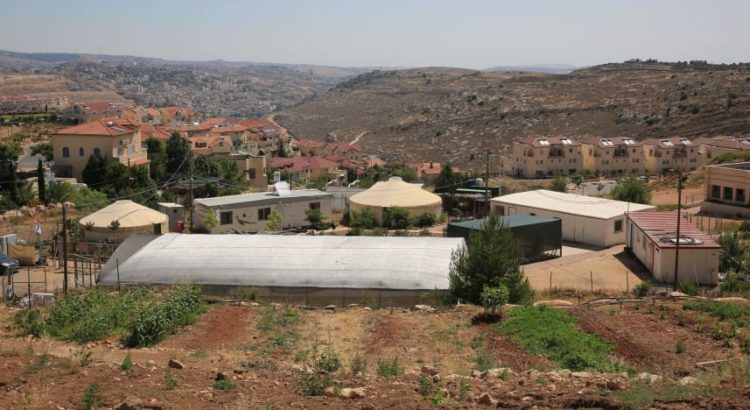
Israel’s Education Ministry Is Funding Two Illegal West Bank Farm Schools

Asia/Israel/02.07.18/By Yotam Berger and Yarden Zur/Source: www.haaretz.com.

Projects built in Efrat, Geva Binyamin settlements on land that does not belong to the state are left standing as Civil Administration does not enforce the law against them.

The government is financially supporting, two farm schools in the West Bank via the Education Ministry and two local councils that were built illegally on land that does not belong to the state. One is in the Efrat settlement in Gush Etzion and the other is in the Geva Binyamin settlement in the central West Bank. The farms were built by the local councils and the Education Ministry allocates classroom hours to them. The councils and the ministry confirmed their connections to the farms.

The Israeli Civil Administration in the West Bank is aware of the illegal construction but does not enforce the law against it, either because enforcement authority lies with the regional council or the buildings are low on the administration’s order of priorities for demolition.

Students from area schools are brought to both farms for “ecological agricultural education.” Both are officially supported by the Education Ministry, which funds classroom hours, and by the local councils. The Efrat budget shows that last year the settlement received 992,000 shekels ($274,000) from the government to build the farm, but the budget does not specify which government ministry is responsible for transferring the funds.

The farms were built in enclaves along the settlements’ blue line that marks the boundary of state lands. The blue line represents land that Israel holds in the territories where it can build legally and retroactively legalize buildings that were erected illegally. The state does not have this authority on land that is not state land. Usually, lands are excluded from being part of state land in such “enclaves” when it is suspected that they were private Palestinian land.

«For the umpteenth time, Efrat has been caught exploiting the land of its Palestinian neighbors,» said Dror Etkes of the Kerem Navot, a group the stated purpose of which is to halt what it says is the dispossession of land owned by Palestinians in the West Bank. «This time too they will surely tell us that it involves state land,» he said.

The Efrat local council responds: “Although the lands are not within the blue line, they are state lands. No one has claimed ownership of them for decades. (…) Agricultural work at the site does not conflict with the building plans at the location, and any structure erected there is also transportable. Efrat has always upheld the law as well as placing an emphasis on good relations with the neighbors.”

However, the area in question is not within the bounds of state lands and the assertion that the land is part of state lands is false.

Avi Roeh, head of the Mateh Binyamin regional council, says: “These are trailers in a place where there was a school. I can’t tell you if they are inside or outside a blue line. This is a site that has been around for many years, that originally was a state-religious school. Now ‘Siah Hasadeh’ is there and it’s a kind of farm school, not exactly a school – students come there and get lessons about agriculture. As far as I know, the permanent structure is supposed to be built in Kochav Yaakov [a settlement north of Jerusalem]. For now they’re there and they have no option to expand. I think the structures have been there for more than 10 years.”

The Education Ministry responded: “The educational farms in question were built by the local authorities. The ministry only allocates classroom hours to the two farms.”

Source of the notice: https://www.haaretz.com/israel-news/.premium-israel-s-education-ministry-funds-two-illegal-west-bank-farm-schools-1.6197277

 
Comparte este contenido:

United States: Fixing education is key to improving job creation

North America/United States/02.07.18/By Bernie Marcus/Source: thehill.com.

Could merging the Labor and Education departments, as the Trump administration proposes, help make the U.S. education system more responsive to the 21st century needs of the labor market?

Students hope so. While the economy is booming, and the class of 2018 has it better off than its millennial predecessors, the entrepreneurship rate is still sputtering. Combining Labor and Education could help influence colleges to add broad entrepreneurship requirements, which are needed for all students in today’s economy where creative destruction is seemingly upending every profession.

According to Census Bureau data, the start-up rate is still hovering near its Great Recession low. The share of young companies less than a year old has declined by almost half in the last generation. And the Kauffman Foundation’s Startup Activity Index is still below its pre-recession level. Given that start-ups drive productivity and innovation, their disappearance has broader implications than just reduced entrepreneurial opportunity.

There are many reasons for the low start-up rate. For one, health-care premiums on the individual market doubled between 2013 and 2017, according to the Department of Health and Human Services. These high costs tip the scales for would-be entrepreneurs in favor of keeping their day jobs with relatively inexpensive health insurance.

But perhaps the biggest reason for the low start-up rate is the country’s higher-education system, which has not modernized along with the economy. Roughly one-quarter of the 1.9 million bachelor degrees awarded in 2016 were in the fields of humanities, psychology, communications or languages — majors where students generally graduate without any entrepreneurial instruction at all.

Just as students majoring in business and STEM (science, tech, engineering and math), are required to take liberal arts courses because these ideally teach critical thinking skills, students majoring in liberal arts should be required to take entrepreneurship courses. Entrepreneurship can bring solutions to scale, and can especially help liberal arts graduates who have few, if any, hard skills.

Liberal arts programs would also better prepare students for the 21st century economy by incorporating principles of entrepreneurship into the general curriculum. In practice this could mean history classes that highlight how comparative advantage and trade made the West rich; geography classes that explain how micro-lending contributes to indigenous wealth creation in Africa; sociology classes that showcase how economic opportunity is the best way to alleviate poverty; philosophy classes that teach the morality of capitalism.

It’s not only college curricula that have weighed on startup rates but also college cost. According to the Department of Education, the cost of attending a four-year college has risen by 64 percent over the past 20 years, adjusted for inflation. As a result, Americans now shoulder $1.5 trillion in student loan debt — an average of more than $30,000 per borrower. Carrying this much debt makes it difficult to take the entrepreneurial plunge, given that it usually means going into more debt. Colleges that more efficiently teach entrepreneurial skills valued by the job market play an important role in helping to bring down these costs.

All this isn’t to say there’s no entrepreneurial movement on campuses. A Kauffman Foundation report finds entrepreneurial programs have more than quadrupled since 1975. The re-examination of the Department of Education priorities as a result of a merger with the Department of Labor could help build on this momentum to make entrepreneurship a core part of the college experience.

All students should be equipped with the thinking to start the next Etsy, Main Street diner or The Home Depot. Only when entrepreneurship is a core pillar of the educational system will students be able to take full advantage of the modern economy, reverse the dwindling startup rate, and — more importantly — renew the American dream.

Source of the notice: http://thehill.com/opinion/education/395011-fixing-education-is-key-to-improving-job-creation

Comparte este contenido:

Expired education and Africa’s learning crisis

By The Guardian

The recent dismal report of a new World Bank study, which stated that Africa faced learning crises that may hinder its economic growth and the well-being of the citizens, questions the quality of basic education African governments have been providing their people. It is also an eye-opener to the abysmal degeneration of succession management for the society. Although keen observers of events on the continent have been worried about the celebration of mediocrity pervading key areas of society, this new study has presented bleak hope for Africa’s future, if drastic measures are not taken to address basic education. This is disheartening and highly lamentable.

The World Development Report (WDR) 2018, titled “Learning to Realise Education’s Promise”, was co-launched in Abuja the other day by the World Bank Group, the Federal Ministry of Finance and the Federal Ministry of Education. Whilst the report raised concerns about poor future prospect of millions of young students in low and middle-income countries owing to the failure of their primary and secondary schools to educate them to succeed in life, it also called for greater measurement, action on evidence, and coordination of all education actors.

It claimed that despite “considerable progress in boosting primary and lower secondary school enrollment, … “some 50 million children remain out of school, and most of those who attend school are not acquiring the basic skills necessary for success later in life.”

To substantiate its claims, the report noted that among second-grade students assessed on numeracy tests in several sub-Saharan African countries, three-quarters could not count beyond 80 and 40 per cent could not solve a one-digit addition problem. It went further to add: “In reading, between 50 and 80 per cent of children in second grade could not answer a single question based on a short passage they had read, and a large proportion could not read even a single word.”

Concerning Nigeria, the study found out that, when fourth grade students were asked to complete a simple two-digit subtraction problem, more than three-quarters could not solve it. It further stated that “Among young adults in Nigeria, only about 20 per cent of those who complete primary education can read. These statistics do not account for 260 million children who for reasons of conflict, discrimination, disability, and other obstacles, are not enrolled in primary or secondary school.”

Deon Filmer and Halsey Rogers, World Bank Lead Economists, who co-directed the report team, summarized the report when they stated “too many young people are not getting the education they need.” This remark corroborated the observation of Prof. Gamaliel O. Prince, the Vice Chancellor of University of America, California, who remarked at the matriculation of its Nigerian affiliate students, that Nigerians are receiving expired education. The question now is, what kind of education do African young people need?

As if a section of Nigerian youths foresaw the World Bank report, they had, two weeks, earlier flayed the poor education of Nigerian leaders, and had set a list of criteria for the next president. According to them, “many of our past and present leaders are an embarrassment to the country due to their very low educational background and lack of exposure.” These remarks are very instructive because, if today’s leaders, reputed to have had quality basic education, are leading the country astray, the quality of future leaders leaves little to imagine about when the discouraging report of the World Bank is considered.

The vital point that should not be missed in the interpretation of the report is the emphasis on quality basic education. This aspect speaks to Nigeria, where the idea of the educated is construed on the basis of holding a university degree. What kind of education would one claim to have acquired if he earned a university degree and cannot solve the problems of basic numeracy and comprehension? What kind of outcomes would be accomplished by the kind of learning provided by today’s educational institutions? This is not to assert that Nigeria does not have well-trained and adequate manpower. This is far from the truth. The highly quality manpower and human resources which Nigeria has in abundance could be seen in the value Nigerian professionals have added to the growth and progress of other countries.

As this newspaper has always admonished, addressing the problem of education in this country demands emergency response. What this country needs is a leadership that is vision-casting enough to align its human resources for growth in production. All it takes is a vision, the political will to realize that vision, and the sincerity of purpose in mobilizing the people around that vision. If learning is to be impactful and effective as to lead to personal development and pragmatic relevance to society, then Nigeria and all of Africa must first of all, understand the problem they face. Owing to the experiences of colonization, neo-colonization and even globalization, Nigeria and other African countries find themselves in the shackles of economic slavery, and have tied their educational curricula to exploitable learning models that service foreign powers.

Because the structure of income-generation and production has a part to play in learning outcomes in African countries, education ministries and stakeholders of such countries must see learning as a tool for solving problems and generating production in the society. Education should have a promise for children and youths in Africa; incentives should be made available for structured learning.

One of the maladies of African leaders is cronyism and nepotism. This extension of selfish interests to the benefits of family, friends, clans, ethnic groups and political party loyalists has encouraged the dominance of mediocrity in leadership in a manner that suffocates excellence. African leaders should build a culture of succession management founded on excellence so that the right persons in the right places would think out the right policies to move their countries forward. They should take a cue from forward-looking countries by identifying the best in all fields, and positioning them as managers for national reconstruction.

Furthermore, African leaders should go back to the drawing-board and identify the problems facing their people, and on the basis of this, begin to design curricula that should enable African children think inwards. Learning models should consider the role of history in understanding the African predicament and how it can empower them to think about Africa’s place in a competitive world. These models should also stress the relevance of language in learning.

To effectively get this done in Nigeria, especially, and save the nation from its many crises, it is indeed apparent that restructuring into a properly run federalism would have to drive structured learning.

Source of the article: https://guardian.ng/opinion/expired-education-and-africas-learning-crisis/

Comparte este contenido:

Pakistan: 1,000 Pakistani students to be trained in China under CPEC CCC

Asia/Pakistan/02.06.18/Source: gulfnews.com.

CPEC centre is jointly working with the Chinese education ministry which is affiliated with a number of vocational universities and institutes

The China-Pakistan Economic Corridor Cultural Communication Centre (CPEC CCC) under its ‘Talent Corridor’ scheme will offer scholarships to 1,000 Pakistani students for a one-year vocational training starting from November this year in China.

“The students to be selected from across the country will be provided free tuition and dormitory during the training at different universities and institutes in China,” Echo Lee, director-general of CPEC CCC and CEO of St Xianglin Management and Consulting Company while talking to APP here on Sunday.

CPEC CCC is located in China’s Suzhou Vocational University, which has world-class facilities and able faculty, she said.

Its functions include China-Pakistan student exchanges, academic research and seminars, vocational education, organising Chinese culture experience camp and teachers exchange, she added.

Giving further details about the scholarship scheme, Lee said it is a three level programme and the students will be taught outer space and high-speed train technology during the first level while in the middle level, they will be imparted education of hydro-power and solar energy engineering.

The students selected for the lowest level will get training for the driving of different machines and types of equipment including excavation machines and caterpillar etc.

Lee said this year, 1,000 students will be offered 20 majors from a high level to the lower level classes as compared to 100 scholarships in six majors last year.

While hoping for a positive response and cooperation from the Pakistani side, she said at present, the details are being discussed with the concerned officials in the Pakistan ministry of planning, development and reforms as well as the embassy of Pakistan in Beijing.

She informed the CPEC CCC is jointly working along with the Chinese education ministry which is affiliated with a number of vocational universities and institutes.

To a question, she claimed that vocational education in China is the highest level in the world even in some areas it is better than Germany and Japan.

The CEO said this cross-border education exchange programme is step one of the overall project and added in the next phases, equipment and teachers will be sent for vocational training of Pakistani students in Pakistan.

The Chinese vocational education centres, as well as educational parks, would be set up in Pakistan in future, she added.

She said her organisation intends to donate some training equipment and looking forward to a positive response from Pakistani institutions which are interested to receive it.

About the cooperation in the past, she said her organisation has signed a MoU with Khyber Pakhtunkhwa (KP) and Gilgit-Baltistan (GB) governments to set up cultural communication centres under the CPEC framework. These centres will serve as the main forum in the field of Sino-Pak education and cultural communication, she added.

Source of the notice: https://gulfnews.com/news/asia/pakistan/1-000-pakistani-students-to-be-trained-in-china-under-cpec-ccc-1.2245028

Comparte este contenido:

Australia: Student debt: how the government’s Hecs changes will affect you

Oceania/Autrialia/02.07.18/Source: www.theguardian.com.

On 1 July the threshold falls by more than $10,000, so if you earn at least $45,000 you’ll start repaying your loan

From Sunday, thousands of students and graduates across the country will have to start paying off their debts earlier than expected.

In the coming financial year, which starts on 1 July, anybody earning $52,000 or more a year will have to start paying off their student debts, which for most domestic and undergraduate students is known as the Higher Education Contribution Scheme (Hecs).

And that’s just the first stage of changes because the government announced plans to lower the repayment threshold further to $44,999 in the budget. The bill locking in that change was expected to pass the Senate this week but has now been delayed until parliament resumes in August.

Given the bill has not passed before the start of the 2018-19 financial year, the full reduction in the threshold will likely not apply until 1 July 2019.

When do I have to pay it back?

Under changes made in 2016, from 1 July 2018 people earning more than $51,956 will have to start paying back student debts.

If and when the Coalition bill passes, you will have to start paying your debt once you earn $45,000 or more a year, with a likely start date of 1 July 2019.

For the 2017-18 tax return, you will only pay your debt if you have a taxable income of more than $55,874.

Importantly, it’s not just graduates who are affected – you have to start paying your student debt as soon as you hit the income threshold, even if you are still studying.

You also still have to pay your debt if you’ve moved overseas. This used to be a loophole – worth $20m-$30m a year in lost revenue – but it was closed in 2016.

How much do I have to pay? 

The amount you pay rises as you make more money.

Under the new rules, those on the lowest bracket (more than $44,999 but less than $51,957) will have to pay 1% of their total income. For someone earning $45,000 before tax – or $865 a week – it would be $8.60 a week.

Those earning between $51,957 and $58,379 will have to pay 2%, and so on, rising to a maximum of 10% for those over $131,989.

It’s important to note that you pay a percentage of your total income – not a percentage of your debt.

The move will generate $345.7m in savings until 2020-21. Previously, any extra contributions you made offered you an extra discount on your debt, but this policy has been repealed.

Your total debt should be included on your tax return, and can be viewed on the MyGov website. You can also contact the ATO to ask for updates.

As well as Hecs, it includes other related debts like Fee-Help (for full-fee paying students), Vet Fee-Help (for vocational colleges), OS-Help (for when you study overseas or are on exchange) and SA-Help (when you take a loan to pay your $149 student services amenity fee).

How long do I have?

A Hecs debt is effectively an interest-free loan. Rather than charging you money, the government indexes your debt to the consumer price index – the amount goes up every financial year, but by not more than the rate of inflation, so the effective change is zero.

This means it shouldn’t cost you more to pay off your Hecs over a long time, and there is no time limit to pay it off.

The yearly indexation only applies to debts older than 11 months, and it happens every 1 June.

However, the government’s changes have also created a new a lifetime cap on all Hecs loans of $104,440 – starting on 1 January 2019. Previously there was only a cap on postgraduate, full-fee and vocational loans. The cap is higher for those studying medicine, dentistry or veterinary science ($150,000)

Only loans taken out after 1 January 2019 will count towards the cap – so existing debts do not.

Can I reduce or cancel my debt?

If you are a nurse, midwife or teacher, or a maths, statistics or science graduate, you may be eligible for the Hecs-Help benefit, which will reduce your Hecs debt.

The scheme was cancelled by the government on 1 July 2017. However, because you have two years to lodge a tax return, if you were eligible in the 2016-17 financial year, you can still claim it until 30 June 2019.

If you were eligible in the 2015-16 financial year, you have until Sunday to claim it.

Eligibility criteria are quite complex, so check with the Study Assist websiteand the Australian Taxation Office.

In special circumstances, you can also have some of your Hecs debt cancelled.

If you failed a subject, or had to withdraw from a subject due to illness or other circumstances, you can apply to your university or education provider to have the debt for that subject cancelled.

If you withdrew after the census date without a special circumstance, you still have to pay the Hecs debt for that subject. You also can’t cancel the debt for a subject if you successfully completed it.

After revelations that many private colleges were exploiting the Vet-Fee loan system, the government also introduced debt cancellations if your vocational provider committed “unacceptable conduct” – for example, if you were pressured into signing up for a course, were offered money or goods to sign up, or were lied to about how much the course cost.

Source of the notice: https://www.theguardian.com/australia-news/2018/jun/28/student-debt-how-the-governments-hecs-changes-will-affect-you

Comparte este contenido:

Why Teaching English Through Content Is Critical for ELL Students

United States / July 1, 2018 / Author: Katrina Schwartz / Source: KQED

Teaching grade-level content to students who have just arrived in the United States and whose English skills are limited is a difficult task. High school-level content specialists especially have little training on how to integrate language acquisition into their content. Often teachers deal with that by either dumbing down the curriculum to make it linguistically simpler or alternating between lessons focused on language and those about content.

Teachers in San Francisco were looking for better ways to teach their newcomer students the English skills they need, without losing a focus on the complex content all students should be learning. To do that, they looked to adopt some of the strategies of the Writing Is Thinking Through Inquiry(WITsi) work being done in New York City with the general education population.

Based on Judith Hochman’s work, at its core these strategies focus on building up students’ ability to put together sentences piece by piece*. Through an inquiry process, New York teachers discovered that their students’ writing was breaking down at the level of the sentence, making it difficult for them to express more nuanced and complex arguments.

Nell Scharff Panero developed the WITsi strategies and has been working with New York Renewal schools to implement them. As she watched teachers having some success, she realized the same strategies could be powerful for English learners. She has been working with language specialists to adapt the strategies for that population.

“Teachers are so responsive to this work,” said Amy Gottesfeld, a supervisor in San Francisco’s Multilingual Pathways Department. “They’re finding it hugely helpful and successful in terms of giving them concrete ways to integrate language into their content.”

San Francisco Unified School District is starting small, bringing together sheltered pathway teacher cohorts from seven high schools around the district. Together they look closely at student writing, share lesson ideas, and try to deepen their own understanding of the English Language and how to teach it through content.

“Given these strategies that support language, that support writing, without having to sacrifice the focus on content has felt liberating to people,” Gottesfeld said.

The program is intentionally set up around cohorts at each school so that teachers can collaboratively build the WITsi strategies into every class, regardless of content area. One activity asks students to write sentences using “but, because and so” correctly. These small conjunctions are powerful language markers that students often use incorrectly.

But when the science teacher is using “but, because, so” sentence routines to help students understand relationships in an ecosystem, while in the next room the history teacher is using the same structures to help students identify the effects of colonialism, it reinforces writing and thinking for students. And, it means students are getting explicit language development help throughout the school day, not only during their legally required English Language Development time.

“I was like, oh, this is what I’ve been missing,” said Anne Ryan, a history teacher in the sheltered language pathway for newcomers at Thurgood Marshall High School in San Francisco. She first learned about some of the strategies through an exchange with the Internationals Network for Public Schools in New York, whose teachers have become standouts in developing language alongside content. She was trying to use some tips she picked up at a conference on her own when SFUSD announced the current pilot. She jumped at the chance for more formal training on the strategies.

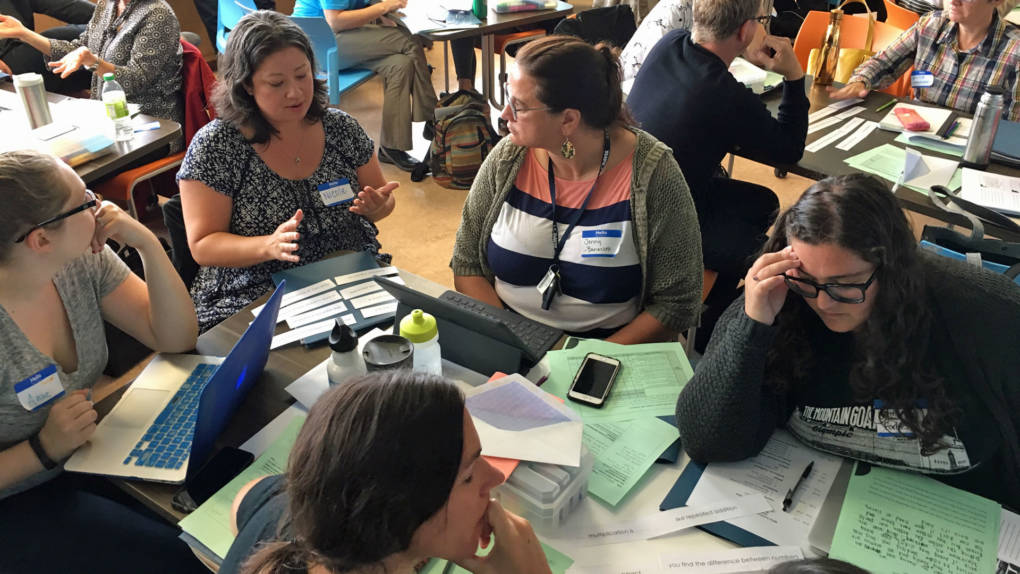
Teachers in Thurgood Marshall High School's sheltered language pathway collaborate during a professional development training about how to teach thinking through writing.
Teachers in Thurgood Marshall High School’s sheltered language pathway collaborate during a professional development training about how to teach thinking through writing. (Courtesy Amy Gottesfeld/SFUSD)

“I think that non-English Language Development and English teachers, a lot of us still have nervousness around how to really develop English and writing skills in our classroom,” Ryan said. “But it really is our responsibility as well. I think doing the WITsi has made that responsibility feel lighter and feel effective.”

Bringing instruction down to the level of the sentence forces the teacher to carefully identify the most important information she wants her students to learn that day, and build sentence-level activities around the main content goal. This practice often leads to more effective instruction, in addition to helping students build their language skills.

WITsi work in New York City Renewal schools with the general education population has uncovered similar sentence-level misunderstandings in high school student writing. In those cases, it’s often hard for high school teachers to accept that they have to go back and teach the basic building blocks of good sentence writing, then paragraphs, and finally essays. They feel that their students should already have those skills.

But with newcomer students, teachers are hungry for anything that will help them make their curriculum more accessible to students who don’t have language skills yet, but desperately need them. All of these strategies should be used in conjunction with the most important content of the day. The idea is to marry the linguistics with subject mattercontent at every step to make the language relevant, while helping students learn the content.

SEVEN BASIC WRITING STRATEGIES

1. Sentence boundaries: These activities are designed to help students understand what a sentence is and what it is not.

In the process, teachers can identify the parts of a sentence: noun, verb, object, but more than the grammar, these activities use content to discuss what makes a sentence. How can one tell if something is a fragment, or a run-on? Activities include matching different parts of a sentence to either make a complete sentence or repair a fragment. Or, teachers might ask students to sort sentences into fragments, complete sentences and run-ons.

“But again all the sorting that you’re doing is around the content that you’re studying,” Gottesfeld said. So, if the lesson focus is Alexander Hamilton, all the sorting and matching is related to his historical contributions. The dual approach is the most important part of all these strategies.

2. Recognizing different sentence types like statements, questions, exclamations or commands.

This includes helping students look for clues — does the sentence start with a question word, for example? While it may seem simple to a native speaker, expressing the content using various types of sentences can dramatically change meaning, an important concept for students to understand. Also, focusing explicitly on questioning helps empower English learners as question askers throughout the curriculum and in other learning settings.

3. Working with the coordinating conjunctions “but, because and so” to help students elaborate on their sentences.

Many students, even ones who speak English, don’t have a firm grip on the differences these words signal. “But, because, so” activities might start off with matching sentence stems to sentence ends based on the conjunction, and gradually become more difficult, ending with giving a student the three bases and having them complete the sentence.

This is often a favorite with teachers and students because it begins to open the door to more analytical thinking. Knowing how to use these conjunctions is not only a language rule, it indicates the student’s ability to think comparatively, to explain, to make connections.

4. Subordinating conjunctions

Subordinating conjunctions are an important way English speakers vary sentences structure and express complicated relationships between things. They’re also tricky for non-native English speakers, and deserve explicit introduction. Words that signal time and position are powerful expressions of analytical thinking. When teachers introduce subordinating conjunctions within a content lesson, it gives students more ways to express complex ideas and improves sentence fluency.

5. Sentence combining

Activities in this sequence include giving students two sentences and asking them to use a variety of techniques to combine them into one. Scaffolds might include giving students a word bank or conjunctions to choose from, while the most complex version might ask students to write a sentence with an independent and dependent clause on Alexander Hamilton that uses a conjunction. A core goal of these activities is to use relevant content to help students reduce redundancy in their writing by combining sentences. It’s also an opportunity to work on syntax within the context of content objectives. Students are motivated by the desire to be understood.

6. Appositives

Appositives are a language structure that allows the writer to rename a noun. This is another explicit language structure that makes student writing more interesting, specific and nuanced. But rather than making it a disconnected grammar lesson, teachers can use activities about their content that incorporate appositive practice.

Many English learners also struggle to follow the chain of references in texts with unknown words, so explicitly teaching about appositives can help with reading comprehension as well.

7. Sentence expansion with descriptors

In these activities students ask students to expand on a simple, unelaborated sentence by asking them to answer a series of questions aimed at teasing out details. A typical simple sentence might be, “Alexander Hamilton helped establish it.” The teacher then writes questions to identify the information that would elaborate this sentence: What did he establish? Why did he establish it? How did he do it? Who helped him? Once students have identified all these details, they rewrite or “expand” the unelaborated sentence into a much improved one that includes those details. This guided process helps model the way English sentences are constructed and is a precursor to revision.

“The ‘Writing as thinking’ presents somewhat of a sequence to introducing these strategies and approaches,” Gottesfeld said. “That feels new and clearly makes sense” to many teachers in the sheltered language pathways.

And when students have these clear sentence-level building blocks, practice them regularly, and understand the way they function to express ideas, teachers can use them in the most complex process of all: parallel revision.

“We know that revision is critical for the writing process to support students in developing good writing,” Gottesfeld said. Parallel revision is a more structured way to help students revise their writing. Teachers might write “elaborate” next to a thought in a student’s paragraph and suggest the student think about the “but, because, so” strategy to carry out that elaboration. This practice can also make peer revision more useful, grounding the discussion in specific strategies the kids know well through prior practice.

“It puts the kid in a position where they have to think about language that they know and try to apply it,” said Joanna Yip, a former teacher in the Internationals Network who helped design the materials and activities SFUSD teachers are using. “It is an absolutely necessary component for kids who are learning the language.” Through parallel revision students begin to truly appropriate the language and transfer the piecemeal sentence-level work into paragraphs and even essays.

Yip said this systematic approach to language construction that WITsi offers is fairly new to many English language teachers, especially ones who see themselves foremost as content specialists and secondarily as teachers of English. Rather than chunking out the steps of writing a paragraph and asking students to follow instructions, parallel revision requires students themselves to do the thinking about which strategy responds to the teacher’s feedback.

Yip said a lot of English language teachers are well versed in using language frames, sentence starters, vocabulary work and scaffolding larger pieces of writing. They regularly use the cycle Pauline Gibbons champions, in which teachersbuild up background knowledge jointly as a class before asking students to do it on their own. “That’s all good and necessary,” Yip said, “but the one missing piece to those approaches tends to be there isn’t explicit instruction on how to build sentences.”

And keeping these strategies tightly tied to the content makes the language lessons useful to students. Too often when teachers try to focus on the nuts and bolts of language, they end up delivering a disconnected lesson on grammar that students don’t transfer to the writing they do in each content area.

“If they have opportunities to do this kind of work that is appropriate for their phase of language development, then over time they will gain that momentum as students,” Yip said. “When they feel supported in doing it, it’s a rigorous task, but a task they can manage.” She said it’s unreasonable to ask a student who has been in the country for three months to write an essay. And without carefully scaffolding writing strategies, that student may never get to the essay writing level.

A TEAM EFFORT

Evelyn Sulem is just finishing up her second year of teaching high school history. She said teaching in the sheltered language pathway isn’t a highly coveted position, so it often falls to newer teachers. But she enjoys watching the incredible progress her students make and plans to continue teaching newcomer students, especially now that she feels she has a few more tools and a supportive group of colleagues.

“I have definitely seen a massive progress in the level of English and in the level of content knowledge,” Sulem said about using the WITsi strategies. She meets with colleagues from other content specialties who also teach newcomers once a week. They share strategies and try to sync up their curriculum to reinforce vocabulary, concepts and language structures.

“We try to bring forth the vocabulary in all the disciplines,” Sulem said. Through this intensive WITsi work, she has also become more aware of the different English levels in her classroom. She is now carefully building more scaffolds into her lessons, using WITsi strategy variants to support her students to understand the history content. For example, students might complete the activities in their home language, or discuss the content with a partner in their home language before trying to use their English to write down thoughts..

“We teach history in a workshop style,” Sulem said. The social studies department at Lincoln wants to build students into critical thinkers who can analyze history. They try not to lecture from the front of the room, and have de=emphasized memorization. That’s even more important when students don’t understand the lecture anyway. “We don’t give any lectures, but we engage students with simple text which has history content,” Sulem said.

Sulem is grateful the WITsi work has given her more tools to reach her newcomer English learners, but she admits the work is very difficult. Many of her students arrived in the U.S. with interrupted educations, and their writing skills in a home language aren’t strong either.

“It makes me think about my own teaching practice in a different way,” Sulem said. “Students need visuals and need to be informed about the same theme in three different ways: speaking, writing and visually.”

And because she teaches a few sections of general education students, Sulem is applying tactics that work with her newcomers to all her classes. She thinks teaching English learners has made her a more creative teacher, helping her to guide kids to an analytical understanding of history using multimodal forms of learning. And when she can see a student is struggling to express a complex idea in their writing, she’s got more linguistic supports to help them get there.

*This piece has been edited to reflect that the WITsi strategies build on ideas originally developed by Judith Hochman.

Source of Article:

https://www.kqed.org/mindshift/51268/why-teaching-english-through-content-is-critical-for-ell-students

ove/mahv

Comparte este contenido:
Page 88 of 144
1 86 87 88 89 90 144