Page 266 of 343
1 264 265 266 267 268 343

OREALC UNESCO: Las carreras docentes en América Latina. La acción meritocrática para el desarrollo profesional

Este informe revisa la situación actual de las carreras docentes en América Latina. Para ello se han registrado las regulaciones de dieciocho países de la región sobre la base de cuatro ejes: los mecanismos de acceso a la carrera docente, las estrategias de promoción laboral, los procesos de evaluación de la función docente y los procedimientos de salida de la carrera. Posteriormente, se hizo un énfasis particular en los programas de incentivos y estímulos al trabajo docente desarrollados en la región.

Las carreras docentes latinoamericanas son plataformas legales heterogéneas en cuanto a su naturaleza jurídica, su orientación técnica y su organización interna. Esto es debido al extendido periodo de tiempo que abarcan estas regulaciones. Para el 2014 coexisten en la región carreras diseñadas y aprobadas en los años 50, junto con la regulación más reciente de año 2013.

No obstante, es posible organizar las carreras docentes latinoamericanas en tres grupos, a partir de dos características: la amplitud y longitud de la carrera, medida desde las estrategias de promoción horizontal y vertical, y la incorporación de mecanismos de evaluación con consecuencias de alto impacto; es decir, evaluaciones del desempeño de los maestros que pueden devenir en la pérdida de la estabilidad laboral.

En el primer grupo se encuentran la mayoría de regulaciones de la región. En todas ellas, la dinámica de la carrera está basada en criterios como la antigüedad y la acumulación de certificaciones. No solo no está prevista la evaluación del desempeño, sino que la estabilidad laboral está asegurada por el Estado, salvo casos tipificados por actos reñidos con la moral y la ética, o por procesos ordinarios de jubilación.

En el segundo grupo se encuentran aquellas carreras que están fundamentadas en las carreras de primera generación, pero que sin embargo presentan algunos rasgos propios de las nuevas carreras. En la mayoría de los casos estos rasgos están vinculados con la evaluación del desempeño.

La segunda generación de carreras es el tercer grupo. Son las más recientes y están diseñadas bajo enfoques estrictamente meritocráticos. En estas carrerasla estabilidad laboral está asociada a los resultados de evaluaciones de desempeño y suelen privilegiar la promoción horizontal.

La región requiere desarrollar investigación sobre los resultados de la implementación de las nuevas generaciones de carreras docentes, que permita utilizar información específica que complemente las orientaciones ideológicas de las reformas. Mientras eso suceda, es posible tener en cuenta algunas consideraciones generales que sirvan a la implementación de dichas carreras y al diseño de futuras regulaciones.

En el futuro, los diseños de nuevas carreras, así como la implementación de las más recientes regulaciones deberían buscar reconocer y premiar el mérito sin perder la esencia colectiva de la educación. Esto se constituye en un primer gran reto que las políticas de regulación docente deben enfrentar. En esta misma línea de desafíos se debería incluir en las carreras más alternativas de promoción laboral y nuevas posibilidades de espacios de trabajo; establecervínculos entre las carreras y los planes de formación en un marco de políticas docentes integrales; elaborar marcos de desempeños, estándares o competencias específicas sobre la función y la práctica docente; diseñar regulaciones específicas alineadas con el marco jurídico nacional; y formular planes integrados de estímulos e incentivos al desempeño docente.

Las carreras docentes en América Latina tienen el reto principal de constituirse en instrumentos de desarrollo profesional que contribuyan al fortalecimientode la profesión y, consecuentemente, a la elevación de la calidad educativa.

Libro esta disponible en este enlace: http://unesdoc.unesco.org/images/0024/002440/244074s.pdf

Comparte este contenido:

Argentina /CTERA: defiende una nueva ley de financiamiento educativo

Fuente CTERA

En el marco de la Campaña por una nueva Ley de Financiamiento Educativo la CTERA difunde la revista editada por la Secretaría de Educación que inaugura la serie llamada “Pedagogía y Políticas Educativas” de Ediciones CTERA.
En esta publicación se presentan distintas reflexiones y argumentaciones acerca de la necesidad de contar con una nueva Ley de Financiamiento Educativo que permita garantizar el derecho social y humano a la Educación en el contexto actual.
En este número inaugural de la serie escriben referentes sindicales y pedagógicos, e incluye una nota de opinión de Stella Maldonado del año 2010, donde nuestra querida compañera ya planteaba la necesidad de contar con un marco normativo que lleve la inversión en Educación al 10% del PBI. También presenta un informe elaborado por el Instituto de Investigaciones Pedagógicas “Marina Vilte” de CTERA sobre las tendencias privatizadoras de la educación en las definiciones presupuestarias y financieras, y una síntesis de la investigación realizada por el Observatorio Latinoamericano de Políticas Educativas de la IEAL sobre las tendencias actuales en educación.

Esta publicación contiene:
Editorial. Sonia Alesso
Financiamiento educativo en el año del Bicentenario. Stella Maldonado
Financiamiento educativo, una lucha histórica de la CTERA. Hugo Yasky
Ley de Financiamiento Educativo o leyes del mercado. Adriana Puiggrós
Financiamiento Educativo y Políticas Públicas, Educación Pública de calidad para todos y todas. Silvia Almazán y Roberto Baradel
Presupuesto educativo: qué hay, qué falta… Miguel Duhalde
Las tendencias privatizadoras de la educación en la definiciones presupuestarias y financieras. IIPMV, Secretaría de Educación
«Tendencias en Educación». OLPE – IEAL

A continuación la publicación:

Financiamiento

Comparte este contenido:

The scourge of illiteracy and the authoritarian nightmare

At the present historical moment, Americans live in a society in which thinking is viewed as an act of stupidity, and ignorance is treated as a virtue. Literacy is now regarded with disdain, words are reduced to data, and science is confused with pseudo-science. For instance, two thirds of the American public believe creationism should be taught in schools and most of the Republicans in Congress do not believe that climate change is caused by human activity, making the U.S. the laughing stock of the world. News has become entertainment and echoes reality rather than interrogating it. Popular culture revels in the spectacles of shock and violence. Unsurprisingly, education in the larger culture has become a disimagination machine, a tool for legitimizing ignorance, and it is central to the formation of an authoritarian politics that has gutted all those public spheres in which thoughtfulness, critical exchange, and informed dialogue can take place.

Illiteracy has become a scourge and a political tool designed primarily to make war on language, meaning, thinking, and the capacity for critical thought. Illiteracy no longer simply marks populations immersed in poverty with little access to quality education; nor does it only suggests the lack of proficient skills enabling people to read and write with a degree of understanding and fluency. More importantly, illiteracy is about what it means not to be able to act from a position of thoughtfulness, informed judgment, and critical agency. It suggests not only learning the skills and knowledge to understand the world but also to intervene in it and change it when necessary. Illiteracy has become a form of political repression that discourages a culture of questioning, renders agency as an act of intervention inoperable, and restages power as a mode of domination. It is precisely this mode of illiteracy that both privatizes and kills the imagination by poisoning it with falsehoods, consumer fantasies, data loops, and the need for instant gratification.

This is a mode of manufactured illiteracy and education that has no language for relating the self to public life, social responsibility or the demands of citizenship. It is important to recognize that the rise of this new mode of illiteracy is not simply about the failure of public and higher education to create critical and active citizens; it is about a society that eliminates those public spheres that make thinking possible while imposing a culture of fear in which there is the looming threat that anyone who holds power accountable will be ignored or punished. At stake here is not only the crisis of a democratic society, but a crisis of memory, ethics, and agency.

What role might education and critical pedagogy have in a society in which the public goods disappear, emotional life collapses into the therapeutic, and education is reduced to either a private affair or a kind of algorithmic mode of regulation in which everything is reduced to a market-based outcome. What role can education play to challenge the deadly claim of casino capitalism that all problems are individual, regardless of whether the roots of such problems lie in larger systemic forces? In a culture drowning in a new love affair with instrumental rationality, it is not surprising that values that are not measurable — compassion, vision, the imagination, trust, solidarity, care for the other, and a passion for justice — wither.

One of the challenges facing the current generation of educators, students, progressives, and other cultural workers is the need to address the role they might play in educating students to be critically engaged agents, attentive to addressing important social issues and being alert to the responsibility of deepening and expanding the meaning and practices of a vibrant democracy. At the heart of such a challenge is the question of what education should accomplish, not simply in a democracy but at an historical moment when the United States is about to slip into the dark night of authoritarianism. In a world in which there is an increasing abandonment of egalitarian and democratic impulses, what will it take to educate young people and the broader polity to challenge authority and hold power accountable? How might we construct an education capable of providing students with the skills, ideas, values, and authority necessary for them to nourish a substantive democracy, recognize anti-democratic forms of power, and to fight deeply rooted injustices in a society and world founded on systemic economic, racial, and gendered inequalities? What will it take for educators to recognize that the culture of education is not simply about the business of culture but is crucial to provide the conditions for students to address how knowledge is related to the power of both self-definition and social agency? What work do educators have to do to create the economic, political, and ethical conditions necessary to endow young people and the general public with the capacities to think, question, doubt, imagine the unimaginable, and defend education as essential for inspiring and energizing the citizens necessary for the existence of a robust democracy?

.

Henry A. Giroux is a widely published social critic and McMaster University professor who holds the McMaster Chair for Scholarship in the Public Interest, the Paulo Freire Distinguished Scholar Chair and is a Visiting Distinguished University Professor at Ryerson University. Born in Rhode Island, he held numerous academic positions in the U.S. and now lives in Hamilton.

Comparte este contenido:

México: En unos días se decidirá sobre mega paro interuniversitario

Fuente: revoluciontrespuntocero/ 27 de Abril de 2016

Tras llevarse a cabo el día de hoy la asamblea interuniversitaria, estudiantes del Instituto Politécnico Nacional (IPN),  de la Universidad Nacional Autónoma de México UNAM, la Universidad Autónoma Metropolitana (UAM), la Universidad Autónoma de la Ciudad de México y la Universidad de Chapingo, y otras, acordaron que el próximo 16 de mayo se decidirá si se realiza un mega paro en mencionadas instituciones.

Reunidos en la  UPIICSA, alrededor de 200 jóvenes aseguraron que  la reforma al nivel básico es una muestra de lo que el Gobierno quiere hacer con la educación pública y los maestros.

Además, se acordó que los estudiantes se  unirán a la marcha de la Coordinadora Nacional de Trabajadores de la Educación (CNTE) y la de los padres de  Ayotzinapa, programada para el 1 de mayo.

Del mismo modo,  padres de los normalistas  asistieron también a la  asamblea, al cumplirse 19 meses, ofreciendo apoyo a los universitarios.

Comparte este contenido:

México: La CNTE recibe a Nuño con protestas y vandalismo en Michoacán; hay 44 detenidos

Fuente: proceso.com / 27 de Abril de 2016

MORELIA, Mich. (apro).- La visita a esta ciudad del secretario de Educación Púbica, Aurelio Nuño, desencadenó protestas y actos de vandalismo por parte de la Sección 18 de la Coordinadora Nacional de Trabajadores de la Educación (CNTE), los cuales dejaron 44 personas detenidas, entre maestros y normalistas.

Y es que los inconformes rompieron vidrios y lanzaron piedras al Centro de Convenciones y Exposiciones de esta ciudad (Ceconexpo), por lo que la policía tuvo que intervenir.

Con pancartas en contra de la reforma y del descuento a los salarios, los trabajadores de la CNTE, calificaron la visita de Nuño como “una provocación”.

Aunque no portaban palos en el momento de su llegada, un grupo trató de irrumpir al salón Michoacán donde se efectuaba el evento, causando destrozos en puertas y ventanas, lo que movilizó a elementos de seguridad que se encontraban en el sitio.

Minutos después, otro grupo que se encontraba afuera del recinto intentó ingresar de igual manera, pero fueron detenidos por elementos de seguridad que ya se encontraban resguardando los alrededores.
En ese momento hubo discusiones, gritos, reclamos y rechiflas por la seguridad que consideraron excesiva.

Posterior a ello, y como generalmente sucede, los docentes intentaron bloquear avenidas, en este caso la Ventura Puente y comenzaron a aventar a los elementos de seguridad.

Cuando se intentó detener a algunos profesores, estos huyeron a Plaza Camelinas para evitar detenciones, pero fue inútil. En ese instante comenzaron a arrojar a la policía estructuras metálicas y piedras mientras corrían a diversas zonas alrededor del Centro de Convenciones.

Tras este hecho, los elementos lograron detener a 44 profesores y normalistas que se unieron a la movilización y a los actos vandálicos cometidos en el recinto, donde se encontraban Aurelio Nuño y el gobernador de Michoacán, Silvano Aureoles Conejo.

El titular de la Secretaría de Seguridad, José Antonio Bernal, informó que tras el operativo desplegado afuera del Centro de Convenciones fueron detenidas 44 personas, entre los que hay estudiantes normalistas y docentes adheridos a la CNTE.

El funcionario estatal señaló que el operativo se desplegó tras los actos de vandalismo realizados por los estudiantes, quienes destrozaron Ceconexpo. Acto seguido, elementos de la corporación acudieron a desalojar a los estudiantes y posteriormente detenerlos.

Ante ello, el recinto permanece resguardado por elementos de Seguridad para evitar más desmanes, pues en el sitio también se encuentran estudiantes normalistas.

Comparte este contenido:

India: How UoH and JNU Have Taken Us From Public Protest to Public Pedagogy

Fuente: thewire.in/ Por Pramod K. Nayar/ 27 de Abril de 2016

In the public debates around key concepts raised by the students, democracy finds its greatest strength: the right to speak, the right to be heard and the right to plurality

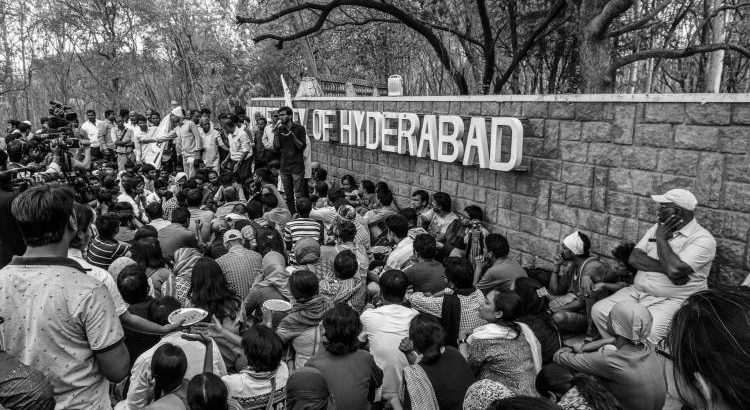
Fotografia: Two spaces in India have been radically transformed since January 18, 2016: the educational institution and the public space of the town/city.

January 18, 2016 saw the first protests over the suicide of the Dalit student-scholar, Rohit Vemula, at the University of Hyderabad (UoH), driven to despair over his suspension from residential areas of the educational institution by a university order, allegedly at the behest of a ruling party’s local member of parliament, and unfairly tried before being convicted. On February 12, 2016, Kanhaiya Kumar, president of the Jawaharlal Nehru University Students’ Union (JNUSU) was arrested on sedition charges for allegedly raising anti-India slogans at a student gathering. Widespread protests across the country resulted, and we saw a merger of both ‘causes’ in the protests.

Numerous public intellectuals, activists, jurists, educationists, and politicians gave interviews, wrote opinion pieces, joined campaigns and signed petitions. Processions and protests also included, expectedly, shut-downs of educational institutions, street protests and online campaigns across Indian cities. Heated debates on television were accompanied by letters to respected newspapers from parents, former teachers, alumni of these institutions and others. Worldwide coverage came in the form of BBC and CNN reportage and signature campaigns by academics, submitted to the Indian government, the president and others.

What do the protests congealing around Rohit/UoH and Kanhaiya/JNU mean for the landscape of ‘public pedagogy’ and how might they transform the scene of education itself, if followed through?

Public pedagogy, as theorists such as Henry Giroux have defined it, is an essential system of education that works outside institutions:

learning and education happening outside of formal schooling systems and position informal spaces of learning such as popular culture, the Internet, public spaces such as museums and parks, and other civic and commercial spaces, including both old and new social movements, as sites of pedagogy containing possibilities for both reproduction and resistance.

The protests around Rohit/UoH and Kanhaiya/JNU moved out of public educational institutions to public spaces: the streets. The streets and open spaces outside public offices, government buildings in the campaigns such as ‘Chalo UGC’become, I propose, spaces of education.

There is, in other words, an educative force and appeal in the protests. Pedagogy, said Henry Giroux, ‘is not simply about the social construction of knowledge, values, and experiences; it is also a performative practice embodied in the lived interactions among educators, audiences, texts, and institutional formations’. We saw these interactions in the above protests.

Public pedagogy as embodied in the protests is essential to India’s democracy for several reasons.

First, it takes theories and ideas, ideologies and ideologies from the classroom to the public space of debate. Point-counterpoint, the clash of ideologies (SFI/ABVP, Congress/BJP, Marxist/Neoliberal) were embodied in the speeches and discussions outside the institution and thus explicated in real-time in a real-life situation. This is a pedagogy that emerges from outside the institution as well, when thinkers and commentators as diverse as protesting mothers and lawyers (Teesta Setalvad) inform the public of what wrongs have been perpetrated and, more importantly, what is at stake.   This is therefore a pedagogy of the public, emerging from outside the licensed scholarly world of academia and is more akin to cultural work around social justice and ideas of democracy.

Second, ideas of nationalism, continuing discrimination, identity, patriotism, freedoms (of various kinds) were articulated in ways that these became, at least for the duration of the protests, a public lingua franca. Here protests that debated key concepts were pedagogic for the public (okay, the public that cared to listen, exactly as in a class room). It brought to public attention issues of academic freedoms, the right to protest, the modes of social integration, the subtleties of discrimination and the education policies around, say research programs in universities. This pedagogy for the public is an important development in Indian democracy because it is not a set of state-governed instructions as to what to think or how to think. Public pedagogy cohering around Rohit/Kanhaiya and concepts of discrimination or freedoms mobilizes public sentiment through the instruction generated by the protests.

Third, the protests around identity and concepts such as freedom or nationalism altered the polis. The polis, wrote Hannah Arendt, ‘is the organisation of the people as it arises out of acting and speaking together’. Thus, the polis was a pluralised space, with arguments and counterarguments around abstract ideas of nationhood and identity being articulated in a blurring of advocacy, education and activism.

Fourth, it expanded the public educational institution to encompass the street at a time when the space of public institutions is shrinking. Judith Butler writing about the Occupy movement: by “performatively laying claim to public education … precisely at a historical moment in which that access is being shut down”, through budget cuts, censorship and fee-hike, the protests symbolically lay claim to “buildings that ought properly, now and in the future, to belong to public education.” The public institution where debates around abstract concepts and concrete social inequities may be debated extends into the public space of the city when these protests move out of the walls. The public institution is then projected as a space where these inequities are institutionalised, even as they are spaces segregated from the surrounding city or context. The protests in these two cases demonstrated how the institution only reflects its surrounding social realities, as the nation yet again learnt what it meant to be inside places of higher learning devoted, ostensibly, to ideas of equality, freedom and justice. The protests also underlined the need for public institutions to be truly public and not subject to ideological regimentation, to be truly public and plural.

Fifth, the direction in which protests such as these move is not determined by an agenda from the outside or from within an educational regime. It emerges from within the very recognition of what is at stake: freedom from discrimination, freedom to access equality and social justice, etc. We can see the protests as public pedagogy for the political learning they disseminate about what it means to be a part of the Indian public. These protests took a crisis within public institutions into the public outside the institution so that they fed off each other.

Sixth, the public pedagogy the protests embody is about publicness, about being a concerned public. By drawing attention to structures and regimes of exclusion – including censorship, which is a process of excluding words – the protests educate us on what is at stake in being a public, a polis. This is not to say that politics replaces education. Rather, from a theoretical standpoint, education for the public is drawn from a political campaign and thereby it, the public, understands itself better as a public.

The Rohit/Kanhaiya protests are important because of these pedagogic effects they can potentially generate, for the ideas around which they cohered and for the political learning they offer to the ones who heard them. In the public debates around key concepts, democracy finds its greatest strength: the right to speak, the right to be heard and the right to plurality.

Pramod K. Nayar is a Professor at the University of Hyderabad


Enlace original:  http://thewire.in/
Comparte este contenido:
Page 266 of 343
1 264 265 266 267 268 343