Page 6 of 9
1 4 5 6 7 8 9

¿Quién es la maestra premiada como docente del año que la Casa Blanca no quiere que conozcamos?

Estados Unidos / 13 de mayo de 2018 / Autor: Redacción / Fuente: Democracy Now

Mandy Manning recibió en Estados Unidos el premio 2018 a la Maestra del Año en un evento en la Casa Blanca, pero la prensa no pudo acceder a su discurso y el presidente Trump no mencionó con qué población trabaja como docente: niños y niñas inmigrantes y refugiados. Manning aprovechó su presencia en la Casa Blanca para entregar al presidente Donald Trump pilas de cartas de sus estudiantes refugiados e inmigrantes, ante la mirada atenta de la multimillonaria secretaria de Educación Betsy DeVos. Además, al acercarse a recibir el premio, lucía seis prendedores con consignas políticas que mostraban, por ejemplo, arte de la Marcha de Mujeres 2017, la bandera de la diversidad y la frase “¡Igualdad Trans Ya!”.

Para ampliar esta información, vea (en inglés) nuestra conversación con Mandy Manning que se comunica con nosotros desde Spokane, Washington, donde trabaja como docente de inglés y matemática en la secundaria Joel E. Ferris. Fue nombrada Maestra del Año 2018 a nivel nacional por el Consejo de Directivos de Escuelas Estatales (CCSSO por su sigla en inglés).

Fuente de la Noticia:

https://www.democracynow.org/es/2018/5/7/meet_the_teacher_who_staged_a

Comparte este contenido:

El boicot de Trump a científicos chinos compromete la ciencia mundial

Estados Unidos/12 de Mayo de 2018/Europa Press

Académicos británicos advierten de que las medidas propuestas por la administración Trump para restringir que investigadores chinos trabajen en Estados Unidos podrían «sofocar» el progreso global.

La Casa Blanca está discutiendo si limitar el acceso de los ciudadanos chinos a los Estados Unidos, incluyendo la restricción de ciertos tipos de visas disponibles y ampliando en gran medida las normas relativas a los investigadores chinos que trabajan en proyectos con valor militar o de inteligencia en empresas y universidades estadounidenses.

El posible boicot, que podría afectar directamente a 300.000 investigadores, parece estar motivado por temores de que los investigadores chinos puedan estar involucrados en actividades de espionaje y transfiriendo descubrimientos secretos estadounidenses al gobierno chino.

COMO DESPUÉS DE LA PRIMERA GUERRA MUNDIAL Investigadores de las Universidades de Bristol, Warwick y London School of Economics and Political Science (LSE) han establecido paralelismos con la fuerte declinación en la cooperación científica internacional después de la Primera Guerra Mundial, advirtiendo que un impacto similar podría verse si se ponen nuevas barreras lugar por los Estados Unidos.

Al comienzo de la guerra, el mundo se dividió en los campos de los Aliados (Reino Unido, Francia, después los Estados Unidos y varios países más pequeños) y Central (Alemania, Austria-Hungría, Imperio Otomano, Bulgaria).

La participación de científicos en el desarrollo de armas químicas y la postura extremadamente nacionalista adoptada por muchos en apoyo de su patria enfrentaron a los campos científicos opuestos entre sí.

Inmediatamente después del final de la guerra, los científicos aliados impusieron un boicot contra los científicos de Alemania y sus aliados, que separó a los científicos en campos opuestos hasta mediados de la década de 1920.

Un reciente trabajo de investigación publicado en el Quarterly Journal of Economics, examinó el efecto de este boicot y muestra que las barreras a la cooperación científica internacional no solo ralentizan la producción de ciencia básica, sino que también dañan la aplicación de la ciencia en el desarrollo de nuevas tecnologías.

Alessandro Iaria, uno de los autores del informe y profesor de Economía de la Universidad de Bristol, dijo en un comunicado: «Además de las consecuencias inmediatas que podría tener un boicot científico, también podría haber ramificaciones perjudiciales a largo plazo para todo el progreso científico y la innovación tecnológica en todo el mundo.

«Si bien los efectos globales de un boicot de este tipo son difíciles de estimar, hay lecciones de la historia que pueden informar a los responsables políticos sobre los posibles efectos a largo plazo para el progreso científico y la innovación tecnológica.

«Nuestros resultados sugieren que la política científica debe estar orientada a facilitar el acceso y capitalizar los posibles efectos catalíticos de la investigación de vanguardia para mejorar el progreso científico. La comunidad académica mundial tiene preocupaciones reales de que un boicot a los investigadores chinos podría frenar este progreso «.

La investigación, también llevada a cabo por Carlo Schwarz de la Universidad de Warwick y el Dr. Fabian Waldinger de LSE, encontró que las barreras crecientes a la cooperación científica internacional durante el boicot condujeron a una disminución en el número de artículos publicados por científicos de ambos lados.

Los científicos que habían confiado en la investigación de vanguardia del extranjero publicaron menos trabajos que los científicos que históricamente trabajaron con la investigación de su país de origen. Por ejemplo, los bioquímicos estadounidenses que dependían de la investigación de Alemania vieron su productividad disminuir en un 33 por ciento en comparación con los biólogos estadounidenses que utilizaron la investigación de sus contrapartes en Estados Unidos.

Es importante destacar que el boicot no solo afectó a los científicos centrales, sino a toda la comunidad científica internacional en general.

Los científicos afectados también produjeron menos descubrimientos científicos, medidos por la introducción de palabras novedosas en títulos en revistas científicas y por nominaciones para un Premio Nobel, y menos de sus descubrimientos científicos encontraron aplicación en patentes.

Carlo Schwarz, de la Universidad de Warwick, dijo: «El período histórico único nos permite estudiar la importancia de la cooperación científica internacional. Isaac Newton dijo que, en su investigación, estaba ‘sobre los hombros de gigantes’. Nuestro trabajo destaca la importancia del acceso a las mejores ideas científicas existentes para la creación de nuevas investigaciones «.

Fuente: http://www.europapress.es/ciencia/laboratorio/noticia-boicot-trump-cientificos-chinos-compromete-ciencia-mundial-20180511161945.html

Comparte este contenido:

Estados Unidos: Corey Robin: los docentes en huelga son “la verdadera resistencia” a los republicanos “incoherentes” y los demócratas “destruidos”

Estados Unidos / 22 de abril de 2018 / Autor: Redacción / Fuente: Democracy Now

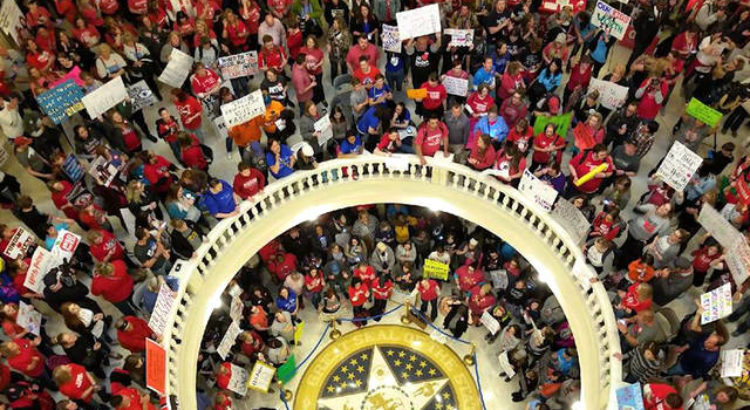
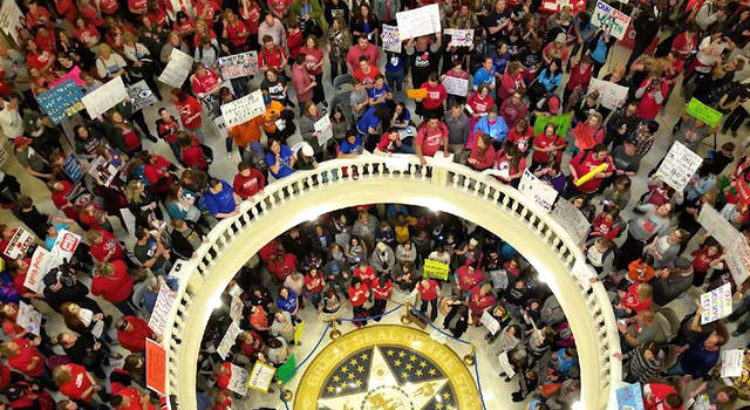
En el marco de la revuelta de docentes que se desarrolla en todo EE.UU., decenas de docentes de Oklahoma completaron una marcha de siete días y 177 km, desde Tulsa hasta la Ciudad de Oklahoma, capital del estado. Las escuelas públicas de toda Tulsa y Ciudad de Oklahoma permanecen cerradas, al tiempo que miles de docentes continúan la huelga en reclamo de mayor financiamiento para la educación, que va por su noveno día. La huelga se produce en momentos que la Corte Suprema analiza el caso Janus contra Federación Estadounidense de Empleados Estatales, Municipales y de Condados (AFSCME) que podría asestar un fuerte golpe a los sindicatos públicos de todo el país. Además, la huelga se produce en momentos que el presidente Trump designa exitosamente a jueces de derecha en tribunales federales, lo que dará nueva forma al sistema judicial para las futuras décadas.
Para saber más de este tema, puede ver otra parte de la conversación que tuvimos (en inglés) con Corey Robin. Robin es profesor de ciencias políticas en Brooklyn College y el Centro de Graduados de la Universidad de Nueva York. Robin afirma que el movimiento conservador es “débil e incoherente” y el Partido Demócrata, “una máquina destruida”. Además dice que los trabajadores que se organizan en revueltas como la de los docentes son la “verdadera resistencia” en la EE.UU. de hoy.

Fuente de la Noticia:

https://www.democracynow.org/es/2018/4/12/corey_robin_striking_teachers_are_real

Comparte este contenido:

USA: Corey Robin: Striking Teachers Are “Real Resistance” to “Incoherent” Republicans and “Gutted” Dems (Audio)

USA / April 22, 2018 / Democracy Now


In the continuing teachers’ rebellion sweeping the U.S., dozens of Oklahoma teachers have completed a 7-day, 110-mile march from Tulsa to the state capital Oklahoma City. Public schools across Tulsa and Oklahoma City remain closed as thousands of teachers continue their strike for education funding into a ninth day. The strike comes as the Supreme Court is considering Janus v. AFSCME, a case that could deal a massive blow to public unions nationwide—and as President Trump is successfully appointing right-wing judges to federal courts, reshaping the judiciary for decades to come. We continue our conversation with Corey Robin, a professor of political science at Brooklyn College and the Graduate Center of the City University of New York. Robin calls the conservative movement “weak and incoherent” and the Democratic Party “a gutted machine,” and says labor organizing like the teachers’ revolt are the “real resistance” in the U.S. today.

Transcript
This is a rush transcript. Copy may not be in its final form.

AMY GOODMAN: This is Democracy Now!, democracynow.org, The War and Peace Report. I’m Amy Goodman, with Nermeen Shaikh, as we continue with our guest, from Paul Ryan to what’s happening around the country in the conservative movement and those that are challenging it. Nermeen?

NERMEEN SHAIKH: Well, in Oklahoma, dozens of teachers have completed a 7-day, 110-mile march from Tulsa to the state capital Oklahoma City, where they will now meet with lawmakers to demand they pass legislation to fund education in Oklahoma. Public schools across Tulsa and Oklahoma City remain closed as thousands of teachers continue their strike into its ninth day.

AMY GOODMAN: Our guest Corey Robin recently wrote on Facebook, “In West Virginia, Oklahoma, Kentucky, and Arizona, we’re seeing the real resistance, the most profound and deepest attack on the basic assumptions of the contemporary governing order. These are the real midterms to be watching, the places where all the rules and expectations we’ve come to live under, not just since Trump’s election but since forever, are being completely scrambled and overturned.”

Professor Corey Robin, can you talk more about these teacher rebellions? I mean, you had the stoppage in Kentucky. You had West Virginia, and they won. You have now—you have now Oklahoma and then Arizona. We’re talking about Trump land here.

COREY ROBIN: I think it’s really important for a couple of reasons. Beyond the specific issues of teacher pay and classrooms and quality of public education, which is in such a parlous state, what these teachers are really doing is raising the question about the low-taxes, low-public-services politics that we have been living with in this country for a very long time.

I just want to bring this back for an historical analogy. If we went back to 1978—and this is why the midterm question is important—if you had looked at the midterm elections in 1978, you would have seen that the Democrats were still firmly in control of the House of Representatives, in the House, and the Senate, and in control of many state legislatures across the country. You would had very little inkling, just looking at the midterms, of the very profound right-wing counterrevolution that was coming in two years, in the election 1980. If, however, you had looked at what happened in California with Proposition 13, which was a public ballot initiative that basically made it very difficult to raise taxes anymore, there you would have have seen the future of American politics for the next half-century.

Likewise today, I think if you’re looking at what’s happening in Oklahoma, really, as you said, in the heart of Trump country, these teachers are saying—are saying something that is such a challenge to the Republican Party about taxes and spending, but also to the Democratic Party. I think it’s very important. Democrats have been terrified of being tagged as the tax-and-spend party, really since Walter Mondale. And what are these—and the only times Democrats are willing to raise taxes is to deal with the deficit or the debt. What are these teachers saying? They’re saying raise the capital gains tax, not to cut the debt or the deficit, not to be good government people, but instead to deliver vital public services that the public needs and wants. And I think that’s the real challenge that they’re posing.

AMY GOODMAN: I mean, this is such an astounding story that’s happening in Oklahoma. You have schools that are only operating four days a week, because they don’t have enough money for the fifth day, and the teachers don’t have enough money to teach for the fifth day, because they need second and third jobs. We had a teacher who taught—what—for 20 years, and so had her husband, and her husband, on his day off, he sells his own blood products.

COREY ROBIN: I mean, it’s horrible. But in a way, it’s just a very extreme version, I think, of what happens in a lot of states. I mean, I teach at the City University of New York. It used to be one of the crown jewels of the city and of the state. It has also been—systematically been underfunded and defunded, by both Republicans and Democrats alike. This is a national problem. What’s so amazing is that it’s being confronted in the place where you would think there would be the most support for it. And not only are they doing this—

AMY GOODMAN: You’re talking about Governor Cuomo, Democratic Governor Cuomo, here in New York.

COREY ROBIN: Yes, Democratic governor. And going way back to his father, as well, defunded CUNY, but—Mario Cuomo. But in Oklahoma, you know, these teachers are doing this, and they’ve got—it’s amazing to me, is that they’ve got overwhelming public support with what they’re doing.

NERMEEN SHAIKH: Well, has there been any precedent, is there any precedent, for this number of teachers’ strikes, or even public sector workers, in general, in the U.S.?

COREY ROBIN: I think, oh, there definitely have—I mean, public sector workers have really been in the forefront for the last 50 years—

NERMEEN SHAIKH: Right.

COREY ROBIN: —of leading strikes. In the 1970s, particularly women and people of color were in the vanguard of a lot of these efforts, in organizing public sector workers. And, in fact, one of the reasons you could say that the Republican right has been so—pushing so hard on this Janus decision, which would basically make it very hard for public sector unions, the Supreme Court decision, is precisely because they feel like that’s the last bastion of unionized workers, and they are workers that tend to be, compared to the rest of the workforce, overwhelmingly women and people of color.

AMY GOODMAN: And this is why judges are so important right now, and as you have Mitch McConnell saying, “The fight should be in the Senate. We’re going to lose the House,” he said—

COREY ROBIN: Yes.

AMY GOODMAN: —apparently this weekend, according to The Washington Post, that the fight is around the judiciary. And they are packing these courts.

COREY ROBIN: Yeah.

AMY GOODMAN: I mean, they do take this extremely seriously, for anyone who thinks that President Trump isn’t getting anything accomplished.

COREY ROBIN: I mean, this has been very clear from the early part of the Trump administration. They were—they bungled so many other things. But the one thing that, from the get-go, they knew how to do was to get the courts, the judges appointed. In fact, he’s been appointing judges at a faster rate than Barack Obama did, I think faster than George W. Bush did. But that tells you something, though, I think, not about the strength of the conservative movement and the Republican Party, but about its weakness. McConnell is very clear about this: “If we can just hold on to the Senate, we can have a lock on the courts, not just the Supreme Court, but the courts, for 30 to 40 years.” And remember, the judges they appoint, these are people who are, you know, in their fifties, in their forties, who will be with us for a very, very long time.

AMY GOODMAN: I mean, you have this judicial nominee, Vitter, Wendy Vitter—

COREY ROBIN: Yes.

AMY GOODMAN: —who worked for the archdiocese in Louisiana, who, when confronted by Senator Blumenthal yesterday about whether she supports this landmark Supreme Court decision, Brown v. Board of Education, challenging desegregation, she demurred. She said she wouldn’t say.

COREY ROBIN: Yes. Well, this is their—this is the big strategy all the conservative justices and nominees have been pioneering, really going back to Judge Bork in the 1980s, which is: Say nothing, make no statements whatsoever about your points of view. And you can present yourself as if you’re—you know, remember, Clarence Thomas said he had no opinion whatsoever on Roe v. Wade. He had never—he claimed he had never even had a conversation about Roe v. Wade, even though he was in law school when Roe v. Wade was decided. So this is a long-standing strategy, to say nothing about what your opinions are, and to get you in that way.

AMY GOODMAN: And you have Stephen Reinhardt now, who has just died, 9th Circuit Court of Appeals, a huge deal, was the last of President Jimmy Carter’s federal judicial appointees. Trump can now remake the 9th Circuit.

COREY ROBIN: Yeah. I mean, and this is—and this is really the goal. I mean, it’s been really astonishing, again, given the dysfunction and the disorganization that we’ve seen throughout this administration, their inability to pursue things on so many fronts, but when it comes to this, this is something that they’ve been very focused on, you know, almost maniacally so.

NERMEEN SHAIKH: Well, can you talk about, Corey, the rise of someone like Bernie Sanders and all the movements—the Occupy Wall Street movement, Black Lives Matter—in the context of what you were saying earlier, that these strikes are geared towards not just Republicans, or opposed not just Republican policies, but also Democrat policies?

COREY ROBIN: Yeah. So, you know, the—as I’ve said, the conservative party—the conservative movement in the Republican Party is quite weak, I think, and in part the reason why it’s so weak is because conservatism, you know, as a historical project, really was overwhelmingly successful. The fundamental target of conservatism, number one, was the labor movement, and, compared to what—the heyday of American labor, completely succeeded in destroying it. And the second target was the black freedom struggle, and they were very successful in destroying that struggle, as well. So, conservatism, I think we have to realize, has been very successful.

And what you’re seeing now, I think, on the left, in both Occupy, Bernie Sanders, the teacher strikes, Black Lives Matter, is a growing confrontation, within the left, a growing reckoning of how successful, in fact, conservatism has been, and how feckless and ineffective the Democratic Party and traditional liberalism has been in opposing this. And I think, frankly, the real story in American politics right now is not so much what’s happening with the Republican Party and the conservative movement, which, as I’ve said, is, by any historical measure, quite weak and incoherent, precisely because it was so victorious over the last several decades. I think the real story, the real question is: Is there going to be a force on the left, not just movements in the street, but an organized force that’s able to tip this house of cards over?

AMY GOODMAN: So, talk about that further, what exactly you mean, where you feel the Democratic Party is failing right now.

COREY ROBIN: Well, I mean, first of all, you can just look at the numbers. I mean, Bernie Sanders pointed this out in Mississippi the other day and got actually attacked for it. But the fact of the matter is, over the last 10 years the Democrats have lost nearly a thousand legislative seats. That’s, I think, the highest proportion of seats lost under a Democratic—a two-term Democratic president since at least maybe Dwight David Eisenhower. I mean, it’s—you oftentimes lose seats, but the proportions were just tremendous. And the Democratic Party as a whole is really a kind of gutted machine. I mean, the mere fact, I might say, that Bernie Sanders was able to get as far as he did in those primaries tells you how weak and sort of structureless and rudderless the Democratic Party is.

But I think the real question is, on the left: Do you have an ideology, a theory, a kind of set of accounts, similar, frankly, to what Ronald Reagan did in 1980 or FDR did in 1932? These are these two great realignment presidents—”great” not in the sense that I support Reagan, but, you know, powerful. And what they did was articulate a really profound, completely countervailing set of ideas and institutions, and were able to shatter the existing dispensation. I think that’s the question that’s on the table and that Bernie is sort of slowly pushing towards.

AMY GOODMAN: Well, Corey Robin, we thank you for this very interesting discussion, one we will continue, professor of political science at Brooklyn College and Graduate Center of the City University of New York, author of The Reactionary Mind: Conservatism from Edmund Burke to Donald Trump.

A very happy birthday to—a landmark birthday to Anna Özbek!

https://www.democracynow.org/2018/4/12/corey_robin_striking_teachers_are_real

Comparte este contenido:

The Ghost of Fascism in the Age of Trump

By Henry A. Giroux, Truthout

In the age of Trump, history neither informs the present nor haunts it with repressed memories of the past. It simply disappears. Memory has been hijacked. This is especially troubling when the «mobilizing passions» of a fascist past now emerge in the unceasing stream of hate, bigotry, lies and militarism that are endlessly circulated and reproduced at the highest levels of government and in powerful conservative media, such as Fox News, Breitbart News, conservative talk radio stations and alt-right social media. Power, culture, politics, finance and everyday life now merge in ways that are unprecedented and pose a threat to democracies all over the world. This mix of old media and new digitally driven systems of production and consumption are not merely systems, but ecologies that produce, shape and sustain ideas, desires and modes of agency with unprecedented power and influence. Informal educational apparatuses, particularly the corporate-controlled media, appear increasingly to be on the side of tyranny. In fact, it would be difficult to overly stress the growing pedagogical importance of the old and new media and the power they now have on the political imaginations of countless Americans. This is particularly true of right-wing media empires, such as those owned by Rupert Murdoch, as well as powerful corporate entities such as Clearwater, which dominates the radio airwaves with its ownership of over 1,250 stations. In the sphere of television ownership and control, powerful corporate entities have emerged, such as Sinclair Broadcast Group, which owns the largest number of TV stations in the United States. In addition, right-wing hosts, such as Rush Limbaugh and Sean Hannity have an audience in the millions. Right-wing educational apparatuses shape much of what Americans watch and listen to, and appear to influence all of what Trump watches and hears. The impact of conservative media has had a dangerous effect on American culture and politics, and has played the most prominent role in channeling populist anger and electing Trump to the presidency. We are now witnessing the effects of this media machine. The first casualty of the Trump era is truth, the second is moral responsibility, the third is any vestige of justice, and the fourth is a massive increase in human misery and suffering for millions.

Instead of refusing to cooperate with evil, Americans increasingly find themselves in a society in which those in commanding positions of power and influence exhibit a tacit approval of the emerging authoritarian strains and acute social problems undermining democratic institutions and rules of law. As such, they remain silent and therefore, complicit in the face of such assaults on American democracy. Ideological extremism and a stark indifference to the lies and ruthless polices of the Trump administration have turned the Republican Party into a party of collaborators, not unlike the Vichy government that collaborated with the Nazis in the 1940s. Both groups bought into the script of ultra-nationalism, encouraged anti-Semitic mobs, embraced a militant masculinity, demonized racial and ethnic others, supported an unchecked militarism and fantasies of empire, and sanctioned state violence at home and abroad.

Words carry power and enable certain actions; they also establish the grounds for legitimating repressive policies and practices.

This is not to propose that those who support Trump are all Nazis in suits. On the contrary, it is meant to suggest a more updated danger in which people with power have turned their backs on the cautionary histories of the fascist and Nazi regimes, and in doing so, have willingly embraced authoritarian messages and tropes. Rather than Nazis in suits, we have a growing culture of social and historical amnesia that enables those who are responsible for the misery, anger and pain that has accompanied the long reign of casino capitalism to remain silent for their role and complicity in the comeback of fascism in the United States. This normalization of fascism can be seen in the way in which language that was once an object of critique in liberal democracies loses its negative connotation and becomes the opposite in the Trump administration. Politics, power and human suffering are now framed outside of the realm of historical memory. What is forgotten is that history teaches us something about the transformation and mobilization of language into an instrument of war and violence. As Richard J. Evans observes in his The Third Reich in Power:

Words that in a normal, civilized society had a negative connotation acquired the opposite sense under Nazism … so that ‘fanatical’, ‘brutal’, ‘ruthless’, ‘uncompromising’, ‘hard’ all became words of praise instead of disapproval… In the hands of the Nazi propaganda apparatus, the German language became strident, aggressive and militaristic. Commonplace matters were described in terms more suited to the battlefield. The language itself began to be mobilized for war.

Fantasies of absolute control, racial cleansing, unchecked militarism and class warfare are at the heart of much of the American imagination. This is a dystopian imagination marked by hollow words, an imagination pillaged of any substantive meaning, cleansed of compassion and used to legitimate the notion that alternative worlds are impossible to entertain. There is more at work here than shrinking political horizons. What we are witnessing is a closing of the political and a full-scale attack on moral outrage, thoughtful reasoning, collective resistance and radical imagination. Trump has normalized the unthinkable, legitimated the inexcusable and defended the indefensible.

Of course, Trump is only a symptom of the economic, political and ideological rot at the heart of casino capitalism, with its growing authoritarianism and social and political injustices that have been festering in the United States with great intensity since the late 1970s. It was at that point in US history when both political parties decided that matters of community, the public good, the general welfare and democracy itself were a threat to the fundamental beliefs of the financial elite and the institutions driving casino capitalism. As Ronald Reagan made clear, government was the problem. Consequently, it was framed as the enemy of freedom and purged for assuming any responsibility for a range of basic social needs. Individual responsibility took the place of the welfare state, compassion gave way to self-interest, manufacturing was replaced by the toxic power of financialization, and a rampaging inequality left the bottom half of the US population without jobs, a future of meaningful work or a life of dignity.

The call for political unity transforms quickly into the use of force and exclusionary violence to impose the authority of a tyrannical regime.

Trump has added a new swagger and unapologetic posture to this concoction of massive inequality, systemic racism, American exceptionalism and ultra-nationalism. He embodies a form of populist authoritarianism that not only rejects an egalitarian notion of citizenship, but embraces a nativism and fear of democracy that is at the heart of any fascist regime.

How else to explain a sitting president announcing to a crowd that Democratic Party congressional members who refused to clap for parts of his State of the Union address were «un-American» and «treasonous»? This charge is made all the more disturbing given that the White House promoted this speech as one that would emphasize «bipartisanship and national unity.» Words carry power and enable certain actions; they also establish the grounds for legitimating repressive policies and practices. Such threats are not a joking matter and cannot be dismissed as merely a slip of the tongue. When the president states publicly that his political opponents have committed a treasonous act — one that is punishable by death — because they refused to offer up sycophantic praise, the plague of fascism is not far away. His call for unity takes a dark turn under such circumstances and emulates a fascist past in which the call for political unity transforms quickly into the use of force and exclusionary violence to impose the authority of a tyrannical regime.

In Trump’s world, the authoritarian mindset has been resurrected, bent on exhibiting a contempt for the truth, ethics and alleged human weakness. For Trump, success amounts to acting with impunity, using government power to sell or to license his brand, hawking the allure of power and wealth, and finding pleasure in producing a culture of impunity, selfishness and state-sanctioned violence. Trump is a master of performance as a form of mass entertainment. This approach to politics echoes the merging of the spectacle with an ethical abandonment reminiscent of past fascist regimes. As Naomi Klein rightly argues in No Is Not Enough, Trump «approaches everything as a spectacle» and edits «reality to fit his narrative.»

As the bully-in-chief, he militarizes speech while producing a culture meant to embrace his brand of authoritarianism. This project is most evident in his speeches and policies, which pit white working- and middle-class males against people of color, men against women, and white nationalists against various ethnic, immigrant and religious groups. Trump is a master of theater and diversion, and the mainstream press furthers this attack on critical exchange by glossing over his massive assault on the planet and enactment of policies, such as the GOP tax cuts, which are willfully designed to redistribute wealth upward to his fellow super-rich billionaires. Trump’s alleged affair with adult film star Stormy Daniels garners far more headlines than his deregulation of oil and gas industries and his dismantling of environment protections.

Economic pillage has reached new and extreme levels and is now accompanied by a ravaging culture of viciousness and massive levels of exploitation and human suffering. Trump has turned language into a weapon with his endless lies and support for white nationalism, nativism, racism and state violence. This is a language that legitimates ignorance while producing an active silence and complicity in the face of an emerging corporate fascist state.

Like most authoritarians, Trump demands loyalty and team membership from all those under his power, and he hates those elements of a democracy — such as the courts and the critical media — that dare to challenge him. Echoes of the past come to life in his call for giant military parades, enabling White House press secretary Sarah Sanders to call people who disagree with his policies «un-American,» and sanctioning his Department of Justice to issue a «chilling warning,» threatening to arrest and charge mayors with a federal crime who do not implement his anti-immigration policies and racist assaults on immigrants. What can be learned from past periods of tyranny is that the embrace of lawlessness is often followed by a climate of terror and repression that is the essence of fascism.

Whether Trump is a direct replica of the Nazi regime has little relevance compared to the serious challenges he poses.

In Trump’s world view, the call for limitless loyalty reflects more than an insufferable act of vanity and insecurity; it is a weaponized threat to those who dare to challenge Trump’s assumption that he is above the law and can have his way on matters of corruption, collusion and a possible obstruction of justice. Trump is an ominous threat to democracy and lives, as Masha Gessen observes, «surrounded by enemies, shadowed by danger, forever perched on the precipice.» Moreover, he has enormous support from his Vichy-like minions in Congress, among the ultra-rich bankers and hedge fund managers, and the corporate elite. His trillion-dollar tax cut has convinced corporate America he is their best ally. He has, in not too subtle ways, also convinced a wide range of far-right extremists extending from the Ku Klux Klan and neo-Nazis to the deeply racist and fascist «alt-right» movement, that he shares their hatred of people of color, immigrants and Jews. Imaginary horrors inhabit this new corporate dystopian world and frighteningly resemble shades of a terrifying past that once led to unimaginable acts of genocide, concentration camps and a devastating world war. Nowhere is this vision more succinctly contained than in Trump’s first State of the Union Address and the response it garnered.

State of Disunion

An act of doublespeak preceded Donald Trump’s first State of the Union Address. Billed by the White House as a speech that would be «unifying» and marked by a tone of «bipartisanship,» the speech was actually steeped in divisiveness, fear, racism, warmongering, nativism and immigrant bashing. It once again displayed Trump’s contempt for democracy.

Claiming «all Americans deserve accountability and respect,» Trump nevertheless spent ample time in his speech equating undocumented immigrants with the criminal gang MS-13, regardless of the fact that undocumented immigrants commit fewer crimes than US citizens. (As Juan Cole points out, «Americans murdered 17,250 other Americans in 2016. Almost none of the perpetrators was an undocumented worker, contrary to the impression Trump gave.»)

For Trump, as with most demagogues, fear is the most valued currency of politics. In his speech, he suggested that the visa lottery system and «chain migration» — in which individuals can migrate through the sponsorship of their family — posed a threat to the US, presenting «risks we can just no longer afford.» In response to the Dreamers, he moved between allegedly supporting their bid for citizenship to suggesting they were part of a culture of criminality. At one point, he stated in a not-too-subtle expression of derision that «Americans are dreamers too.» This was a gesture to his white nationalist base. On Twitter, David Duke, the former head of the Ku Klux Klan, cheered over that remark. Trump had nothing to say about the challenges undocumented immigrants face, nor did he express any understanding of the fear and insecurity hanging over the heads of 800,000 Dreamers who could be deported.

Trump also indicated that he was not going to close Guantánamo, and once again argued that «terrorists should be treated like terrorists.» Given the history of torture associated with Guantánamo and the past crimes and abuses that took place under the mantle of the «war on terror,» Trump’s remarks should raise a red flag, not only because torture is a war crime, but also because the comment further accelerated the paranoia, nihilist passions and apocalyptic populism that feeds his base.

Fascism is hardly a relic of the past or a static political and ideological system.

Pointing to menacing enemies all around the world, Trump exhibited his love for all things war-like and militaristic, and his support for expanding the nuclear arsenal and the military budget. He also called on «the Congress to empower every Cabinet secretary with the authority to reward good workers — and to remove federal employees who undermine the public trust or fail the American people.» Given his firing of James Comey, his threat to fire Jeff Sessions, and more recently his suggestion that he might fire Deputy Attorney General Rod J. Rosenstein — all of whom allegedly displayed disloyalty by not dismantling the Russian investigation conducted by Special Council Mueller — Trump seems likely to make good on this promise to rid the federal workforce of those who disagree with him, allowing him to fill civil service jobs with friends, family members and sycophants. This is about more than Trump’s disdain for the separation of power, the independence of other government agencies, or his attack on potential whistleblowers; it is about amassing power and instilling fear in those he appoints to government positions if they dare act to hold power accountable. This is what happens when democracies turn into fascist states.

Trump is worse than almost anyone imagined, and while his critics across the ideological spectrum have begun to go after him, they rarely focus on how dangerous he is, hesitant to argue that he is not only the enemy of democracy, but symptomatic of the powerful political, economic and cultural forces shaping the new US fascism.

There are some critics who claim that Trump is simply a weak president whose ineptness is being countered by «a robust democratic culture and set of institutions,» and not much more than a passing moment in history. Others, such as Wendy Brown and Nancy Fraser, view him as an authoritarian expression of right-wing populism and an outgrowth of neoliberal politics and policies. While many historians, such as Timothy Snyder and Robert O. Paxton, analyze him in terms that echo some elements of a fascist past, some conservatives such as David Frum view him as a modern-day self-obsessed, emotionally needy demagogue whose assault on democracy needs to be taken seriously, and that whether or not he is a fascist is not as important as what he plans to do with his power. For Frum, there is a real danger that people will retreat into their private worlds, become cynical and enable a slide into a form of tyranny that would become difficult to defeat. Others, like Corey Robin, argue that we overstep a theoretical boundary when comparing Trump directly to Hitler. According to Robin, Trump bears no relationship to Hitler or the policies of the Third Reich. Robin not only dismisses the threat that Trump poses to the values and institutions of democracy, but plays down the growing threat of authoritarianism in the United States. For Robin, Trump has failed to institute many of his policies, and as such, is just a weak politician with little actual power. Not only does Robin focus too much on the person of Trump, but he is relatively silent about the forces that produced him and the danger these proto-fascist social formations now pose to those who are the objects of the administration’s racist, sexist and xenophobic taunts and policies.

The ghosts of fascism should terrify us, but most importantly, they should educate us and imbue us with a spirit of civic justice.

As Jeffrey C. Isaac observes, whether Trump is a direct replica of the Nazi regime has little relevance compared to the serious challenges he poses; for instance, to the DACA children and their families, the poor, undocumented immigrants and a range of other groups. Moreover, authoritarianism is looming in the air and can be seen in the number of oppressive and regressive policies already put into place by the Trump administration that will have a long-term effect on the United States. These include the $1.5 trillion giveaway in the new tax code, the expansion of the military-industrial complex, the elimination of Obamacare’s individual mandate, the US recognition of Jerusalem as Israel’s capital, and a range of deregulations that will impact negatively on the environment for years to come. In addition, there is the threat of a nuclear war, the disappearance of health care for the most vulnerable, the attack on free speech and the media, and the rise of the punishing state and the increasing criminalization of social problems. As Richard J. Evans, the renowned British historian, observes, «Violence indeed was at the heart of the Nazi enterprise. Every democracy that perishes dies in a different way, because every democracy is situated in specific historical circumstances.»

US society has entered a dangerous stage in its history. After 40 years of neoliberalism and systemic racism, many Americans lack a critical language that offers a consistent narrative that enables them to understand gutted wages, lost pensions, widespread uncertainty and collapsing identities due to feeling disposable, the loss of meaningful work and a formative culture steeped in violence, cruelty and an obsession with greed. Moreover, since 9/11, Americans have been bombarded by a culture of fear and consumerism that both dampens their willingness to be critical agents and depoliticizes them. Everyone is now a suspect or a consumer, but hardly a critically engaged citizen. Others are depoliticized because of the ravages of debt, poverty and the daily struggle to survive — problems made all the worse by Trump’s tax and health policies. And while there is no perfect mirror, it has become all the more difficult for many people to recognize how the «crystalized elements» of totalitarianism have emerged in the shape of an American-style fascism. What has been forgotten by too many intellectuals, critics, educators and politicians is that fascism is hardly a relic of the past or a static political and ideological system.

Trump is not in possession of storm troopers, concentration camps or concocting plans for genocidal acts — at least, not at the moment. But that does not mean that fascism is a moment frozen in history and has no bearing on the present. As Hannah Arendt, Sheldon Wolin and others have taught us, totalitarian regimes come in many forms and their elements can come together in different configurations. Rather than dismiss the notion that the organizing principles and fluctuating elements of fascism are still with us, a more appropriate response to Trump’s rise to power is to raise questions about what elements of his government signal the emergence of a fascism suited to a contemporary and distinctively US political, economic and cultural landscape.

What seems indisputable is that under Trump, democracy has become the enemy of power, politics and finance. Adam Gopnik refutes the notion that Trumpism will simply fade away in the end, and argues that comparisons between the current historical moment and fascism are much needed. He writes:

Needless to say, the degradation of public discourse, the acceleration of grotesque lying, the legitimization of hatred and name-calling, are hard to imagine vanishing like the winter snows that Trump thinks climate change is supposed to prevent. The belief that somehow all these things will somehow just go away in a few years’ time does seem not merely unduly optimistic but crazily so. In any case, the trouble isn’t just what the Trumpists may yet do; it is what they are doing now. American history has already been altered by their actions — institutions emptied out, historical continuities destroyed, traditions of decency savaged — in ways that will not be easy to rehabilitate.

There is nothing new about the possibility of authoritarianism in a particularly distinctive guise coming to the US. Nor is there a shortage of works illuminating the horrors of fascism. Fiction writers ranging from George Orwell, Sinclair Lewis and Aldous Huxley to Margaret Atwood, Philip K. Dick and Philip Roth have sounded the alarm in often brilliant and insightful terms. Politicians such as Henry Wallace wrote about American fascism, as did a range of theorists, such as Umberto Eco, Arendt and Paxton, who tried to understand its emergence, attractions and effects. What they all had in common was an awareness of the changing nature of tyranny and how it could happen under a diverse set of historical, economic and social circumstances. They also seem to share Philip Roth’s insistence that we all have an obligation to recognize «the terror of the unforeseen» that hides in the shadows of censorship, makes power invisible and gains in strength in the absence of historical memory. A warning indeed.

Trump represents a distinctive and dangerous form of US-bred authoritarianism, but at the same time, he is the outcome of a past that needs to be remembered, analyzed and engaged for the lessons it can teach us about the present. Not only has Trump «normalized the unspeakable» and in some cases, the unthinkable, he has also forced us to ask questions we have never asked before about capitalism, power, politics, and yes, courage itself. In part, this means recovering a language for politics, civic life, the public good, citizenship and justice that has real substance. One challenge is to confront the horrors of capitalism and its transformation into a form of fascism under Trump. This cannot happen without a revolution in consciousness, one that makes education central to politics.

Moreover, as Fredric Jameson has suggested, such a revolution cannot take place by limiting our choices to a fixation on the «impossible present.» Nor can it take place by limiting ourselves to a language of critique and a narrow focus on individual issues. What is needed is also a language of hope and a comprehensive politics that draws from history and imagines a future that does not imitate the present. Under such circumstances, the language of critique and hope can be enlisted to create a broad-based and powerful social movement that both refuses to equate capitalism with democracy and moves toward creating a radical democracy. William Faulkner once remarked that we live with the ghosts of the past, or to be more precise: «The past is never dead. It’s not even past.»

However, we are not only living with the ghosts of a dark past; it is also true that the ghosts of history can be critically engaged and transformed into a democratic politics for the future. The Nazi regime is more than a frozen moment in history. It is a warning from the past and a window into the growing threat Trumpism poses to democracy. The ghosts of fascism should terrify us, but most importantly, they should educate us and imbue us with a spirit of civic justice and collective courage in the fight for a substantive and inclusive democracy. The stakes are too high to remain complacent, cynical or simply outraged. A crisis of memory, history, agency and justice has mushroomed and opened up the abyss of a fascist nightmare. Now is the time to talk back, embrace the radical imagination in private and public, and create united mass based coalitions in which the collective dream for a radical democracy becomes a reality. There is no other choice.

Source:

http://www.truth-out.org/news/item/43529-the-ghost-of-fascism-in-the-age-of-trump

Comparte este contenido:

El falso feminismo de las marchas anti Trump

Ilka Oliva Corado

Marchas de feministas pro Hillary Clinton. No se necesita tener más de dos dedos de frente para saber que estas manifestaciones son manipuladas y que tienen intereses que nada tienen que ver con los derechos de género.   Sin embargo entiendo lo geniudo de la decisión de muchas en participar y no voy a generalizar.

Toda mujer que crea que Hillary Clinton es feminista no ha entendido en lo más mínimo el feminismo, y peor aún que la apoye y le dé su voto.   Y es lo que ha sucedido en Estados Unidos con la ola de mujeres jóvenes que se han dejado llevar por la emoción y el discurso anti género de Trump. Y satanizan a Trump cuando tienen a un ejemplar a cada dos metros de distancia: en sus casas, en las escuelas, en su comunidad, en su trabajo; porque los hombres como Trump son producto del sistema como lo es el un falso Obama que resultó más kukluxklan que el más caucásico de los racistas. Obama es un negro pro sistema. Y que se disfrace y que la gente le crea es otra cosa, como lo hace Clinton con el feminismo.

¿Por qué estas feministas que marchan contra Trump no marcharon contra Obama durante su mandato, cuando murieron cientos de niñas, adolescentes y mujeres sirias y yemeníes, por la invasión estadounidense en esos países? ¿Por qué no se plantaron tomando las calles cuando soldados estadounidenses violaron a por lo menos 53 niñas colombianas? ¿Acaso estas niñas, adolescentes y mujeres no importan como las nacidas en Estados Unidos? ¿Por qué estas mujeres feministas no se interesan por la política exterior de su país, más bien la solapan, callando o justificando que su país lo único que hace es defenderse de ataques terroristas e intenciones de invasión?

¿Por qué apoyar a una mujer como Clinton que representa igual o peor peligro para la política exterior de Estados Unidos que el mismo Trump? Y peor aún, tomarla como referente del feminismo e instar a que mujeres jóvenes la sigan. ¿Por qué feministas anti sistema se han volcado a apoyarla y a convertirla en una plataforma anti Trump? Para no ir tan lejos, ¿por qué estas multitudes de mujeres no forman un frente anti deportaciones de indocumentados? Sería una plataforma sólida y con un mensaje claro al mundo.

¿Acaso importan más los derechos de género de ciudadanas o residentes estadounidenses que los derechos humanos de quienes son los más golpeados del sistema por no tener documentos? Cualquier feminista sabe que los derechos de género son derechos humanos, por ende una feminista real jamás iría a manifestar sin exigir derechos para las minorías; donde viéndolo por el lado del género también hay niñas, adolescentes y mujeres indocumentadas. Hay familias que están siendo separadas y no por la administración Trump, esto viene desde la administración Obama.

Porque muchas de estas falsas feministas que abarrotaron las calles de Estados Unidos, tienen mujeres indocumentadas trabajando en sus casas, limpiándolas, cuidando a sus hijos mientras ellas asisten a la universidad o al trabajo, mientras ellas logran desarrollarse profesionalmente. Y no les conviene que tengan derechos laborales que ellas exigen sí para ellas y su manada, porque entonces las perjudica como empleadoras, no podrían aprovecharse más de quienes les trabajan por migajas. Quienes cuidan sus jardines son indocumentados, quienes siembran y cosechan las frutas y verduras que ellas comen todos los días, son indocumentados. Quienes limpian los baños en los centros comerciales, en las escuelas, en las universidades son indocumentados. De los indocumentados se aprovechan todos, porque quién quisiera que tuvieran derechos laborales si tendrían que pagarles conforme a la ley.

¿Por qué estas feministas pro derechos humanos entonces si saben el peligro que sufren familias completas por las deportaciones no hacen un frente y exigen una Reforma Migratoria Integral? Sería un ejemplo claro y humano de querer cambiar el sistema. Sin necesidad de andarse pegando golpes en el pecho o auto proclamándose feministas. El feminismo se demuestra en acción, no en recitales ni en bacanales.

Las violaciones sexuales que sufren niñas, adolescentes y mujeres por parte del ejército estadounidense fuera del país, son tan importantes como las que sufren mujeres nacidas en Estados Unidos, viviendo dentro del país.

¿Por qué estas miles, miles de mujeres no protestaron por la insolencia de Trump ante Palestina? Fácil, porque las mujeres palestinas les importan un carajo y lo que pueda pasarles a otras en cualquier lugar del mundo por parte del gobierno estadounidense.

Así de grande es su doble moral y su falso feminismo.

¿Por qué estas mujeres arrechas que se auto flagelaron en las marchas no pidieron el alto al bloqueo a Cuba? ¿La devolución de Guantánamo? ¿Por qué no pidieron un alto a la invasión de Estados Unidos a otros países? Porque lo que les suceda a las personas de otros países, sean del género que sean, a ellas les importa un carajo. ¿Cuál feminismo entonces?

Existe una confusión bárbara en cuanto al concepto feminismo entre las mujeres jóvenes estadounidenses. Porque ninguna feminista de verdad, apoyaría que una Clinton   dirija una invasión estadounidense en países como Venezuela, como ya lo vimos cuando en Miami prometía sacar al “dictador” Maduro cuando el tiempo de las guarimbas, que ellos mismos armaron. O que una feminista de verdad apoye las deportaciones de niños y adolescentes que llegaron al país sin compañía, como lo hizo Clinton cuando Obama decidió acabar con el programa temporal que ellos mismos armaron para justificar la militarización de México y el triángulo norte de Centroamérica.

O una Clinton que le dio continuidad a la construcción del muro entre México y Estados Unidos, que inició su esposo. Trump es el hombre típico de la sociedad y este falso feminismo también lo es.

Como vemos, ser feminista no es solo de soplar y hacer botellas, el feminismo se vive con las acciones cotidianas, no con pancartas, bacanales y fotos para las redes sociales.

Estamos a años luz de un feminismo consecuente, irreverente y humano. Ante todo humano.  Por ahí alguien dirá: “pero de algo a nada…”  Justificar diciendo  algo nada, son patadas de ahogado. Y disculpen flores si les marchito un pétalo pero a las cosas por su nombre.

Fuente del articulo: https://cronicasdeunainquilina.com/2018/01/22/el-falso-feminismo-de-las-marchas-anti-trump/

Fuente de la imagen: https://www.telesurtv.net/__export/1516635197556/site

Comparte este contenido:

Aunque salga a perseguir a sus líderes, Trump no podrá detener el movimiento por los derechos de los inmigrantes

Por: Amy Goodman

En el aniversario del nacimiento de Martin Luther King Jr., el presidente de Estados Unidos, Donald Trump, viajó a su club de Golf en West Palm Beach, Florida. Según información, se trata de la 91ª visita de Trump a un club de golf desde que asumió la presidencia. Mientras tanto, en la ciudad de Nueva York, decenas de personas se manifestaron en la iglesia Judson Memorial para exigir la liberación de Jean Montrevil y Ravi Ragbir, recientemente detenidos por el Servicio de Inmigración y Control de Aduanas de Estados Unidos (ICE, por sus siglas en inglés). Entre los dos, han estado en Estados Unidos un total de casi 60 años.

Ambos son destacados defensores de los derechos de los inmigrantes. No son los únicos a quien el ICE ha estado persiguiendo últimamente, lo que deja entrever que existe un plan concertado del Gobierno de Trump de perseguir a líderes de la comunidad inmigrante de Estados Unidos.

Jean Montrevil nació en Haití y ha vivido en Estados Unidos durante más de 30 años. Haití es el país más pobre del hemisferio occidental y aún se está recuperando del devastador terremoto de 2010, en el que murieron cientos de miles de personas. Es además uno de los lugares a los que, en una diatriba racista pronunciada hace una semana, Trump calificó de “países de mierda” junto a El Salvador y países de África. El comentario tuvo lugar durante una reunión en la Casa Blanca, en la que Trump estaba discutiendo con senadores acerca de un posible acuerdo legislativo sobre la inmigración. Se informó que Trump preguntó: “¿Por qué tenemos que recibir aquí a todas estas personas de países de mierda?”, y añadió: “¿Para qué queremos más haitianos? Llévenselos”. Trump dijo además que necesitamos más inmigrantes de lugares como Noruega, uno de los países con mayor porcentaje de población blanca en el mundo.

A Jean Montrevil, un conocido líder comunitario de la ciudad de Nueva York, efectivamente se lo llevaron. Hablando desde Haití, Jean nos dijo el miércoles en el programa Democracy Now!,: “Es la primera vez que despierto en Haití después de 32 años”. A continuación nos contó su travesía: “Me deportaron el martes, sin notificar a mi abogado. Simplemente me deportaron. Mi caso aún estaba siendo revisado por la justicia. Fue muy difícil, dos días infernales. …Imagínense estar despierto durante dos días seguidos, sin alimentos, encadenado y sin que me dieran explicación alguna. Y ahora estoy en Haití”.

Durante muchos años Jean ha sido voluntario de New Sanctuary Coalition, un grupo religioso defensor de los derechos de los inmigrantes, que tiene su sede es la iglesia Judson Memorial. Cuando le preguntamos si creía que su trabajo con el grupo había contribuido a su detención y deportación, respondió: “No me arrepiento de la labor que hice con el movimiento Sanctuary, porque nadie sabía lo que el ICE estaba haciendo hasta que lo fundamos.”

Ravi Ragbir es el director ejecutivo de New Sanctuary Coalition. Fue detenido por el ICE el 11 de enero, el mismo día que Trump realizó los comentarios racistas. Ravi está casado con una ciudadana estadounidense y es reconocido a nivel nacional como líder del movimiento por los derechos de los inmigrantes. Al igual que Jean Montrevil, funcionarios del ICE esposaron a Ravi y lo enviaron rápidamente en un avión a una cárcel en Miami.

Desde allí logró dictar su “Carta desde una cárcel de inmigración”, una misiva inspirada en la “Carta desde una cárcel de Birmingham”, escrita por Martin Luther King Jr. en 1963. Uno de los oradores de la manifestación por la liberación de Ravi Ragbir, Rhiya Trivedi, miembro del Comité de Defensa de Ravi, leyó la carta:

“Cada instante fue incierto, excepto por la certeza de que querían que me fuera. En este momento debemos hablar acerca de cambiar el sistema para que nadie tenga que sufrir este tipo de daño, no solo por mí, sino por todas las familias que pueden ser separadas. Hasta que no logremos una reforma debemos derogar la ley que criminaliza a los inmigrantes, que nos trata como menos que seres humanos, solo por un documento”.

Inmediatamente después de su detención, se suscitó una protesta frente al edificio federal del ICE en Manhattan. Mientras se llevaban a Ravi en una ambulancia, 18 personas –entre ellas miembros del ayuntamiento de la ciudad de Nueva York– fueron detenidas mientras intentaban impedir pacíficamente que la ambulancia avanzara. Ravi fue trasladado al Centro de Detención Krome en Florida y podría ser deportado a Trinidad y Tabago, de donde es originario, aunque después de las protestas públicas y una impugnación judicial, el ICE informó a sus abogados que enviarían a Ravi a un centro de detención en la zona de la Ciudad de Nueva York.

Esto está ocurriendo en todo el país. Colorado es el estado que tiene más refugiados internos en el país. Sandra López, una mexicana con tres hijos, ha vivido en Estados Unidos durante 20 años y desde octubre se encuentra en la iglesia Unitaria de Carbondale, Colorado. Ingrid Encalada Latorre volvió a Denver, una ciudad santuario, también en octubre. El día en que Ravi fue detenido, el ICE también detuvo al esposo de Ingrid, Eliseo Jurado.

En Seattle, el ICE envió un “aviso de comparecencia” a Maru Mora Villalpando, que ha vivido en Estados Unidos durante 25 años y dirige la organización Northwest Detention Center Resistance.

Maru nos dijo en el programa Democracy Now!: “El ICE realmente nos está enviando el mensaje de que abandonemos toda actividad política, de que abandonemos nuestro activismo”. Sin embargo, como demuestra la gran presión ejercida en el Congreso para proteger a los 800.000 jóvenes inmigrantes conocidos como “soñadores” que viven en Estados Unidos, el movimiento dedicado a defender los derechos de los inmigrantes es cada vez más fuerte y multitudinario; está creciendo y resistiendo ante las deportaciones masivas y el racismo del presidente Trump y sus seguidores.

© 2018 Amy Goodman

Traducción al español del texto en inglés: Mercedes Camps. Edición: María Eva Blotta y Democracy Now! en español, spanish@democracynow.org

Amy Goodman es la conductora de Democracy Now!, un noticiero internacional que se emite diariamente en más de 800 emisoras de radio y televisión en inglés y en más de 450 en español. Es co-autora del libro “Los que luchan contra el sistema: Héroes ordinarios en tiempos extraordinarios en Estados Unidos”, editado por Le Monde Diplomatique Cono Sur.

Fuente: http://www.democracynow.org/es/2018/1/19/aunque_salga_a_perseguir_a_sus

Comparte este contenido:
Page 6 of 9
1 4 5 6 7 8 9