Page 420 of 621
1 418 419 420 421 422 621

Nigeria: «Hoy nos toca enfrentar la privatización de la educación»

Nigeria/24 de Octubre de 2016/La Capital

La vicepresidenta de la Internacional de la Educación para América Latina, Fátima Silva, alertó sobre las presiones del Banco Mundial.

Fátima Silva es la vicepresidenta de la Internacional de la Educación para América latina, la mayor entidad del mundo que reúne a la docencia organizada. También participó en el 31er. Encuentro Nacional de Mujeres (ENM) que se realizó en Rosario el fin de semana pasado. «Lo que viene para nosotros es una fuerte privatización del sector educativo», marcó como tema principal en la agenda de la educación regional.

«Es una alegría participar de este encuentro, primero como mujer, como feminista y por creer en la agenda nuestra que defendemos», arrancó sin mediar más que la invitación a la entrevista. Quien es dirigente de la Federación de Trabajadores de la Eduación de Mato Grosso del Sur (Fetems) y de la confederación brasileña que nuclea al magisterio (CNTE) participó de los talleres, del plenario de la CTA y marchó junto a las más de 70 mil mujeres que se movilizaron por la ciudad. Fueron tres jornadas ganadas por la alegría, las reivindicaciones de género y un revelador compromiso político.

Fátima Silva fue una más entre las miles de mujeres que se sumaron a la masiva convocatoria local. «Quiero felicitar a todas las organizaciones que están involucradas en este encuentro en Rosario, principalmente las de la educación de este país que tienen un papel muy importante, como la Ctera, la Conadu y la CTA, y a las luchadoras sociales que estamos acá», distinguió.

Las niñas de Nigeria

El sábado participó del plenario de la CTA realizado en La Toma, donde sus primeras palabras fueron para que se recuerde a las 270 niñas secuestradas en abril de 2014 de un colegio católico de Chibok, en el estado de Borno (Nigeria), por el ejército de Boko Haram. Niñas que siguen siendo sometidas a las más espantosas crueldades. «El mundo se olvidó de ellas!», exclamó Silva.

También hubo un apartado especial en su discurso para la militante social Milagro Sala, presa política del gobierno provincial jujeño desde enero pasado, a cargo de Gerardo Morales. Gran parte de las consignas que se escucharon en las tres jornadas del ENM estuvieron dedicadas a pedir la pronta liberación de la dirigente de la Tupac . Y Silva no dejó de valorar como un triunfo del género, que en este nuevo siglo se logró en la región elegir a tres jefas de Estado, en referencia a Cristina Fernández de Kirchner, Dilma Rousseff y Michelle Bachelet.

Agenda no superada

La referente del magisterio valoró la diversidad de mujeres que asistieron al encuentro, de todas las clases sociales y edades. También la posibilidad de defender los puntos y principios que son comunes, de darle continuidad a una agenda que todavía no está superada: «La laicidad del Estado, de cómo el Estado y la iglesia tratan el cuerpo de las mujeres como de su propiedad».

Para Silva el encuentro resultó «una sumatoria de fuerzas para enfrentar lo que se viene con los gobiernos conservadores, neoliberales, como el Macri en la Argentina y el de Temer en Brasil, que atacan primero las políticas públicas, algo que afecta directamente a las mujeres».

Mercantilización educativa

La dirigente sindical alertó sobre el avance de los organismos financieros como la Organización para la Cooperación y el Desarrollo Económicos (Ocde), que es la que promueve las famosas Pruebas Pisa, y también sobre los nuevos pactos que persiguen fines de lucro en materia educativa, como el Acuerdo sobre el Comercio de Servicios más conocido por Tisa, por su sigla en inglés (Trade in Services Agreement).

—La educación es uno de los temas clave de esas políticas públicas ¿qué es lo más preocupa de este tema en la región?

—La agenda mundial puesta por la Ocde, por el Banco Mundial y el FMI, que es una agenda privatizante, que abre la posibilidad al comercio educativo. Y países como la Argentina, Brasil o Colombia atraen mucho este capital en este proceso de privatización. Hay un acuerdo que está promocionando la Ocde que se llama Tisa, que plantea la liberación del comercio educativo. Lo que viene para nosotros, para América latina y el mundo es una fuerte privatización al sector educativo; y de diversas formas, porque hay distintas maneras de entregar las escuelas a las organizaciones privadas, donde el Estado entiende que es un servicio público pero no garantizado por él mismo. La principal agenda que tenemos que enfrentar hoy es contra la privatización de la educación. Una cuestión que más se fortalece con esta ola de gobiernos conservadores, que en la Argentina llegó por el voto, por poco, pero llegó, pero en Brasil por un proceso de golpe que no respetó a 54 millones de votos que eligió a una presidenta. O como en Honduras que fue un golpe más violento pero fue el primero de este siglo en nuestra América; o también como pasó en Paraguay. Son países muy vulnerables, en el sentido de aceptar las presiones y de liberalizar el comercio educativo. Lo que viene para nosotros es un período de muchas dificultades en todas las políticas públicas, y la educación está en primer lugar.

—¿Cómo afecta este proceso a las trabajadoras de la educación?

—Hay un fuerte desprestigio en la profesión docente hoy. Esto es parte de un proceso de campaña de desvalorizar lo público y justificar una privatización. En esta campaña todo lo que es público no sirve, no es bueno. Entonces cuando hay un acto de violencia en las escuelas públicas es tratado con grandes espacios por toda la prensa, divulgado las 24 horas, y si se trata de un colegio privado de «prestigio» poco se habla. Los resultados positivos de las escuelas públicas son ocultados. Hay una fuerte campaña de desprestigio tanto a la educación pública como al trabajo del docente.

—Para ese fin también se usan las pruebas estandarizadas.

—Las Pruebas Pisa sirven para hacer un ranqueo y avalar iguales con desiguales. Sirven para mostrar que América latina en este ranqueo no está bien, y que la culpabilidad está en los maestros «que no tienen buena formación, ni buena capacitación» entonces también «vamos evaluar a los maestros y a poner incrementos salariales a los buenos y aquellos que no son tan buenos los vamos a pasar a despido». Y sobre ese pretexto pasan a las escuelas a administraciones privadas que van a hacer las contrataciones de los docentes sin garantizar ningún derecho ni el proceso educativo. Algo parecido pasa con la gestión de la educación a distancia, con el uso de las tecnologías que son totalmente favorables; sin embargo el papel del colectivo, del maestro, del profesor, ese es imprescindible. La educación es un proceso colectivo, que tiene que sumar a las nuevas herramientas tecnológicas pero tiene que ser un espacio de convivencia y garantizado por el Estado.

Fuente: http://www.lacapital.com.ar/hoy-nos-toca-enfrentar-la-privatizacion-la-educacion-n1263389.html

Comparte este contenido:

Sudáfrica: Honour TUT student leader with free education – ANCYL

África/Sudáfrica/Octubre de 2016/Fuente: News 24

RESUMEN: La Liga Juvenil del Congreso Nacional Africano (ANCYL) ha expresado su tristeza por la muerte de  Benjamin Phehla, líder estudiantil de Tshwane University of Tecnología Lesego, después de que él murió cuando un coche se estrelló contra los estudiantes que protestaban. «Hacemos un llamado a nuestro gobierno para darse cuenta de que la llamada y la implantación de la enseñanza gratuita es urgente ahora más que nunca», dijo el portavoz nacional Mlondi Mkhize en un comunicado el sábado. Un número de estudiantes, incluyendo Phehla, sufrió heridas y fueron trasladados al hospital Dr. George Bujari, donde posteriormente murió Phehla, después de un conductor perdió el control de su auto y chocó contra ellos. El ANCYL ha llamado a la policía para hacer una investigación «exhaustiva» sobre el incidente. Mkhize también pidió que el gobierno de honrar Phehla declarando la educación gratuita y de calidad.

The African National Congress Youth League (ANCYL) has expressed sadness at the death of Tshwane University of Technology student leader Lesego Benjamin Phehla, after he was killed when a car ploughed into protesting students.

“We call on our government to realise that the call and the implementation of free education is now urgent more than ever,” said national spokesperson Mlondi Mkhize in a statement on Saturday.

A number of students, including Phehla, sustained injuries and were taken to Dr George Mukhari Hospital, where Phehla subsequently died, after a driver lost control of his car and crashed into them.

The ANCYL has called for police to do a “thorough” investigation on the incident.

Mkhize also called for government to honour Phehla by declaring free and quality education.

Struggle

Earlier, Young Communist League of South African national spokesperson Molaodi Wa Sekake said they were saddened by Phehla’s passing.

The organisation relied on him and other comrades to broaden access and redress in TUT and other institutions of higher learning, the YCL said.

“Our structures must continue to struggle for transformation of their institution because that’s what Cde Lesedi believed in. Comrade Lesedi knew that the call for free quality education for the poor is a mandate,” the spokesperson said in a statement on Saturday.

He called on all their members to unite and defend the struggle for quality education for the poor.

Higher Education and Training Minister Blade Nzimande also expressed his condolences.

“We have indeed learnt with sadness of the unfortunate passing of Mr Phehla, a student who was looking forward to a bright future as a professional. On behalf of the department and our government, we join President Jacob Zuma in passing our heartfelt condolences and sympathies to the family.”

Nzimande also called for calm and restraint from police and students after several students were injured when police fired rubber bullets at the University of the Witwatersrand.

Fuente: http://www.news24.com/SouthAfrica/News/honour-tut-student-leader-with-free-education-ancyl-20161022

Foto de archivo

Comparte este contenido:

Ghana: Teacher absenteeism reduces to 7 percent – Education Minister

África/Ghana/Octubre de 2016/Fuente: Citifmonline

RESUMEN: La política de tolerancia cero para los Maestros absentismo adoptada por el Ministerio de Educación para mejorar la rendición de cuentas, y aumentar la presencia de los profesores, así como el tiempo en el escritorio en las escuelas ha dado resultados positivos. Después de tres años de su aplicación, la tasa de ausentismo de los maestros ha disminuido del 27 por ciento en 2012 a siete por ciento en 2016. Profesor Naana Jane Opoku Agyemang-, Ministro de Educación, que anunció este en Accra, dijo, el Ministerio seguirá defendiendo el curso hasta que la tasa de ausentismo de los maestros es llevado a cero. Dijo que después de que ella y su equipo había iniciado visitas sorpresa a un sinnúmero de escuelas en todo el país, el Consejo Nacional de Inspección (ONI) y el Servicio de Educación de Ghana (GES) fueron dotados de recursos para intensificar tanto la supervisión externa e interna en las escuelas básicas, entre otras muchas funciones .

The Zero Tolerance for Teacher Absenteeism policy adopted by the Ministry of Education to enhance accountability, and increase teacher presence as well as time on desk in schools has yielded positive results.

After three years of its implementation, the rate of teacher absenteeism has declined from 27 per cent in 2012 to seven per cent in 2016.

Professor Naana Jane Opoku-Agyemang, Minister of Education, who announced this in Accra said, the Ministry would continue to champion the course until the rate of teacher absenteeism is brought to zero.

She said after she and her team had initiated surprise visits to countless schools throughout the country, the National Inspectorate Board (NIB) and the Ghana Education Service (GES) were resourced to intensify both external and internal monitoring in basic schools, among many other functions.

She, therefore, commended various stakeholders including teachers, the teacher unions, traditional authorities, district education officers, and the parents who supported the Ministry to achieve the result.

“I wish to thank everyone for their cooperation which has helped improve the image of our cherished profession,” she added.

On In-Service Education and Training Programme, the Minister said, in the four-year period, a total of 12,085 Mathematics and 2,387 Science teachers across the country were trained.

Prof Opoku-Agyemang said in addition, 5,626 non-core subject teachers and 5,923 Heads from Public Basic Schools in the 75 deprived districts and low-performing schools (public and private) also received training.

“In our effort to accelerate ICT education at the basic education level, 81,000 basic school teachers have been trained since 2013 to enable them acquire the requisite skills in the use of ICT to facilitate teaching and learning.

“A total number of 54,500 Laptops were procured and distributed to basic school teachers, and 60,000 laptop computers were distributed to public basic schools across the country,” she said.

The Minister said in order to strengthen governance of educational institutions to improve efficiency of education service delivery, the Ministry had over the past two years embarked on a process to review the legal and regulatory framework of some of its agencies.

To date, three bills, namely, Technical University Act, 2016 (Act 992); University of Environment and Sustainable Development Act, 2015 (Act 898), and Chartered Institute of Taxation Act, 2016 (Act 916) have been passed into Acts of parliament and accented by the President.

Prof Opoku-Agyemang announced that Tertiary Education Research Fund Bill had also been approved by Cabinet and is currently before Parliament for Consideration while Ghana Book Development Council Bill was currently at the Attorney General’s Department.

Fuente: http://citifmonline.com/2016/10/22/teacher-absenteeism-reduces-to-7-percent-education-minister/

Foto de archivo

Comparte este contenido:

Fantástico invento genera 100 litros de agua al día – Adiós a la escasez de agua

23 Octubre 2016/Fuente y Autor: despiertavivimosenunamentira

Los Arquitectos italianos Arturo Vittori y Andreas Vogler de estudio de Arquitectura y Visión desarrollaron una torre de agua increíble hecha con materiales naturales. El proyecto fue presentado por primera vez en la Bienal de Arquitectura de Venecia en 2012, y está dirigido a las poblaciones rurales de desarrollo, donde la infraestructura que facilita el acceso al agua potable es casi imposible.

El proyecto titulado Warka water fue diseñado para recoger la humedad del aire a través de la condensación y depositar así el agua a un recipiente. Consiste en una torre de 10 metros, lo que puede generar unos 100 litros de agua/día. Su estructura se basa principalmente en el bambú y el revestimiento de plástico reciclado.

La estructura consta de cinco módulos que se pueden instalar de abajo hacia arriba por algunas personas, sin necesidad de andamios y pesa sólo 60 kg.

Un invento fantástico y sencillo que ya está siendo utilizado inicialmente en Etiopía, es de esperar que se extienda al resto del mundo.


Fuente de la noticia: http://despiertavivimosenunamentira.com/warka-water-invento-que-genera-100-litros-de-agua-al-dia/

Fuente de la imagen: http://despiertavivimosenunamentira.com/wp-content/uploads/warka-water-FILEminimizer.jpg

Comparte este contenido:

Uganda: Makerere Students Strike Over Poor Quality Meals

África/Uganda/23 Octubre 2016/Fuente: Allafrica/Autor: Blanshe Musinguzi

Resumen: Universidad de Makerere estudiantes residentes de Lumumba, Mary Stuart y salas de complejos se declararon en huelga ayer en protesta por las comidas de mala calidad.

Makerere university resident students from Lumumba, Mary Stuart and Complex halls went on strike yesterday evening protesting poor quality meals.

Led by residents of Lumumba hall, the angry students poured down all the food they had been served for supper.

In 2014, Makerere University stopped providing meals to government sponsored students in halls of residence, and outsourced catering services to private firms. The institution wanted to focus on its core functions of teaching and research.

Under the new system, students from different halls of residence were grouped to share service points. For instance residents of Mary Stuart, Complex and Lumumba halls have their meals at Mary Stuart hall; Livingstone shares a serving point with Africa Hall, unlike in the past, where students had meals at their respective halls of residence.

«At the beginning, food was better than what was being provided by government. The quality has since deteriorated as the beans being served contain weevils,» said Lumumba hall chairperson, Gerald Wabugoya Kamanah.

He said the private meal providers are also rude when responding to students’ complaints.

Mary Stuart chairlady Barbara Nakwaggwa told this newspaper that the quality and quantity of food is wanting.

The university’s chief security officer Jackson Mucunguzi who calmed the riotous students said the issue will be sorted today.

«I have heard your concerns. The Guild president and hall chairpersons will meet tomorrow and engage food providers to find a lasting solution,» Mr Mucunguzi said, adding that throwing away food was uncalled for.

At Mary Stuart, the Lumumba and Complex hall serving point, food is provided by Finaland and Bar Restaurant. The manager, however, could not be reached for comment.

The university administration privatised meals arguing that feeding students was increasingly becoming expensive yet government had failed to increase the money it paid for feeding its students.

Fuente de la noticia: http://allafrica.com/stories/201610200368.html

Fuente de la imagen: http://allafrica.com/download/pic/main/main/csiid/00361929:1fffc591b832d2a7b29bc7a886bf5402:arc614x376:w285:us1.pn

Comparte este contenido:

South Africa: Student Protesters Berate University Head

África/Sudáfrica/23 Octubre 2016/Fuente:abcnenws /Autor: CHRISTOPHER TORCHIA

Resumen: Manifestantes estudiantiles recriminaron el rector de una de las mejores universidades de Sudáfrica el miércoles, descargando su ira por los derechos de matrícula a lo que se suponía que era un evento de construcción de la paz. La tensa escena , lo que finalmente alivió cuando Habib salió por una puerta lateral, refleja las divisiones amargas todavía hierve a fuego lento después de semanas de protestas de los estudiantes universitarios para la enseñanza gratuita a través de África del Sur.

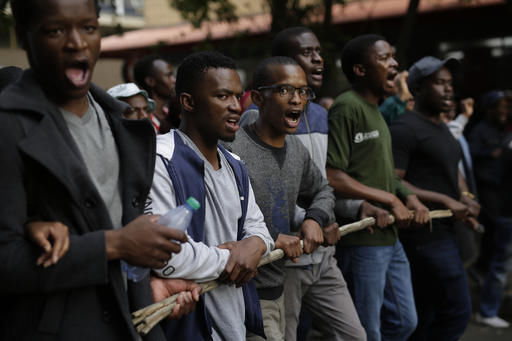
Student protesters berated the vice-chancellor of one of South Africa’s top universities on Wednesday, venting their anger over school fees at what was supposed to be a peace-building event.

«You are a very cruel man. I hate you,» student leader Vuyani Pambo said into a microphone as Adam Habib, vice-chancellor of the University of the Witwatersrand in Johannesburg, sat quietly in a pew at the front of the Holy Trinity Catholic Church where the meeting was held.

The tense scene, which eventually eased when Habib left through a side door, reflected the bitter divisions still simmering after weeks of university student protests for free education across South Africa.

While there is widespread support for the idea of free education, the South African government says it can only cover fee increases for poor students next year and has been critical of student protests involving vandalism and stone-throwing.

Meanwhile, many students want to study rather than go along with protesters’ calls for disruption. University administrators like Habib seem caught in the middle, trying to get classes back on track while calling for more state investment in education. Protesters also have blamed him for campus battles with police who say, in turn, that their role is to keep order.

On Wednesday, a Johannesburg court denied bail to Mcebo Dlamini, a student leader at the University of the Witwatersrand who was arrested for alleged violence and intimidation during protests. The next hearing in his case is Nov. 15.

A group of academics at the University of the Witwatersrand called for a meeting at the church, which is adjacent to the university, with the goal of working toward «a peace accord for the university, so that it can unite to solve the goals currently facing higher education.»

It didn’t turn out that way.

Father Graham Pugin, the church’s pastor who was hit in the face by a police rubber bullet during an Oct. 10 skirmish between police and protesters, gave a brief introduction. But students quickly expressed outrage that Habib was present.

«Habib must go,» they chanted.

Several people stood around Habib, fearing the hostile crowd might close on him. He eventually left after Pambo, the student leader, said the vice-chancellor should be able to leave unharmed «to show the country that we are not criminals.»

On Friday, protesters encircled Vice-Chancellor Max Price of the University of Cape Town outside a campus building, and he was pushed and took two punches to the body, according to the university.

Managers at the University of the Witwatersrand said they had been invited to the church meeting by its organizers.

«We are disappointed that people felt that we should exit the peace meeting even after we had been invited to attend it,» Habib said in a statement. «We remain committed to working with students and student leaders in trying to find solutions to these issues, many of which can only be resolved at the national level.»

Fuente de la noticia: http://abcnews.go.com/International/wireStory/leader-south-african-student-protests-denied-bail-42901643

Fuente de la imagen: http://bloximages.newyork1.vip.townnews.com/roanoke.com/content/tncms/assets/v3/editorial/1/0c/10c2172f-360a-5fe1-925e-ff1133aa5d40/5807adbb74b8b.image.jpg?resize=512%2C341

Comparte este contenido:

Kenia: Kuppet Meets TSC As KNUT Demands 300pc Raise

África/Kenia/23 Octubre 2016/Fuente: Allafrica/Autor: Ouma Wanzala

Resumen: La dirección de la Unión Nacional de Docentes de Kenia (Knut) se ha dado por terminada  las negociaciones salariales dentro de los próximos 10 días. En una reunión de un día de duración, que se celebró el miércoles en la sede de Knut en Nairobi, el Consejo resolvió que una conclusión oportuna de las conversaciones podría allanar el camino para la elaboración de presupuestos.

The leadership of the Kenya National Union of Teachers (Knut) has been directed to conclude salary talks within the next 10 days.

The union’s top decision making organ, the National Executive Council, also directed the negotiating team, led by Secretary-General Wilson Sossion, chairman Mudzo Nzili, treasurer John Matiang’i and deputy secretary-general Hesbone Otieno, not to accept anything less than 300 per cent from the employer.

In a day-long meeting that was held on Wednesday at Knut headquarters in Nairobi, the council resolved that a timely conclusion of the talks would pave the way for budgeting.

At the same time, the Kenya Union of Post-Primary Education Teachers (Kuppet) led by Secretary-General Akelo Misori on Wednesday held talks with the TSC on a pay increase for its members.

Mr Misori said the TSC had sought more time to get an offer after a four-hour meeting.

«We have given them more time to prepare for the offer,» said Mr Misori.

The two teachers’ unions have demanded salary increases of between 200 per cent and 300 per cent, with several allowances and other benefits.

Sources told the Nation that the Knut NEC had warned that «it has options if the collective bargaining agreement that has a salary component is not reached».

Mr Sossion said the top organ appreciated the progress in the talks and directed that they be concluded on time.

HIRE MORE TEACHERS

«We briefed them and with their approval, we are ready to get the CBA that will have all components,» said Mr Sossion.

He added that the issue of employment of teachers was also discussed and they resolved that the government must hire more teachers.

On Tuesday, Education Cabinet Secretary Fred Matiang’i told Parliament that the country was facing a shortage of 87,489 teachers, with primary schools being in need of 39,913 teachers and secondary schools having a deficit of 47,576 teacher.

He said proper distribution of teachers was required, adding that the urban areas had more teachers than the rural regions.

However, Knut has demanded that more than 90,000 teachers be employed to address the shortage.

Mr Sossion added that the union was also opposed to the relocation of the Kenya Technical Trainers College from Gigiri to the Kenya Science College on Ngong Road, Nairobi.

Mr Sossion added that NEC had demanded the employment of all teachers who have graduated after further studies, saying that government must appreciate their investments.»We want them to be promoted from the day they graduated,» said Other issues that Knut discussed included union dues and other operational activities.This is the first time NEC is meeting after last year’s union elections.The team will resume talks with the Teachers Service Commission on Monday.

Fuente de la noticia: http://allafrica.com/stories/201610200529.html

Fuente de la imagen: http://allafrica.com/download/pic/main/main/csiid/00250463:2d7c6eb72331a41b15b3ce90c3fdaff9:arc614x376:w614:us1.jpg

Comparte este contenido:
Page 420 of 621
1 418 419 420 421 422 621