Page 419 of 772
1 417 418 419 420 421 772

La UNESCO nombra patrimonio de la humanidad una isla japonesa solo para hombres

Japón / www.playgrounmag.net / 12 de Julio de 2017

Las mujeres están vetadas, y los hombres tienen que entrar desnudos

Si planeas una visita a la sagrada isla de Okinoshima, muy conocida dentro del archipiélago japonés, debes de tener en cuenta dos cosas: el paso a las mujeres está restringido y los hombres solo pueden acceder a tierra completamente desnudos. Eso sí, no pueden entrar todos los hombres. Solo un pequeño grupo selecto.

Situada a medio camino entre la isla principal de Kyushu y la península coreana, esta isla era el centro de relaciones con China y Corea y también se utilizaba como espacio sagrado para rezar por la seguridad marítima a mediados del siglo IV.

La isla, que ocupa poco más de 700 metros cuadrados, fue reconocida el pasado fin de semana comopatrimonio de la humanidad por la UNESCO.

El acceso a la isla está muy restringido: en principio se permite viajar a la isla a los sacerdotes de Munakata Taisha, un grupo de sintoístas. El protocolo para entrar en la isla consiste en desnudarse completamente y bañarse en el mar para “liberarse de las impurezas”.

También se les prohíbe llevar a casa recuerdos, incluyendo objetos como ramitas u hojas de hierba,según informa la web de la isla.

Además, también se permite anualmente viajar a unos 200 hombres una vez el año, el 27 de mayo, día en el que se honra a los marineros que murieron en la batalla naval durante la guerra Ruso-Japonesa (1904-1905).

Okinoshima no es el primer lugar religioso en Japón con la entrada prohibida a las mujeres. El Monte Athos, por ejemplo, también mantiene la prohibición a las visitantes femeninas. En el periodo Heian las mujeres comenzaron a ser excluidas de las ceremonias religiosas. Algunas creencias budistas declararon la “impureza” sobre las mujeres. Estas creencias se han mantenido hasta nuestros días, aunque estos espacios cada vez generan más polémica y rechazo entre la población.

Fuente:http://www.playgroundmag.net/noticias/japonesa-nombrada-patrimonio-humanidad-UNESCO_0_2007999189.html
Comparte este contenido:

Pakistán: Malala abre cuenta en Twitter

Pakistán/11 de julio de 2017/Fuente: http://www.semana.com

La joven ganadora del premio Nobel de Paz mudará su causa por la defensa de la educación y los derechos de los niños a las redes sociales.

El mensaje fue corto pero contundente. «Hola, Twitter», escribió el viernes Malala Yousafzai, la activista paquistaní y premio Nobel de Paz más joven del mundo. El saludo se volvió viral en un instante. A sus 19 años de edad, Malala anunció que era su último día de colegio y que entraba a esta red social. Y en pocos días, ya tiene más de 656.000 seguidores, un paso contundente en la lucha que continuará ahora en redes sociales en pro de la educación y los derechos de los niños.

@Malala

La paquistaní tiene muy claro su objetivo de vida desde muy pequeña. A sus 11 años ya escribía sobre la educación de las niñas en un blog de la BBC. Dos años más tarde, saltó a la fama en el documental Class Dismissed, en el que contaba su experiencia viviendo en el área militarizada de Pakistán.

Poco después y a causa de su recién adquirida prominencia internacional, un hombre armado ingresó a su bus escolar y le disparó tres veces, una de ellas en la cabeza. Milagrosamente, Malala sobrevivió y desde entonces se dedicó a luchar por el derecho de los niños de su país a recibir educación en paz.

Nunca abandonó sus obligaciones académicas, que continuó en Reino Unido, y que concluyó hasta ahora, como declaró en Twitter. “Graduarse del colegio es una experiencia agridulce para mí. Estoy emocionada con mi futuro, pero sé que millones de niñas alrededor del mundo no pueden ir al colegio y quizás nunca tengan la oportunidad de completar su educación”, escribió Malala en una serie de mensajes que llegaron a más de 54.000 retuits en pocos días.

Cientos de personas aprovecharon para darle la bienvenida a la activista, entre ellos Bill y Melinda Gates, el presidente canadiense, Justin Trudeau, el alcalde londinense, Sadiq Khan, y el secretario general de Naciones Unidas, António Guterres.

El presidente Juan Manuel Santos también saludó a la joven, quien le respondió a las pocas horas con un mensaje que decía: “Hola Presidente! Admiro su trabajo para llevar la paz a Colombia. Su país también tiene niñas maravillosas. Me envían mensajes hermosos”.

Como dato curioso, el presidente mexicano, Enrique Peña Nieto, también tuiteó un saludo para Malala, pero, contrario a lo que pasó con Santos, la activista paquistaní no le respondió nada.

Sin embargo, Malala escribió un tuit de agradecimiento en general por todos los mensajes de bienvenida, asegurando que aún está leyendo sus respuestas y que le tomará tiempo leerlas todas.

Además, Malala anunció que pasará el verano haciendo campaña alrededor del mundo: “La siguiente semana, estaré de vuelta con mi #GirlPowerTrip (una gira por los derechos de las niñas) encontrándome con niñas de Oriente Medio, África y América Latina. Cada historia es única – y sus voces son el arma más poderosa en la lucha por la educación y la equidad”.

A principios de este año, Malala anunció que recibió una oferta para estudiar en una universidad de alto nivel en Reino Unido. Según el Mail Online, se trata de Oxford, donde la joven se inscribió siguiendo los pasos de su modelo Benazir Bhutto, la primera mujer en ocupar el cargo de Primer Ministro en Pakistán. Pero antes de entrar a la universidad en otoño, Malala aprovechará sus vacaciones para promocionar los derechos de la educación por todo el mundo.

Y no ha perdido el tiempo. Desde el viernes, viajó a Lancaster, Pensilvania, conocida como la “capital de los refugiados en Estados Unidos” y se encontró con Justin Trudeau en Ottawa. El resto de su recorrido se podrá seguir en su página web y en su cuenta de Twitter.

“Estoy luchando por las niñas, -concluye Malala en su mensaje introductorio-. “¿Me acompañan?”

Fuente de la Noticia:

http://www.semana.com/educacion/articulo/malala-abre-cuenta-de-twitter/531995

Comparte este contenido:

FAO and the Ministry of Education support school garden initiative for better nutrition in Sri Lanka

Sri Lanka/July 11, 2017/By Abdul Mujeeb/Source: http://www.elankanews.com

The Food and Agricultural Organization of the United Nations (FAO) together with the Ministry of Education hosted a ceremony on Tuesday, 4 July 2017 at Wijerama Maha Vidyalaya in Udahamulla, Nugegoda to highlight the importance of school gardens for child nutrition and life skills. The event took place in the context of the project on “Scaling up Nutrition through a Multi-Sector Approach”, jointly implemented by FAO and the World Food Programme (WFP) in collaboration with the Government of Sri Lanka.
 
Through this project, more than 6000 schools have been inspired to create their own organic and healthy garden within the school grounds. To support each school develops their own garden, FAO together with the Ministry of Education has facilitated a series of training workshops in all nine provinces, training 377 education officers.
 
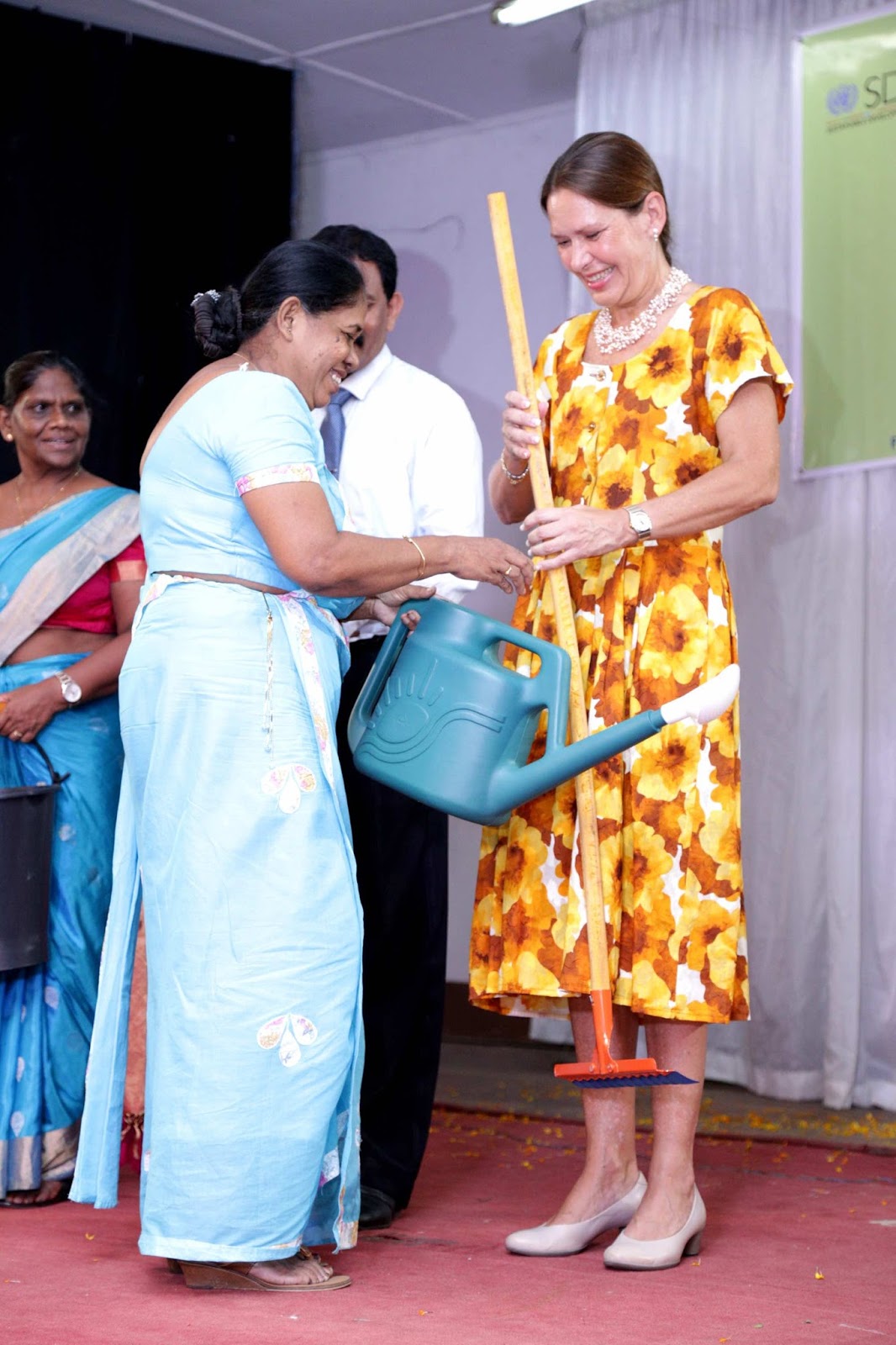
Nina Brandstrup, FAO Representative for Sri Lanka and Maldives presents gardening equipment to principals of 22 schools in the Sri Jayawardenapura Education zone at the school garden ceremony.
Nina Brandstrup, FAO Representative for Sri Lanka and
Maldives presents gardening equipment to principals
of 22 schools in the Sri Jayawardenapura Education
zone at the school garden ceremony.
At these comprehensive two-day workshops, education specialists have learned the different aspects of establishing and managing school gardens, from selecting a location and deciding the type of beds to create, to identifying the best tools and equipment. They have also learned about fertilizing, pruning and pest control by utilizing plant extracts and modern technologies. The education specialists have acquired the skills to impart this knowledge to the school community within each province. They have been provided a guideline and manuals which teachers, parents, and children can use in establishing the school garden. As the project includes knowledge about child nutrition, health, and education, it encourages the children to directly apply what they learn in their school gardens and replicates the same healthy habits at home. FAO has distributed gardening tools and resources to participating schools across the island to support the project’s sustainability.
 
A manual available in both Sinhala and Tamil has been crucial to the success of the initiative and has reached over 300,000 children across the island. In many parts of the country that continue to struggle with food insecurity and undernutrition, this initiative has supported children to take responsibility for their diets and share their learnings with their families and the wider community.
 
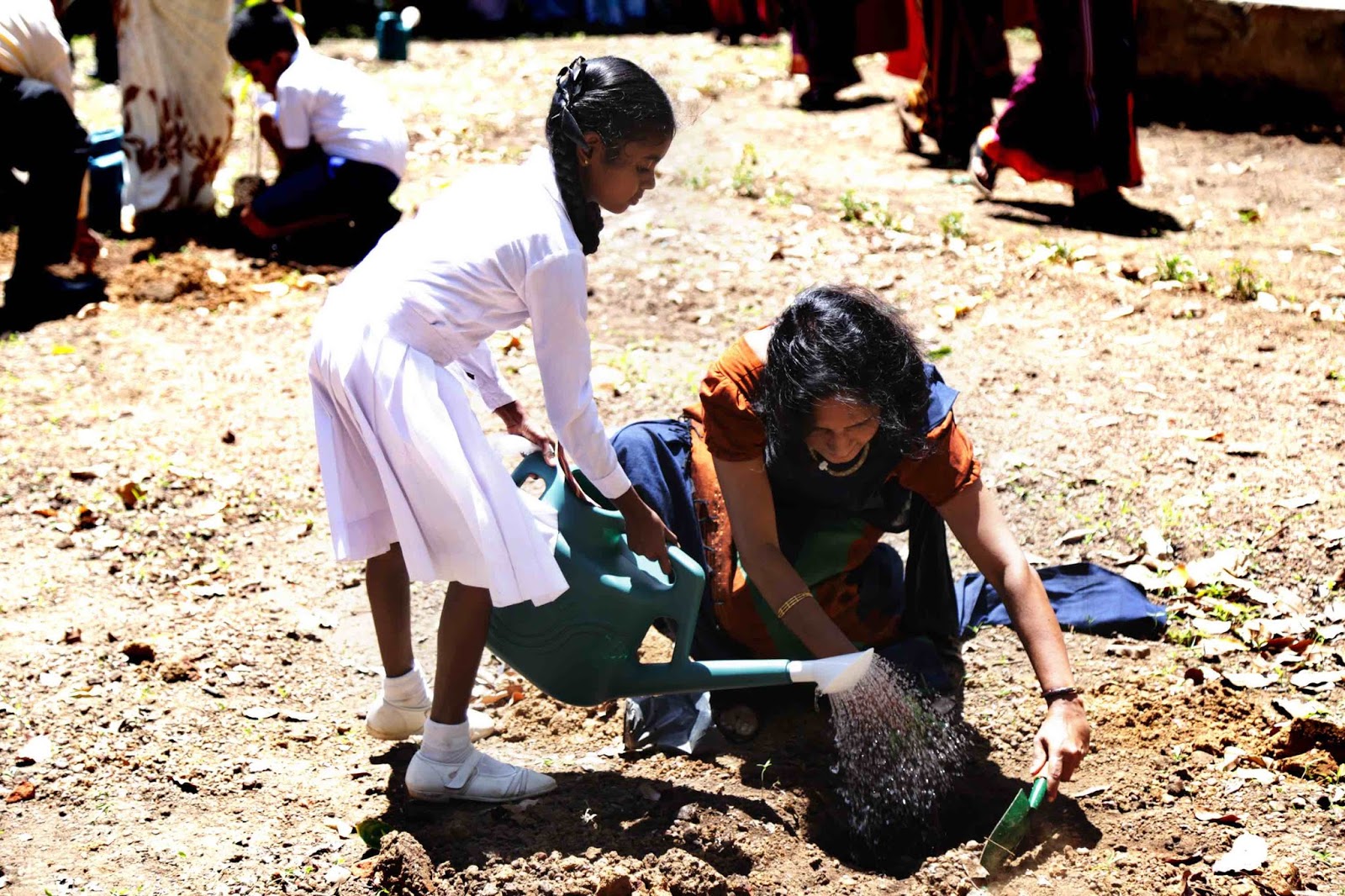
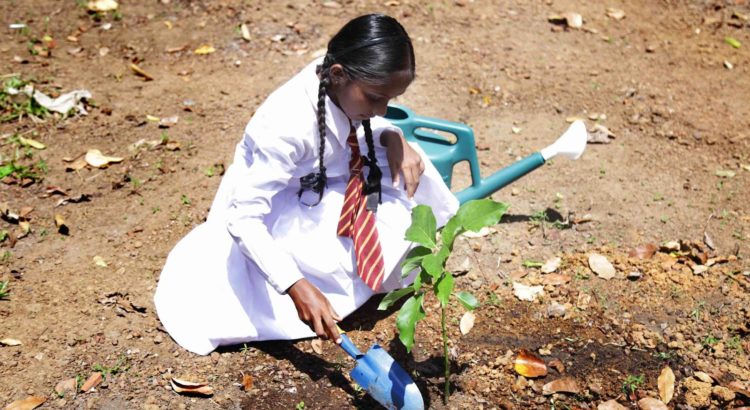
Priyanthi Chandrasekera, Project Manager-Scaling up Nutrition through a Multi-Sector Approach, FAO plants a tree with a student of Wijerama Maha Vidyalaya.
Priyanthi Chandrasekera, Project Manager-
Scaling up Nutrition through a Multi-Sector Approach,
FAO plants a tree with a student of Wijerama Maha Vidyalaya.
Speaking at the event, the FAO Representative Nina Brandstrup highlighted school gardens as a key tool in teaching children the value of nutritious organic food and the importance of sustainable lifestyles. “School gardens can be used as a classroom by reconnecting children with the outdoors and the source of their food,” she said. “These gardens teach children about the importance of a balanced diet and nutrition while opening their eyes to new agriculture concepts. The gardens are also encouraging the children to increase their consumption of fruits and vegetables; no one can resist eating what they grew with their own hands!”
The Honorary Consul of Spain, Priyadarshini Jayawardena encouraged the promotion of school gardens to keep children safe and healthy while nurturing future generations to ensure a healthier and better tomorrow. “Gardens are of utmost importance to the development of the country. Well-nourished children are healthier and learn better, have improved opportunities for growth and contribute positively to society,” she said.
 
Commenting on the programme, Mr. Jayantha Wickramanayake, Director of National Schools said: “This project jointly implemented by the FAO and the Ministry of Education is a good solution to tackle health problems and the lack of awareness about the environment among school children. This programme really takes education beyond the classroom, guiding students to form a relationship with nature. I encourage all principals, teachers, and students to replicate this model in their schools. I have no doubt that this will help to create a healthier generation of youth and contribute towards minimizing the risk of natural disasters in the country with more awareness.”
 
Brenda Barton, Representative and Country Director of World Food Programme (WFP) highlighted that the school garden initiative ties in with the efforts of WFP to treat undernutrition in Sri Lanka. WFP distributes specialized fortified nutritious food to pregnant and nursing women and children aged between 6 months and 5 years and provides technical support to the Ministry of Health to enhance the impact of Thriposha – a nutritious and locally fortified blended food. “Our aim is to support behavioral changes through enhanced nutrition education and information on safe and nutritious foods, dietary diversity, nutrient deficiencies and their root causes,” she said. WFP also supports the Ministry of Health to conduct national nutrition surveys for pregnant and lactating women and for schoolchildren, to promote the linkage of health, nutrition, and food security as a national development priority.
 
The event concluded with the distribution of gardening tools to 22 school principals from the Sri Jayawardenapura Education zone of the Western Province, and the planting of a fruit tree followed by a visit to the school garden by guests and the school community.
 
School gardens are one aspect of the Scaling up Nutrition through a Multi-Sector Approach project, jointly implemented by FAO and WFP in collaboration with the Government of Sri Lanka. The project is part of the United Nations Sustainable Development Goals Fund, an international multi-agency and multi-donor development mechanism created in 2014 by The United Nation Development Programme (UNDP) funded through the Government of Spain. 
Source:
http://www.elankanews.com/2017/07/fao-and-ministry-of-education-support.html
Comparte este contenido:

China Distance Education Hldgs : CDEL Announces Strategic Investment in Beijing Ruida

China/July 11, 2017/Source: http://www.4-traders.com

China Distance Education Holdings Limited (NYSE: DL) (‘CDEL’, or the ‘Company’), a leading provider of online education and value-added services for professionals and corporate clients in China, today announced that it signed a definitive agreement to acquire 40% equity interest in Beijing Ruida Chengtai Education Technology Co., Ltd. (‘Beijing Ruida’), a leading provider of exam preparation services for participants in China’s national judicial examination, for a total consideration of RMB192 million ($28.3 million), subject to adjustments under certain pre-agreed conditions. In addition, CDEL has the right, at its option, to further increase its equity interest in Beijing Ruida up to 60% before April 2019 under certain pre-agreed conditions. The acquisition of 40% equity interest in Beijing Ruida is an all-cash transaction, and is expected to close in the fourth quarter of fiscal 2017.

Mr. Zhengdong Zhu, Chairman and CEO of CDEL, said, ‘Our investment in Beijing Ruida is ideally aligned with our strategy to build industry-leading comprehensive lifelong education verticals. With this investment we immediately strengthen our legal education vertical by adding a prominent national judicial exam preparation provider to our portfolio of education services.’ Mr. Zhu added, ‘Beijing Ruida has enjoyed impressive growth since being launched last year due to its highly acclaimed instructors, best-of-breed educational content, and innovative new media marketing strategy. We welcome the Beijing Ruida team to the CDEL platform.’

Mr. Fengke Liu, Founder and Chairman of Beijing Ruida, said, ‘We are delighted to have CDEL as our strategic investor. CDEL and Beijing Ruida share the common goal of providing high-quality education services to help professionals advance in their careers. We believe our focus on delivering high-quality educational content and services for participants in China’s national judicial examination will further complement CDEL’s broad array of industry-leading exam preparation services.’

Safe Harbor Statement

This announcement contains forward-looking statements within the meaning of Section 27A of the Securities Act of 1933, as amended, and Section 21E of the Securities Exchange Act of 1934, as amended, and as defined in the U.S. Private Securities Litigation Reform Act of 1995. Forward-looking statements are not historical facts, but instead are predictions about future events. Future events are inherently uncertain, and our forward-looking statements may turn out to be incorrect. The Company may not realize the anticipated benefits of the investment in Beijing Ruida. The forward-looking statements in this press release speak only as of the date on which they are made, and we assume no obligation to update any forward-looking statements except as required by law.

About Beijing Ruida

Founded in 2016, Beijing Ruida was established by eight highly acclaimed instructors in China’s legal education industry. Beijing Ruida provides exam preparation services and products, including proprietary books and reference materials, for participants in China’s national judicial examination. Beijing Ruida delivers services and products at six campuses in China (Beijing, Shanghai, Nanjing, Hangzhou, Guangzhou, and Shenzhen) as well as through its online platform and a nationwide network of education partners.

About China Distance Education Holdings Limited

China Distance Education Holdings Limited is a leading provider of online education and value-added services for professionals and corporate clients in China. The courses offered by the Company through its websites are designed to help professionals seeking to obtain and maintain professional licenses and to enhance their job skills through our professional development courses in China in the areas of accounting, healthcare, engineering & construction, and other industries. The Company also offers professional education courses for participants in the national judicial examination, online test preparation courses for self-taught learners pursuing higher education diplomas or degrees, test preparation courses for university students intending to take the nationwide graduate school entrance exam, practical accounting training courses for college students and working professionals, as well as online language courses and third-party developed online courses. In addition, the Company provides business services to corporate clients, including but not limited to tax advisory and accounting outsourcing services. For further information, please visit http://ir.cdeledu.com

Source:

http://www.4-traders.com/CHINA-DISTANCE-EDUCATION-3860988/news/China-Distance-Education-Hldgs-CDEL-Announces-Strategic-Investment-in-Beijing-Ruida-24725738/


Comparte este contenido:

China: Vice primera ministra destaca papel de educación en reducción de pobreza

China/10 julio 2017/Fuente: Spanish People Daily

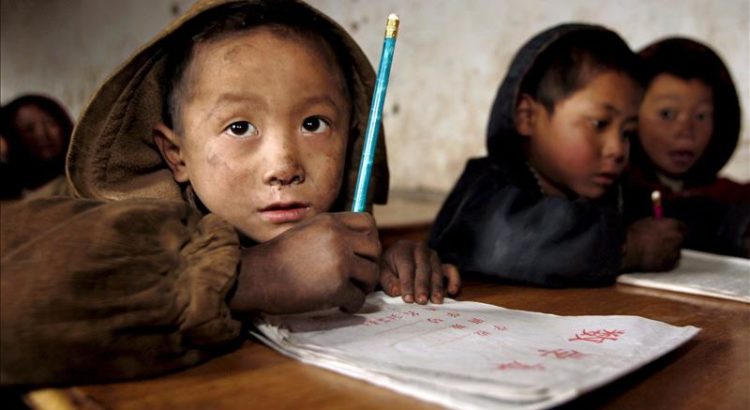
La vice primera ministra china Liu Yandong pidió el sábado mejorar la educación en las áreas subdesarrolladas en medio de los esfuerzos para combatir la pobreza.

«La educación es la manera fundamental de detener la transmisión intergeneracional de la pobreza, y a los niños que viven en áreas pobres se les deben garantizar las condiciones para recibir educación y perseguir sus sueños», destacó Liu en una conferencia sobre la reducción de la pobreza en la provincia noroccidental china de Gansu.

Pidió que mejoren las condiciones escolares en la enseñanza obligatoria, aumenten la cantidad y calidad de los maestros en las zonas rurales y se preste atención especial a los niños que se quedan en su lugar de origen cuando sus padres migran a otros lugares para trabajar.

«Los niños deben recibir una educación justa y sana al comienzo de su vida», sostuvo.

También pidió el desarrollo de la educación profesional y proporcionar a los alumnos ayuda económica para que puedan entrar en las escuelas superiores y obtener empleo.

China planea sacar a toda su población rural de la pobreza antes de 2020. Al cierre del año pasado todavía había 43 millones de personas del rural que vivían en la pobreza.

Fuente noticia: http://spanish.peopledaily.com.cn/n3/2017/0710/c31621-9239289.html

Fuente imagen: http://s03.s3c.es/imag/efe/2015/05/08/20150508-10776607w.jpg

Comparte este contenido:

India: Technology, internet can bridge gap in education: President Pranab Mukherjee

India/Julio de 2017/Fuente: Hindustantime

Resumen: La difusión de tecnología, penetración de las telecomunicaciones e Internet ha ofrecido una oportunidad para cerrar la brecha en la educación en términos de acceso y calidad que debe ser aprovechada, dijo el domingo el presidente Pranab Mukherjee. Mukherjee estaba hablando en la inauguración de tres iniciativas digitales en el sector de la educación – «Swayam», «Swayam Prabha» y National Academic Depository por ministerio de desarrollo de recursos humanos. «La tecnología digital permite a los buenos maestros enseñar directamente a un gran número de estudiantes que no están físicamente presentes en las clases. Las soluciones de TIC ofrecen una experiencia de aprendizaje interactiva a través de la cual los estudiantes de partes remotas del país pueden beneficiarse de las conferencias de los mejores profesores «, dijo. Swayam y Swayam Prabha son aulas digitales cuyo contenido se puede acceder a través de Internet o de servicio directo a domicilio, respectivamente.

The spread of technology, telecom penetration and Internet has offered an opportunity to bridge the divide in education in terms of access and quality which must be seized, President Pranab Mukherjee said on Sunday.

Mukherjee was speaking at the inauguration of three digital initiatives in the education sector – ‘Swayam’, ‘Swayam Prabha’ and National Academic Depository by ministry of human resource development.

“Digital technology enables good teachers to directly teach large number of students who are not physically present in classes. ICT solutions offer an interactive learning experience through which students in remote parts of the country can benefit from lectures of the top teachers,” he said.

Swayam and Swayam Prabha are digital classrooms the contents of which can be accessed either through Internet or direct-to-home service respectively.

National Academic Depository will have education certificates of every student in digital form which will ease the process of verification and also do away with the chances of forgery.

Through Swayam, courses will be offered through digital classrooms with study material available online in videos. It will be available free of cost, however students wanting certifications shall be registered, shall be offered a certificate on successful completion of the course, with a small fee, the Swayam website states.

The student will have opportunity to ask questions which will be answered in real time. Chief economic advisor Arvind Subramanian has also prepared a series of lectures on the Indian economy for Swayam and Swayam Prabha.

The students will be assessed through proctored examination and the marks and grades secured in this exam could be transferred to the academic record of the students, according to the website.

Swayam Prabha will tap into the potential of Direct- to-Home Service wherein a person can install the dish antenna for about Rs 1,500 and have access to 32 digital educational channels run by the HRD ministry.

Everyday, there will be new content for at least four hours which would be repeated five more times in a day, allowing the students to choose the time of their convenience, Additional Secretary in UGC Pankaj Mittal said.

The course content will cover almost every aspect of education in various fields from class nine onwards and preparatory courses for institutes like IITs.

“The quality of teaching and learning process is the heart of higher education. We have seen huge difference in the quality of attainment levels in higher education between the urban and rural areas, between the states and between institutions within a state,” he said.

Mukherjee said there are large numbers of students who study in vernacular languages whereas most of the knowledge is still in English.

“I call upon you all – being the leaders of the higher education system – to make concerted efforts to bridge this gap,” he said.

Fuente: http://www.hindustantimes.com/india-news/technology-internet-can-bridge-gap-in-education-president-pranab-mukherjee/story-aTgTnqQpbYusq5mNH1nPvO.html

Comparte este contenido:

La falta de fondos amenaza la educación de millones de niños en zonas de conflicto, advierte unicef

UNICEF/08 Julio 2017/Fuente: Ecodiario

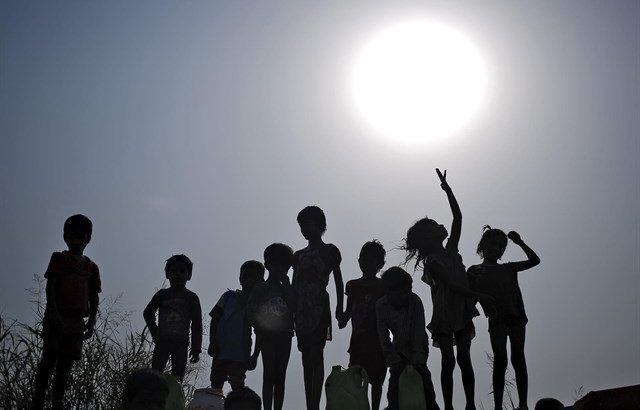
La escasez de fondos está amenazando la educación de millones de niños atrapados en zonas de conflicto o desastres, según señaló este viernes Unicef con motivo de la cumbre del G-20, que se celebra en Hamburgo.

«Sin educación, los niños crecen sin el conocimiento y las habilidades necesarias para contribuir a la paz y el desarrollo de sus países y economías, agravando una situación que ya es desesperada para millones de niños», indicó la más joven Embajadora de Buena Voluntad de Unicef, Muzoon Almellehan, representante de la organización en la cumbre del G-20.

«Para los millones de niños que están creciendo en zonas de guerra, estas amenazas son aún más sobrecogedoras: al no ir a la escuela los niños son más vulnerables ante el matrimonio y el trabajo infantil, y frente al reclutamiento por parte de grupos armados», agregó.

Unicef necesita este año para sus programas de educación en países en situación de emergencia 932 millones de dólares (818 millones de euros), de los cuales hasta ahora solo ha recibido menos de 115 millones de dólares (101 millones de euros) gracias a aportaciones voluntarias. Esta financiación es necesaria para proporcionar acceso a educación formal y no formal a 9,2 millones de niños afectados por crisis humanitarias.

El déficit de fondos para los programas de educación de Unicef en algunos lugares de conflicto del mundo varía desde el 36% en Irak hasta el 64% en Siria, 74% en Yemen y 78% en República Centroafricana.

EDUCACIÓN VITAL

Para los niños que han experimentado el trauma de una guerra y el desplazamiento, la educación es vital, indica la organización. «Cuando yo escapé de Siria en 2013, me aterraba pensar que nunca podría volver a la escuela. Pero cuando llegué a Jordania y me di cuenta de que había una escuela en el campo de refugiados me sentí aliviada y esperanzada», afirmó Muzoon. «La escuela ofrece a niños como yo esperanza y la oportunidad de un futuro positivo y en paz».

Según Unicef, la búsqueda de oportunidades de educación es una de las razones que impulsan a las familias y niños a huir de sus hogares, muchas veces arriesgando sus vidas. Una encuesta realizada a refugiados y migrantes en Italia revela que el 38% de ellos se dirigió a Europa para acceder a oportunidades de formación; otro estudio similar en Grecia mostró que uno de cada tres padres o cuidadores mencionaba la búsqueda de educación para sus hijos como el motivo principal por el que habían dejado sus países para ir a Europa.

Como activista para la educación y refugiada siria, Muzoon se une a Unicef para hablar en nombre de los millones de niños y niñas que están desarraigados debido a conflictos y que no pueden ir a la escuela.

«Insto a los líderes del mundo a que inviertan en el futuro de los niños que viven en situaciones de emergencia. Al hacerlo estarán invirtiendo en el futuro de nuestro mundo», afirmó.

PLAN DE ACCIÓN

Unicef continúa instando a todos los gobiernos a adoptar el plan de acción para proteger a los niños refugiados y migrantes, uno de cuyos seis puntos es la educación.

Según la organización, más de 25 millones de niños de entre 6 y 15 años, el 22% del total de niños en esas edades, están fuera de la escuela en zonas de conflicto de 22 países.

En todo el mundo, cerca de 50 millones de niños están desarraigados, 28 millones se han visto obligados a abandonar sus hogares por conflictos de los que no son responsables y otros tantos millones han migrado con la esperanza de encontrar una vida mejor y más segura.

En 2016 solo se destinaron a educación el 3,6% de los fondos humanitarios. Cada año se necesitan 8.500 millones de dólares (7.464 millones de euros) para subsanar este déficit, indica Unicef, que proporcionó apoyo educativo a 11,7 millones de niños en crisis humanitarias durante 2016.

Fuente: http://ecodiario.eleconomista.es/sociedad/noticias/8482174/07/17/La-falta-de-fondos-amenaza-la-educacion-de-millones-de-ninos-en-zonas-de-conflicto-advierte-unicef.html

Comparte este contenido:
Page 419 of 772
1 417 418 419 420 421 772