Page 123 of 144
1 121 122 123 124 125 144

Important lessons for antiwar movement makers…

By: Bill Ayer

The Antiwar Movement Then and Now

Howard Machtinger
Vietnam Full Disclosure

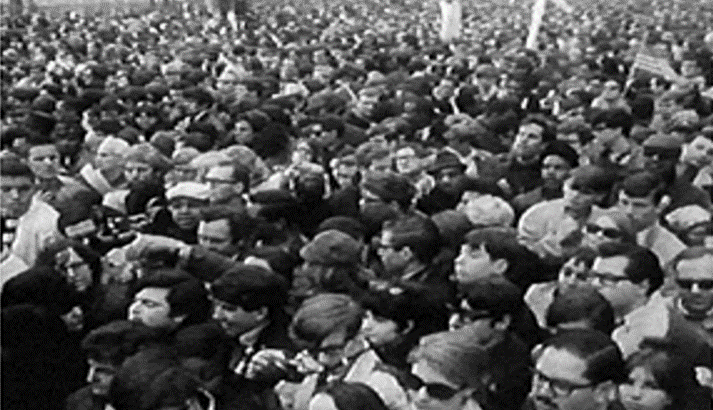
A broad-based antiwar movement which challenges white and male supremacy and stands in support of oppressed people around the globe, from the Rohingya to the Palestinians, is an important part of a larger movement for social change; one that can navigate racial, class, gender, generational, ideological, spiritual and strategic and tactical differences is required.


It is offered—not in expectation of agreement—but to provoke a serious discussion about the current state of antiwar politics.

Burns and Novick in their PBS documentary: The Vietnam War could not ignore the antiwar movement, but exhibit little interest in its dynamics, except in its supposed hostility to American GIs. Since my interest still lies in how to build a more effective antiwar movement, I want to focus on the lessons learned and not learned by the Vietnam antiwar movement as a prelude to exploring how we might move forward to confront the multiple wars and threats of war that beset our world.

Of course, there was not one unified antiwar movement, but a conglomeration of tendencies featuring contending critiques, strategies and tactics. What follows is an attempt at a succinct, dispassionate description of those tendencies, which no doubt risks over-simplification. I will look at three general perspectives. I will begin with a critique of tendencies with which I was associated.

The first set of tendencies included the anti-imperialists, militants, and Marxist-Leninists. Members of these overlapping, but distinct groupings, all grasped the depth of the problem that the war in Vietnam exposed. The war was not a mistake or an aberration from the general direction of US global policy. Its goal was to dominate the world and, in this particular case, to gain a strategic foothold in mainland Asia. These movement tendencies recognized the need to do more and to widen the scope of protest. They also placed great importance in connecting to and humanizing the Vietnamese enemy, not merely viewing them as victims, but recognizing and honoring their capacity to resist.

Too often, however, the connection remained abstract or turned romantic. Che’s invocation of “2, 3 many Vietnams” not only decontextualized Vietnamese resistance, but led people to ignore or downplay the incredible price paid for this resistance. In the 1980’s an uncritical anti-imperialism led to support for leaders who proved to be problematic such as Cayetano Carpio in El Salvador, Daniel Ortega in Nicaragua, and Robert Mugabe in Zimbabwe. One version of anti-imperialism meant support for any leader hostile to the US; including people like Saddam Hussein or Bashar al-Assad. For them, the enemy of our enemy by definition became a friend. Anti-imperialists did not always acknowledge other negative forces operating in the world aside from US imperialism.

The romanticization of the Vietnamese resistance also led militants to overstate the revolutionary possibilities in 1960s and 70s America. Some resorted to violent methods that proved ineffective, isolating, and divisive for the movement as a whole. Though violence as a strategy, not as spontaneous outbursts, constituted a small part of the antiwar movement, it too often became the ‘issue’ and functioned to divert attention from the monumentally greater violence of imperial war.

The parts of this tendency that identified with global Communism–a relatively small, but influential sector–had little understanding of that movement, weak grasp of the Sino-Soviet split, and were often ignorant of differences within Vietnamese Communism. Sometimes the result was a dumbed-down and sanitized Maoism. Their version of democratic centralism was rarely democratic. And they were often drawn into obscure sectarian struggles.

The pacifist left tendency brought a solid grasp of the profound penetration of militarism in the US economy, its politics and culture. It offered a valuable overall critique of war and militarism. A. J. Muste and Dave Dellinger played unifying roles in an often-fractious movement. And militant pacifists like Dellinger forged a creative model of militant nonviolence that effectively expressed the depth of opposition to the war.

But other pacifists enjoyed the role of the ‘good’ protestor as opposed to other less acceptable protestors, thereby dividing the movement and enabling an establishment critique, providing fodder for false equivalences between imperial violence and resistance to it. Pacifists could and did adopt a purer than thou attitude. It should have been possible to legitimize one’s own form of protest without delegitimizing other forms. Most significantly, the pacifist tendency was overwhelmingly white and middle class with insufficient connection to the powerful movements of people of color that had staked out clear and resonant positions against the war. This was not simply a question of coalition building, but of creating consistent, enduring relationships of trust.

Another tendency consisting largely of dissident and liberal Democrats saw the war as a losing proposition damaging US credibility, draining treasure, destroying morale and national unity, not to mention increasing battlefield casualties. This is in part the perspective of the Burns/Novick effort. This tendency brought to light the war’s corrosive effect on democratic institutions: the expanding imperial Presidency, the impotence and irrelevance of Congress, and the repression of protest. Innovative forms of working ‘the system’ were created, that while often frustrating, pointed the way to a possible political revitalization. These movements led to some Congressional scrutiny of the war, LBJ’s abdication, McGovern’s nomination as the Democratic candidate in 1972 and Nixon’s impeachment; generally forcing politicians to openly deal with the war.

But it proved unable to prevent Nixon’s election–allowing him to pose as a strange sort of stealth peace candidate—and didn’t achieve majority support in the Congress until very late in the war. It did not develop adequate means of holding politicians accountable. It both expanded the scope of mainstream politics and was simultaneously hemmed in by the establishment.

Parts of this tendency also posed as a preferred, less radical alternative to the politics of the street. Finally its overly pragmatic strategy implied that the war was a correctible mistake, not requiring a fundamental overhaul of the national security state and its imperial goals.

There are important parts of the movement that I have obviously so far ignored. The antiwar movement was a boost to the development of new creative and feisty women’s and queer liberation movements both by providing spaces for activism and then circumscribing these spaces because of the limits of iantiwar leaders’ consciousness of gender issues. So women and LGBTQ people were energized and then marginalized which simultaneously divided the movement and resulted in new organizational forms, including significant antiwar organization and action as well as a critique of military and movement macho.

The level and sophistication of GI and veteran resistance was unprecedented. Dewey Canyon III in Washington DC in 1971, when veterans threw away their medals, brought the issue of the war’s immorality and pointlessness home and helped transform the public face of the antiwar movement from that of cowardly, spaced out hippies and unrealistic pacifists. Often left buried in the dustbin of history are efforts like the coffee house movement where civilians and soldiers collaborated in spreading the antiwar message. It would certainly be worthwhile to further explore what was learned about civilian/soldier relationships from this experience.

After the war, the antiwar movement lost steam and direction in a sense succumbing to the fantasy that the end of the war allowed a return to normalcy without further consequence. We did not succeed in helping Americans come to terms with military defeat—to understand it as something positive for the American spirit.

Vietnam was more isolated in the 1980s than during the American war as it invaded Cambodia to overthrow the genocidal Khmer Rouge regime and then fought off a Chinese invasion. The Cold War framing of Southeast Asian conflict as part of a Soviet plot was reasserted by the US with little opposition from the remnants of the antiwar movement; the Maoist fringe, in line with Chinese policy, even supported the Khmer Rouge. There were brief upsurges of activity in response to Reagan’s Central America wars and before both Gulf wars, especially W’s 2003 war. Today there exists a barely perceptible antiwar movement. Its impotence allowed Donald Trump to play a bogus antiwar card during the 2016 campaign.

As antiwar activists we have allowed the myth—of which Burns/Novick partake—of the deep antagonism between the civilian antiwar movement and soldiers to penetrate American consciousness, including that of younger antiwar activists. I have met numerous young activists who take for granted that the antiwar movement typically spat at returning soldiers. We can credit Jerry Lembcke for Burns and Novick not further propounding that particular myth. They favor ’baby killers’. In any large, sprawling social movement almost any perspective can be found. Though I knew a few people who felt like targeting soldiers was legitimate; this was a quite marginal perspective in the antiwar movement. The same mythology led many of those opposed to the Gulf wars to so reassure the public that the movement was pro-soldier that they lost sight of the central task of any effective antiwar movement: projecting and humanizing the direct victims of the war in Iraq. It was a form of surrender to the prevailing Islamaphobia.

As a movement, we have failed to adequately challenge the deleterious effects of imperial war on democratic institutions. ‘Forever war’ means permanent limitations on freedom and the right to protest and continuing intrusions on privacy. We haven’t been able to convincingly demonstrate to Americans the connection between successive wars; how the Iraq war increased sectarianism and chaos in the entire region, catalyzing the growth of groups like ISIS; how we are imprisoned by the terrible logic of war in which the next war is seen as a justifiable and necessary response to the failure of the previous one.

Given this history, how might a more effective antiwar movement be constituted? First of all, we must acknowledge, embrace even, that maybe none of us in this room will be in leadership of this reconstitution. If we are together, we can offer perspective, some cautions, a necessary connection to past efforts. Multiracial forces already in motion will lead the new activist peace/antiwar movement. For instance, the M4BL highlights the militarization and racism of our criminal ‘justice’ system while connecting to global struggles of people of color. The immigration and refugee movements—with important experience in navigating cultural difference—has drawn attention to the connections between war, state violence, and population movement and alerted us to the role of racism and Islamaphobia in mobilizing and justifying aggressive wars. Environmental activists lead us to revalue the leadership of indigenous people as in Standing Rock; organizations like 350.org explicate the relationship between environmental degradation and wars and potential wars over natural resources, as well as leading to increased global migration. The new women’s and LGBTQ movements have led the way in expanding our consciousness of sexual violence in war and in the military. And even as the nature of war has changed, the voices of GIs and veterans remain vital. A new antiwar movement must be constituted and led by those forces which will both broaden and deepen the movement making evident the intersectionality of movements against oppression, white supremacy and militarism.

We are living in a treacherous moment for our and other species. The impact of climate change imposes a fateful due date. The prevalence of nuclear weapons along with authoritarian leaders eager to demonstrate their macho add to the immediate peril.

So a broad-based antiwar movement which challenges white and male supremacy and stands in support of oppressed people around the globe, from the Rohingya to the Palestinians, is an important part of a larger movement for social change; one that can navigate racial, class, gender, generational, ideological, spiritual and strategic and tactical differences is required. Absolute agreement is not required; rather a Zen-like mastery of the art of coordination, mutuality and solidarity is the order of the day. We don’t need one big organization but we do need accountable organizations with accountable leadership. Our movement must not be so ‘correct’ that it does not allow for experimentation and a diversity of tactics. The movement must strive for power as it creates an open and welcoming environment where, rather than being stigmatized or shamed for inevitable mistakes, activists can learn from them and grow with the movement. And we must make our case to ordinary people while still engaging in anti-racist and anti-sexist initiatives. The other side is driven by a mean-spirited white male nationalism that we must directly take on.

There is a lot we have to do. We must work in establishment politics and reinvigorate democratic forms, fighting for meaningful reform; and at the same time (not necessarily the same people) be on the streets, loud and passionate. We must be militant, but smart and strategic about our militancy; keep the engine rev-ed but prevent it from veering off the tracks. Be moral and not moralistic, nor purer or more radical than thou. Connections are local and global, virtual and personal. Be forthright and sure-footed, but humble about our importance and correctness. Nothing less is required.

My comments leave many questions unexplained and unanswered. My simple goal is not completeness or agreement but to both initiate and add to a discussion that will lead to more effective action. We sorely need some.

The Full Disclosure campaign is a Veterans for Peace effort to speak truth to power and keep alive the antiwar perspective on the American war in Viet Nam — which is now approaching a series of 50th anniversary events. It represents a clear alternative to the Pentagon’s current efforts to sanitize and mythologize the Vietnam war and to thereby legitimize further unnecessary and destructive wars.

Source:

https://billayers.org/2017/10/

Comparte este contenido:

The Critical Importance of STEAM Education

Australia/November 14, 2017

Did you know there were nearly 8.6 million STEAM jobs in 2015 (which is also 6.2 percent of U.S employment)? This data was provided by the Bureau of Labor Statistics and while it’s not as fresh as it could be, it still represents the whole picture quite well.

In other words, there’s a huge niche that remains in high demand and continues to grow each day. Moreover, nowadays it’s yet impossible to predict which jobs will appear in this niche during the next 10-20 years – but what we can say for sure is that they indeed, will appear.

Sounds great, doesn’t it?

What isn’t great is that classical education is not enough to prepare students to take these jobs later. It isn’t surprising in general – after all, the whole educational system didn’t change much over the years, despite how much the technologies have developed. However, it also isn’t very pleasant. No matter how smart and flexible modern students are, if things remained the same, soon we would have found ourselves fighting the market crisis with too many new positions opened and too little people qualified to take them.

That’s why many modern colleges, universities, and schools slowly start offering STEAM education to the students.

What does STEAM education mean?

STEAM stands for «Science, Technology, Engineering, Arts, and Mathematics». Basically, this is an educational method that is focused on these subjects mostly. Students who receive STEAM education are given the assignments that cover all of the subjects mentioned above and are mostly project-based.

Why was STEAM created?

Just like we’ve already mentioned above, the world has changed greatly over the years. Moreover, these changes happened with rapid speed – and it didn’t go unnoticed by many people, including educators.

It also didn’t go unnoticed by them that most of the traditional educational system stopped providing students with the skills needed to live in the modern world. The traditional education as it is these days, addressed problems of the past instead of preparing students for the future – and that’s why STEAM was invented as an alternative to it.

Moreover, the traditional education method is indeed more classic. While it has its perks, it doesn’t cover some subjects crucial for a developing world – engineering and design, for example. And it’s not the theory we’re talking about, it’s the thinking that matters. Sure, some students have this thinking even without a proper education, but we’ll need more students like them in the future and unfortunately, traditional education cannot guarantee that.

STEAM education, however, teaches students that; and that is only one of its many perks.

Why is STEAM important?

Probably one of the most important things about STEAM education is that it helps students develop critical thinking. It’s the critical thinking is so important to live in the modern world – after all, nowadays there are plenty of machines, technologies, and apps able to solve repetitive tasks. However, no machine or computer is yet skilled enough to solve problems that require creativity as well as critical thinking.

So, STEAM education teaches students that – how to be creative, how to solve problems effectively, how to think critically. It also helps them develop transferable skills, which is especially important considering that world continues to grow and change.

These changes will continue, but no one can predict exactly how. The students, however, need to be prepared to work in a growing world and take jobs that don’t exist at the moment – and they’ll need transferable skills to do so.

The process of mastering these skills requires students to respond to changes quickly as well as to adapt to them. This also helps them become more flexible – and, as the arts are included too, students can express their creativity and enjoy the process as well.

How is STEAM taught these days?

Although STEAM education is a new concept, it had already been successfully introduced to many students. It is mostly taught in colleges, helping students to master critical thinking, problem-solving, and use this knowledge to build new approaches, to complete projects using new skills and methods, and old solutions. It also teaches students how to come up with their own solutions to all kinds of problems.

STEAM education is also slowly introduced to young scholars and, hopefully, will become a part of school education all over the world.

Do you think that STEAM education really is the future? Or do you prefer the traditional one and think that it could be adapted effectively to the modern world too? Please share your thought and opinions in the comment section below, we will be glad to read them.

My bio: Lori Wade is a content writer for Elite Essay Writers who is interested in a wide range of spheres from education and online marketing to entrepreneurship. She is also an aspiring tutor striving to bring education to another level like we all do. If you are interested in writing, you can find her on Twitter or Google+ or find her on other social media. Read and take over Lori’s useful insights!

Lori Wade is a regular Maravi Post contributor.

The views expressed in this article are not necessarily those of the Publisher or the Editor of Maravi Post.

Source:

http://www.maravipost.com/critical-importance-steam-education/

Comparte este contenido:

Beyond Pedagogies of Repression

Dr. Henry Giroux

Introduction

At a time when the public good is under attack and there seems to be a growing apathy toward the social contract or any other civic-minded investment in public values and the larger common good, education has to be seen as more than a credential or a pathway to a job, and pedagogy as more than teaching to the test. Against pedagogies of repression such as high-stakes testing, which largely serve as neoliberal forms of discipline to promote conformity and limit the imagination, critical pedagogy must be viewed as crucial to understanding and overcoming the current crises of agency, politics, and historical memory faced by many young people today. One of the challenges facing the current generation of educators and students is the need to reclaim the role that education has historically played in developing critical literacies and civic capacities. Education must mobilize students to be critically engaged agents, attentive to important social issues and alert to the responsibility of deepening and expanding the meaning and practices of a vibrant democracy.

At the heart of such a challenge is the question of what education should accomplish in a democracy. What work do educators have to do to create the economic, political, and ethical conditions necessary to endow young people with the capacities to think, question, and doubt, to imagine the unimaginable, and to defend education as essential for inspiring and energizing the citizens necessary for a robust democracy? In a world that has largely abandoned egalitarian and democratic impulses, what will it take to educate young people to challenge authority, resist the notion that education is only training, and redefine public and higher education as democratic public spheres?

What role might education and critical pedagogy have in a society in which the social has been individualized, emotional life has been collapsed into the therapeutic, and education has been relegated to either a private affair or a kind of algorithmic mode of regulation in which everything is reduced to a desired measurable economic outcome? Feedback loops and testing regimes now replace politics, and the concept of progress is defined through a narrow culture of metrics, measurement, and efficiency.1 In a culture drowning in a new love affair with empiricism and data, that which is not measurable withers. Lost here are the registers of compassion, care for others, the radical imagination, a democratic vision, and a passion for justice. In its place emerges what Goya, in one of his etchings, termed: “The Sleep of Reason Produces Monsters.” Goya’s title is richly suggestive, particularly about the role of education and pedagogy in compelling students to recognize, as my colleague David Clark points out, “that an inattentiveness to the never-ending task of critique breeds horrors: the failures of conscience, the wars against thought, and the flirtations with irrationality that lie at the heart of the triumph of every-day aggression, the withering of political life, and the withdrawal into private obsessions.”2

Given the multiple crises that haunt the current historical conjuncture, educators need a new language for addressing the changing contexts and issues facing a world in which an unprecedented convergence of resources—financial, cultural, political, economic, scientific, military, and technological—is increasingly used to concentrate powerful and diverse forms of control and domination. Such a language must be political without being dogmatic, and needs to recognize that pedagogy is always political, because it is connected to the struggle over agency. In this instance, making the pedagogical more political means being vigilant about those very “moments in which identities are being produced and groups are being constituted, or objects are being created.”3

The testing regimes now promoted by the anti-reformers such as Bill Gates, the Walton family, and others from the “billionaires’ club” function as dis-imagination regimes, undercutting the autonomy of teachers, unions, and the intellectual and political capacities of students to be informed and critically engaged citizens. The educational establishment’s obsession with testing and teaching to the test is part of a pedagogy of repression that attempts to camouflage the role that education plays in distorting history, silencing the voices of marginalized groups, and undercutting the relationship between learning and social change. Too many teachers suffer under regimes of testing, which trap them in a labor process that not only produces political and ethical servility, transforming them into deskilled technicians, but also obscures the role that schools might play in creating the formative cultures that make a democracy possible, and in addressing pedagogy as a moral and political practice.

Testing regimes make power invisible by defining education as a form of training, and pedagogy as strictly a method designed to teach pre-defined, standardized skills. Purposely missing from this discourse is education’s role in shaping identities, desires, values, and notions of agency. Lost from the prison house of testing regimes is any consideration for educators to be attentive to those practices in which critical modes of agency and particular identities are being denied. For example, the Tucson Unified School District Board not only eliminated its famed Mexican American Studies Program, but also banned Chicano and Native American books it deemed dangerous. The ban also included Shakespeare’s play The Tempestand Pedagogy of the Oppressed by the famed Brazilian educator Paulo Freire. This act of censorship provides a particularly disturbing case of the war being waged in the United States against not only young people marginalized by race and class, but also against the very spaces and pedagogical practices that make critical thinking possible.

Testing regimes have nothing to say about the oppressive ideologies that function as part of a hidden curriculum that produces and legitimates tracking, social sorting, segregated schools, the defunding of public schools, and the power exercised over the production and control of knowledge. For instance, the testing movement seriously undermines the critical capacities of students, and gives them no tools to recognize how right-wing religious and political fundamentalists are shaping textbooks. What tools does teaching to the test offer students that might enable them to recognize that in a recently published McGraw-Hill world geography textbook, a speech bubble in a section on Patterns of Immigration pointed to the continent of Africa and read: “The Atlantic Slave Trade between the 1500s and 1800s brought millions of workers from Africa to the southern United States to work on agricultural plantations”?4 Calling slaves “workers,” and the forced migration of Africans to the United States an act of “immigration,” is something that could have been written by the Ku Klux Klan or other white supremacist groups. And it is precisely this kind of historical and political erasure that is central to the testing regimes pushed by dominant financial and class interests.

Such actions are not innocent or free from the working of dominant power and ideology. The damaging ideology underlying the testing mania and its pedagogical forms of oppression suggests the need for faculty to develop forms of critical pedagogy that not only challenge testing regimes but also inspire and energize students. That is, they should be able to challenge a growing number of anti-democratic practices and policies while also resurrecting a radical democratic project that provides the basis for imagining a life beyond a social order immersed in inequality, environmental degradation, and the elevation of war and militarization to national ideals. Under such circumstances, education becomes more than an obsession with accountability schemes, an audit culture, market values, and an unreflective immersion in the crude empiricism of a data-obsessed market-driven society. It becomes part of a formative culture in which thoughtlessness prevails, providing the foundation for what Hannah Arendt called “the curse of totalitarianism.”

At a time of increased repression, it is all the more crucial for educators to reject the notion that public and higher education are simply sites for training students for the workforce, and that the culture of education is synonymous with the culture of business. At issue here is the need for educators to recognize the power of education in creating the formative cultures necessary to challenge the various threats being mobilized against the ideas of justice and democracy, while also fighting for those public spheres, ideals, values, and policies that offer alternative modes of identity, thinking, social relations, and politics.

In both conservative and progressive discourses, pedagogy is often treated simply as a set of strategies and skills used to teach and test for pre-specified subject matter. In this context, pedagogy becomes synonymous with teaching as a technique or the practice of a craft-like skill. Any viable notion of critical pedagogy must grasp the limitations of this definition and its endless slavish imitations, even when they are claimed as part of a radical discourse or project. In opposition to the instrumental reduction of pedagogy to a method—which has no language for relating the self to public life, social responsibility, or the demands of citizenship—critical pedagogy illuminates the relationships among knowledge, authority, and power.5

Central to any viable notion of what makes pedagogy critical is, in part, the recognition that pedagogy is always a deliberate attempt on the part of educators to influence how and what knowledge and subjectivities are produced within particular sets of social relations. This approach to critical pedagogy does not reduce educational practice to the mastery of methodologies. It stresses instead the importance of understanding what actually happens in classrooms and other educational settings by raising questions: What is the relationship between learning and social change? What knowledge is of most worth? What does it mean to know something, and in what direction should one desire? Pedagogy is always about power, because it cannot be separated from how subjectivities are formed or desires mobilized, how some experiences are legitimated and others are not, or how some knowledge is considered acceptable while other forms are excluded from the curriculum.

Pedagogy is a moral and political practice because it offers particular versions and visions of civic life, community, the future, and how we might construct representations of ourselves, others, and our physical and social environment. But it does more; it also, as Roger Simon has written, “represents a version of our own dreams for ourselves, our children, and our communities. But such dreams are never neutral; they are always someone’s dreams and to the degree that they are implicated in organizing the future for others they always have a moral and political dimension.”6

It is in this respect that any discussion of pedagogy must begin with a discussion of educational practice as a particular way in which a sense of identity, place, worth, and above all value is informed by practices that organize knowledge and meaning.7 Central to my argument is the assumption that politics is not only about the exercise of economic and political power, but also, as Cornelius Castoriadis points out, “has to do with political judgements and value choices,” indicating that questions of civic education and critical pedagogy—learning how to become a skilled citizen—are central to the struggle over political agency and democracy.8

In this instance, critical pedagogy emphasizes critical reflection, bridging the gap between learning and everyday life, understanding the connection between power and difficult knowledge, and extending democratic rights and identities by using the resources of history and theory. However, many educators and social theorists refuse to recognize that education does not only take place in schools, but also through what can be called the educative nature of the culture. That is, there are a range of cultural institutions extending from the mainstream media to new digital screen cultures that engage in what I have called forms of public pedagogy, which are central to the tasks of either expanding and enabling political and civic agency, or of shutting them down. At stake here is the crucial recognition that pedagogy is central to politics itself, because it is about changing the way people see things, recognizing that politics is educative and, as the late Pierre Bourdieu reminded us, “the most important forms of domination are not only economic but also intellectual and pedagogical, and lie on the side of belief and persuasion.”9

Just as I would argue that pedagogy has to be made meaningful in order to be made critical and transformative, I think it is fair to argue that there is no politics without a pedagogy of identification; that is, people must invest something of themselves in how they are addressed, or recognize that any mode of education, argument, idea, or pedagogy has to speak to their condition and provide a moment of recognition. Lacking this understanding, pedagogy all too easily becomes a form of symbolic and intellectual violence, one that assaults rather than educates. Once again, one can see this in forms of high-stakes testing and empirically driven teaching approaches that dull the critical impulse and produce what might be called dead zones of the imagination. We also see such violence in schools whose chief function is repression. Such schools often employ modes of instruction that are punitive and mean-spirited, largely driven by regimes of memorization and conformity. Pedagogies of repression are largely disciplinary and have little regard for analyzing contexts and history, making knowledge meaningful, or expanding upon what it means for students to be critically engaged agents.

Expanding critical pedagogy as a mode of public pedagogy suggests being attentive to and addressing modes of knowledge and social practices in a variety of sites that not only encourage critical thinking, thoughtfulness, and meaningful dialogue, but also offer opportunities to mobilize instances of moral outrage, social responsibility, and collective action. Such mobilization opposes glaring material inequities and the growing cynical belief that today’s culture of investment and finance makes it impossible to address social problems facing the United States, Canada, Latin America, and the larger world. Most importantly, such work points to the link between civic education, critical pedagogy, and modes of oppositional political agency that are pivotal to creating a politics that promotes democratic values, relations, autonomy, and social change.

Rather than viewing teaching as a technical practice, pedagogy in the broadest critical sense is premised on the assumption that learning is not about processing received knowledge, but actually transforming it, as part of a more expansive struggle for individual rights and social justice. The fundamental challenge facing educators in the current age of neoliberalism, militarism, and religious fundamentalism is to provide the conditions for students to address how knowledge is related to the power of both self-definition and social agency. In part, this suggests providing students with the skills, ideas, values, and authority necessary for them to nourish a substantive democracy, recognize anti-democratic forms of power, and to fight deeply rooted injustices in a society and world founded on systemic economic, racial, and gendered inequalities. I want to take up these issues by addressing a number of related pedagogical concerns, including the notion of teachers as public intellectuals, pedagogy and the project of insurrectional democracy, pedagogy and the politics of responsibility, and finally, pedagogy as a form of resistance and educated hope.

The Responsibility of Teachers as Engaged Intellectuals

In the age of irresponsible privatization, unchecked individualism, celebrity culture, unfettered consumerism, and a massive flight from moral responsibility, it has become more and more difficult to acknowledge that educators and other cultural workers bear an enormous responsibility in opposing the current threat to the planet and everyday life by reviving democratic political cultures. Lacking a self-consciously democratic political focus or project, teachers are often reduced either to technicians or functionaries, engaged in formalistic rituals, absorbed with bureaucratic demands, and unconcerned either with disturbing and urgent social problems that confront the larger society or the consequences of one’s pedagogical practices and research. In opposition to this model, with its claims to and conceit of political neutrality, I argue that teachers and academics should combine the mutually interdependent roles of critical educator and active citizen. This requires finding ways to connect the practice of classroom teaching with issues that bear on their lives and the larger society, and to provide the conditions for students to view themselves as critical agents capable of making those who exercise authority and power answerable for their actions. The role of a critical education is not to train students solely for jobs, but to educate them to question critically the institutions, policies, and values that shape their lives, their relationships to others, and their myriad of connections to the larger world.

Stuart Hall, one of the founders of cultural studies, was on target when he insisted that educators as public intellectuals have a responsibility to provide students with “critical knowledge that has to be ahead of traditional knowledge: it has to be better than anything that traditional knowledge can produce, because only serious ideas are going to stand up.”10 At the same time, he insisted on the need for educators to “actually engage, contest, and learn from the best that is locked up in other traditions,” especially those attached to traditional academic paradigms.11 It is also important to remember that education as a form of educated hope is not simply about fostering critical consciousness, but also about teaching students, as Zygmunt Bauman has put it, to “take responsibility for one’s responsibilities,” be they personal, political, or global. Students should be made aware of the ideological and structural forces that promote needless human suffering, while also recognizing that it takes more than awareness to resolve them.

What role might educators in both public and higher education play as public intellectuals in light of the poisonous assaults waged on public schools by the forces of neoliberalism and other fundamentalisms? In the most immediate sense, they can raise their collective voices against the influence of corporations that are flooding societies with a culture of violence, fear, anti-intellectualism, commercialism, and privatization. They can show how this culture of commodified cruelty and violence is only one part of a broader and all-embracing militarized culture of war, the arms industry, and a social Darwinian survival-of-the-fittest ethic that increasingly disconnects schools from public values, the common good, and democracy itself. They can bring all of their intellectual and collective resources together to critique and dismantle the imposition of high-stakes testing and other commercially driven modes of accountability on schools.

They can speak out against modes of governance that have reduced teachers and faculty to the status of part-time Walmart employees, and they can struggle collectively to take back public and higher education from a new class of hedge fund managers, corporate elites, and the rich, who want to privatize education and strip it of its civic values and its role as a democratic public good. This suggests that educators must join with parents, young people, social movements, intellectuals, and other cultural workers to resist the ongoing corporatization of public and higher education. It also means developing a comprehensive understanding of the interconnections between the ideology of financial elites, the testing industries, the criminal justice system, and other apparatuses whose purpose is to reduce teachers to the status of clerks, technicians, or “entrepreneurs,” a subaltern class of deskilled workers with little power, few benefits, and excessive teaching loads. As Noam Chomsky has observed, this neoliberal mode of austerity and precarity is part of a business model “designed to reduce labor costs and to increase labor servility,” while at the same time making clear that “what matters is the bottom line.”12

In addition, educators, parents, workers, and others can work together to develop a broader, comprehensive vision of education and schooling that is capable of waging a war against those who would deny both their critical functions—and this applies to all forms of dogmatism and political purity, across the ideological spectrum. As my friend, the late Paulo Freire, once argued, educators have a responsibility to not only develop a critical consciousness in students, but to provide the conditions for students to be engaged individuals and social agents. As Stanley Aronowitz has argued, such a project is not a call to shape students in the manner of Pygmalion, but to encourage human agency, not mold it. Since human life is conditioned rather than determined, educators cannot escape the ethical responsibility of addressing education as an act of intervention whose purpose is to provide the conditions for students to become the subjects and makers of history. This requires dismissing a repressive system of education designed to turn students into simply passive, disconnected objects, or mere consumers and not producers of knowledge, values, and ideas.13

This calls for a pedagogy in which educators would be afraid neither of controversy nor of the willingness to make connections that are otherwise hidden. Nor would they be afraid of making clear the connection between private troubles and broader social problems. One of the most important tasks for educators engaged in critical pedagogy is to teach students how to translate private issues into public considerations. One measure of the demise of vibrant democracy and the corresponding impoverishment of political life can be found in the increasing inability of a society to make private issues public, to translate individual problems into larger social issues. As the public collapses into the personal, the personal becomes “the only politics there is, the only politics with a tangible referent or emotional valence.”14 This is a central feature of neoliberalism as an educative tool, and can be termed the individualization of the social. Under such circumstances, the language of the social is either devalued or ignored, as public life is often reduced to a form of pathology or deficit (as in public schools, transportation, and welfare) and all dreams of the future are modeled increasingly around the narcissistic, privatized, and self-indulgent needs of consumer culture and the dictates of the allegedly free market. Similarly, all problems, whether they are structural or caused by larger social forces, are now attributed to individual failings, matters of character, or individual ignorance. In this case, poverty is reduced to a matter of individual lifestyle, personal responsibility, bad choices, or flawed character.

Pedagogy as a Practice of Freedom

In opposition to dominant views of instrumental and test-driven modes of education and pedagogy, I want to argue for a notion of pedagogy as a practice of freedom—rooted in a broader project of a resurgent and insurrectional democracy—one that relentlessly questions the kinds of labor practices and forms of production enacted in public and higher education. While such a pedagogy does not offer guarantees, it does recognize that its own position is grounded in particular modes of authority, values, and ethical principles that must be constantly debated for the ways in which they both open and close democratic relations, values, and identities. Needless to say, such a project should be principled, relational, and contextual, as well as self-reflective and theoretically rigorous. By relational, I mean that the current crisis of schooling must be understood in relation to the broader assault being waged against all aspects of democratic public life. At the same time, any critical comprehension of those wider forces shaping public and higher education must also be supplemented by an attention to the historical and conditional nature of pedagogy itself. This suggests that pedagogy can never be treated as a fixed set of principles and practices that can be applied indiscriminately across a variety of pedagogical sites. On the contrary, it must always be attentive to the specificity of different contexts and the different conditions, formations, and problems that arise in various sites in which education takes place. Such a project suggests recasting pedagogy as a practice that is indeterminate, open to constant revision, and constantly in dialogue with its own assumptions.

The notion of a neutral, objective education is an oxymoron. Education and pedagogy do not exist outside of relations of power, values, and politics. Ethics on the pedagogical front demand an openness to the other, a willingness to engage a “politics of possibility” through a continual critical engagement with texts, images, events, and other registers of meaning as they are transformed into pedagogical practices, both within and outside the classroom.15Pedagogy is never innocent, and if it is to be understood and problematized as a form of academic labor, educators have the opportunity not only to critically question and register their own subjective involvement in how and what they teach, but also to resist all calls to depoliticize pedagogy through appeals to either scientific objectivity or ideological dogmatism. This suggests the need for educators to rethink the cultural and ideological baggage they bring to each educational encounter. It also highlights the need to make educators ethically and politically accountable and self-reflective for the stories they produce, the claims they make upon public memory, and the images of the future they deem legitimate. Hence, crucial to any viable notion of critical pedagogy is the necessity for critical educators to be attentive to the ethical dimensions of their own practice.

The Promise of a Democracy to Come

As a practice of freedom, critical pedagogy needs to be grounded in a project that not only problematizes its own location, mechanisms of transmission, and effects, but also functions as part of a wider project to help students think critically about how existing social, political, and economic arrangements might better address the promise of a democracy to come. Understood as a form of educated hope, pedagogy in this sense is not an antidote to politics, a nostalgic yearning for a better time, or for some “inconceivably alternative future.” Instead, it is an “attempt to find a bridge between the present and future in those forces within the present which are potentially able to transform it.”16

What has become clear in this current climate of casino capitalism is that the corporatization of education cancels out the teaching of democratic values, impulses, and practices of a civil society by either devaluing or absorbing them within the logic of the market. Educators need a critical language to address these challenges to public and higher education. But they also need to join with other groups outside of the spheres of public and higher education, in order to create broad national and international social movements that share a willingness to defend education as a civic value and public good and to engage in a broader struggle to deepen the imperatives of democratic public life. The quality of educational reform can, in part, be gauged by the caliber of public discourse concerning the role that education plays in furthering, not the market driven agenda of corporate interests, but the imperatives of critical agency, social justice, and an operational democracy.

If we define pedagogy as a moral and political exercise, then education can highlight the performative character of schooling and civic pedagogy as a practice that moves beyond simple matters of critique and understanding. Pedagogy is not simply about competency or teaching young people the great books, established knowledge, predefined skills, and values, it is also about the possibility of interpretation as an act of intervention in the world. Such a pedagogy should challenge common sense and take on the task as the poet Robert Hass once put it, “to refresh the idea of justice going dead in us all the time.”17 Within this perspective, critical pedagogy foregrounds the diverse conditions under which authority, knowledge, values, and subject positions are produced and interact within unequal relations of power. Pedagogy in this view also stresses the labor conditions necessary for teacher autonomy, cooperation, decent working conditions, and the relations of power necessary to give teachers and students the capacity to restage power in productive ways that point to self-development, self-determination, and social agency.

Making Pedagogy Critical and Transformative

Any analysis of critical pedagogy needs to address the importance that affect, meaning, and emotion play in the formation of individual identity and social agency. Any viable approach to critical pedagogy suggests taking seriously those maps of meaning, affective investments, and sedimented desires that enable students to connect their own lives and everyday experiences to what they learn. Pedagogy in this sense becomes more than a mere transfer of received knowledge, a disciplinary system of repression, an inscription of a unified and static identity, or a rigid methodology; it presupposes that students are moved by their passions and motivated, in part, by the identifications, range of experiences, and commitments they bring to the learning process. In part, this suggests connecting what is taught in classrooms to the cultural capital and worlds that young people inhabit.

For instance, schools often have little to say about the new media, digital culture, and social media that dominate the lives of young people. Hence, questions concerning both the emancipatory and oppressive aspects of these media are often ignored, and students find themselves bored in classrooms in which print culture and its older modes of transmission operate. Or they find themselves using new technologies with no understanding of how they might be understood as more than retrieval machines—that is, as technologies deeply connected to matters of power, ideology, and politics. The issue here is not a call for teachers to simply become familiar with the new digital technologies, however crucial, but to address how they are being used as a form of cultural politics and pedagogical practice to produce certain kinds of citizens, desires, values, and social relations. At stake here is the larger question of how these technologies enhance or shut down the meaning and deepening of democracy. Understanding the new media is a political issue and not merely a technological one. Sherry Turkle is right in arguing that the place of technology can only be addressed if one has a set of values from which to work. This is particularly important given the growth of the surveillance state in the United States and the growing retreat from privacy on the part of a generation that is now hooked on the corporate-controlled social media such as Twitter, Instagram, and Facebook.

The experiences that shape young people’s lives are often mediated modes of experiences in which some are viewed as more valued than others, especially around matters of race, sexuality, and class. Low-income white students and poor minorities are often defined through experiences that are viewed as deficits. In this instance, different styles of speech, clothing, and body language can be used as weapons to punish certain students. How else to explain the high rate of black students in the United States who are punished, suspended, and expelled from their schools because they violate dress codes or engage in what can be considered minor rule violations.

Experiences also tie many students to modes of behavior that are regressive, punishing, self-defeating, and in some cases violent. We see too many students dominated by the values of malls, shopping centers, and fashion meccas. They not only fill their worlds with commodities but have become working commodities. Clearly, such experiences must be critically engaged and understood within a range of broader forces that subject students to a narrow range of values, identities, and social relations. Such experiences should be both questioned and unlearned, where possible. This suggests a pedagogical approach in which such experiences are interrogated through what Roger Simon and Deborah Britzman call troubling or difficult knowledge. For instance, it is sometimes difficult for students to take a critical look at Disney culture not just as a form of entertainment, but also as an expression of corporate power that produces a range of demeaning stereotypes for young people, while it endlessly carpet bombs them with commercial products. Crucial here is developing pedagogical practices that not only interrogate how knowledge, identifications, and subject positions are produced, unfolded, and remembered but also how such knowledges can be unlearned, particularly as they become complicit with existing relations of power.

Conclusion

At the dawn of the twenty-first century, the notion of the social and the public are not being erased as much as they are being reconstructed under circumstances in which public forums for serious debate, including public education, are being eroded. Reduced either to a crude instrumentalism, business culture, or defined as a purely private right rather than a public good, teaching and learning are removed from the discourse of democracy and civic culture. Pedagogies of repression wedded to diverse regimes of testing now shamelessly parade under the manner of a new reform movement. In actuality, they constitute not only a hijacking of public and higher education so as to serve the interests of the financial and corporate elite, they also constitute an attack on the best elements of the enlightenment and further undermine any viable notion of democratic socialism.

Under the influence of powerful financial interests, we have witnessed the takeover of public and increasingly higher education by a corporate logic and pedagogy that both numbs the mind and the soul, emphasizing repressive modes of learning that promote winning at all costs, learning how not to question authority, and undermining the hard work of becoming thoughtful, critical, and attentive to the power relations that shape everyday life and the larger world. As learning is privatized, treated as a form of entertainment, depoliticized, and reduced to teaching students how to be good consumers, any viable notions of the social, public values, citizenship, and democracy wither and die. I am not suggesting that we must defend an abstract and empty notion of the public sphere, but those public spheres capable of producing thoughtful citizens, critically engaged agents, and an ethically and socially responsible society.

The greatest threat to young people does not come from lowered standards, the absence of privatized choice schemes, or the lack of rigid testing measures. On the contrary, it comes from societies that refuse to view children as a social investment, consign millions of youth to poverty, reduce critical learning to massive mind-deadening testing programs, promote policies that eliminate the most crucial health and public services, and define masculinity through the degrading celebration of a gun culture, extreme sports, and the spectacles of violence that permeate corporate controlled media industries. Students are not at risk because of the absence of market incentives in the schools, they are at risk because education is being stripped of public funding, public values, handed over to corporate interests, and devalued as a public good. Students are at risk because schools have become dis-imagination machines killing any vestige of creativity, passion, and critical thinking that students might learn and exhibit as part of their schooling. Children and young adults are under siege in both public and higher education because far too many of these institutions have become breeding grounds for commercialism, segregation by class and race, social intolerance, sexism, homophobia, consumerism, surveillance, and the increased presence of the police, all of which are spurred on by the right-wing discourse of pundits, politicians, educators, and a supine mainstream media.

As a central element of a broad-based cultural politics, critical pedagogy, in its various forms, when linked to the ongoing project of democratization can provide opportunities for educators and other cultural workers to redefine and transform the connections among language, desire, meaning, everyday life, and material relations of power as part of a broader social movement to reclaim the promise and possibilities of a democratic public life. Critical pedagogy is dangerous to many educators and others because it provides the conditions for students to develop their intellectual capacities, hold power accountable, and embrace a sense of social responsibility.

One of the most serious challenges facing teachers, artists, journalists, writers, and other cultural workers is the task of developing a discourse of both critique and possibility. This means developing languages and pedagogical practices that connect reading the word with reading the world, and doing so in ways that enhance the capacities of young people as critical agents and engaged citizens. In taking up this project, educators and others should attempt to create the conditions that give students the opportunity to become autonomous actors who have the knowledge and courage to struggle in order to make desolation and cynicism unconvincing and hope practical. Educated hope is not a call to overlook the difficult conditions that shape both schools and the larger social order. On the contrary, it is the precondition for providing those languages and values that point the way to a more democratic and just world. As Judith Butler has argued, there is more hope in the world when we can question common sense assumptions and believe that what we know is directly related to our ability to help change the world around us, though it is far from the only condition necessary for such change.18 There is more hope in the world when educators and others take seriously John Dewey’s insistence that “a democracy needs to be reborn in each generation, and education is its midwife.”19 Today, Dewey’s once vaunted claim is more important than ever, and reminds us that democracy begins to fail and political life becomes impoverished in the absence of those vital public spheres such as public and higher education in which civic values, public scholarship, and social engagement allow for a more imaginative grasp of a future that takes seriously the demands of justice, equity, and civic courage. Democracy should be a way of thinking about education, one that thrives on connecting equity to excellence, learning to ethics, and agency to the imperatives of social responsibility and the public good.20 We may live in dark times, but the future is still open. The time has come to develop a pedagogical language in which civic values, social responsibility, and the institutions that support them become central to invigorating and fortifying a new era of civic imagination, a renewed sense of social agency, and an impassioned international social movement with a vision, organization, and set of strategies to challenge the anti-democratic forces engulfing the planet. My friend the late Howard Zinn got it right in his insistence that hope is the willingness “to hold out, even in times of pessimism, the possibility of surprise.”21 Or, to add to this eloquent plea, I would say, resistance is no longer an option, it is a necessity.

Notes

  1. See for instance Evgeny Morozov, “The Rise of Data and the Death of Politics,”The Guardian, July 20, 2014.
  2. Author’s correspondence with David Clark.
  3. Gary Olson and Lynn Worsham, “Staging the Politics of Difference: Homi Bhabha’s Critical Literacy,”Journal of Advanced Composition 18 (1998): 361–91.
  4. Yanan Wang, “Changes due for ‘revisionist’ textbook,”The Hamilton Spectator, October 6, 2015.
  5. For examples of this tradition, see Maria Nikolakaki, ed.,Critical Pedagogy in the Dark Ages: Challenges and Possibilities (New York: Peter Lang, 2012); Henry A. Giroux,On Critical Pedagogy (New York: Continuum, 2011).
  6. Roger Simon, “Empowerment as a Pedagogy of Possibility,”Language Arts64, no. 4 (1987): 372.
  7. Henry A. Giroux,Education and the Crisis of Public Values, 2nd ed. (New York: Peter Lang, 2015).
  8. Cornelius Castoriadis, “Institutions and Autonomy,” in Peter Osborne, ed.,A Critical Sense (New York: Routledge, 1996), 8.
  9. Pierre Bourdieu and Gunter Grass, “The ‘Progressive’ Restoration: A Franco-German Dialogue,”New Left Review 14 (2002): 66.
  10. Greig de Peuter, “Universities, Intellectuals and Multitudes: An Interview with Stuart Hall,” in Mark Cote, Richard J. F. Day, and Greig de Peuter, eds.,Utopian Pedagogy: Radical Experiments Against Neoliberal Globalization (Toronto: University of Toronto Press, 2007), 113–14.
  11. Ibid., 117.
  12. Noam Chomsky, “The Death of American Universities,”Reader Supported News, March 30, 2015, http://readersupportednews.org.
  13. This idea is central to the work of Paulo Freire, especially hisPedagogy of the Oppressed andPedagogy of Freedom.
  14. Jean Comaroff and John L. Comaroff, “Millennial Capitalism: First Thoughts on a Second Coming,”Public Culture 12, no. 2 (2000): 305–06.
  15. For an informative discussion of the ethics and politics of deconstruction, see Thomas Keenan,Fables of Responsibility: Aberrations and Predicaments in Ethics and Politics (Stanford, CA: Stanford University Press, 1997), 2.
  16. Terry Eagleton,The Idea of Culture (Malden, MA: Blackwell, 2000), 22.
  17. Robert Hass, cited in Sarah Pollock, “Robert Hass,”Mother Jones (March/April 1992), 22.
  18. Cited in Gary Olson and Lynn Worsham, “Changing the Subject: Judith Butler’s Politics of Radical Resignification,”Journal of Advanced Composition 20, no. 4 (200), 765.
  19. John Dewey, cited in E. L. Hollander, “The Engaged University,”Academe 86, no. 4 (2000): 29–32.
  20. Andrew Delbanco,College: What It Was, Is, and Should Be (Princeton, NJ: Princeton University Press, 2006).
  21. Howard Zinn,A People’s History of the United States. (New York: Harper Perennial, 2003), 634.

Source:

Beyond Pedagogies of Repression
Comparte este contenido:

EEUU: Democrat Shea proposes sweeping — and costly — education plan that covers kids from womb to job interview

EEUU/November 14, 2017/By: Erin Cox/ Source: http://www.capitalgazette.com

Democrat Jim Shea is pitching an expansive, costly plan to overhaul Maryland’s education system, starting with expanded prenatal care and stretching through on-the-job training.

The multibillion-dollar proposal emphasizes extra funding for poor areas, universal preschool, child care subsidies, after-school care and summer programs, plus tuition-free community college, higher pay for teachers and a new K-12 curriculum pegged to international standards.

“We have to have all of these building blocks,” Shea said.

The 21-page proposal released Monday morning, however, does not offer a timeline or a price tag for the plan. Shea said those details would come later, after a state commission that’s also working on education reform releases its price estimates for similar ideas.

Shea said in an interview he expected it to cost in the billions of dollars — and that he doesn’t expect to raise taxes in order to pay for it.

Shea criticized Republican Gov. Larry Hogan’s record on education, pointing out that education spending has not risen as quickly as the state’s revenue. Hogan’s spokesman has said the governor has increased education funding each year, and the governor’s record speaks for itself.

Shea promised that, if elected after winning the eight-way Democratic primary, he would make putting more cash into the education system his top priority, and he was willing to make “tough choices” to do it.

He declined to identify what he would trim from state spending in order to make education spending increase at the same rate as state revenue, but he acknowledged it was a big expense that would require significant “political will.”

“Properly funding public education is expensive,” Shea said. “In the long term, however, failing to fund education is far more expensive in lost productivity and underutilized human capital.”

In order to save some money, Shea said that non-classroom costs like transportation, energy and materials could be purchased through a statewide joint purchasing agreement. He speculated that that could save about $100 million annually — about 5 percent of the cost of such purchases.

Many of Shea’s proposals are the same ideas under discussion by the Kirwan Commission, a panel charged by the state legislature to come up with ways to overhaul education in the state. The commission plans to issue its recommendations — and the large price tag that goes with it — by this June.

Shea promised that, if elected, he would fully implement the commission’s recommendations.

A consultant for the commission has estimated Maryland needs to spend $2.9 billion more each year on education, though some commission members have said they expect the total cost of their proposals to be less than that.

“Maryland must invest boldly in education,” Shea said. “If, however, we commit fully to a bold plan to have an education system rivaling the best in the world, the benefits to our children and our state will be enormous and more than justified.”

Shea said that Maryland has taken steps before, pointing to the landmark Thorton funding formula that increased K-12 school funding from $2.6 billion annually in 2002 to $7.9 billion this year.

Maryland eventually raised taxes, in 2007 under then-Gov. Martin O’Malley, in order to pay for the promises in the Thornton program.

Shea called it “morally wrong and, ultimately, economically and socially destructive” that minority and young mothers are less likely to have access to prenatal care.

While Shea said that he believes his entire education plan should be enacted at the same time, he singled out funneling more resources to economically depressed areas as his top priority.

“Every year we delay on that, we are creating more and more problems for ourselves,” he said.

Shea’s proposal includes raising pay for teachers — but he doesn’t say by how much or how quickly those raises would be implemented. He also pitches more professional training for educators, residency programs for teachers in training, and hiring more teachers in order to reduce class sizes.

He said community colleges should offer child care and health care, and Maryland needs more vocational training to connect high school students with jobs.

ecox@baltsun.com

twitter.com/ErinatTheSun

Source:

http://www.capitalgazette.com/news/government/bs-md-democrat-pitches-womb-to-job-interview-education-plan-20171110-story.html

Comparte este contenido:

Pakistan: Is Punjab Education Foundation a better solution?

Pakistan/November 14, 2017/Source: https://www.pakistantoday.com.pk

  • Failure of public education system

How much development and progress has been made can be seen from recent statistics about Literacy Rate in Pakistan. As it dropped by 2pc in the year 2015-16 to 58pc and that under the criteria, “a person is literate who can read and write a paragraph (3 lines) in a national/regional language with comprehension”

On the one hand our government is hiring hundreds and thousands of new teachers while on the other it is privatising thousands of public schools through PEF


“Education is a matter of life and death for Pakistan. The world is progressing so rapidly that without requisite advances in education, not only shall we be left behind others but may be wiped out altogether.” Quaid-e-Azam Muhammad Ali Jinnah.

Recently, Pakistan celebrated its 70th Independence Day. How much development and progress has been made can be seen from recent statistics about Literacy Rate in Pakistan. As it dropped by 2pc in the year 2015-16 to 58pc and that under the criteria, “a person is literate who can read and write a paragraph (3 lines) in a national/regional language with comprehension”.

Reasons behind the downfall of education system?

Let’s talk about the reasons of downfall of education in Pakistan, especially Punjab, which was once considered the hub of educational institutes and province with highest literacy rate. There is no special reason but an amalgam of corruption, overspending education budgets in salaries given to teachers, lack of motivation towards education among students and parents alike, lack of schools in rural areas, lack of counselling, and missing infrastructure in schools.

Punjab Education Foundation (PEF)

Punjab Education Foundation (PEF) was established by the Punjab Assembly’s PEF Act of 1991. At that time its purpose was to help private investors (by funding or granting loans to) build new schools so there may be more schools accessible to the public. The ultimate authority of PEF was under the government from 1991 until Act of 2004 as between this period the chief minister of Punjab was its chair, but after 2004 it started working as an autonomous body under a board of directors. Initially, its basic aim was to provide better education to the nation with the help of private schools by providing teacher training, professional development for private schools, interest-free loans for building construction and by providing special vouchers to households of the students to incentivise them for taking education seriously. But today, a significant chunk of PEF’s budget goes to it Foundation Assisted Schools (FAS) programmes through which, Punjab Education Foundation (PEF) pays for every child’s fee enrolled in a Foundation Assisted Private School.

Punjab Education Foundation (PEF) claims that its programmes are cost effective that is why these programmes are the best solution for equity and quality of education. In a wave of privatisation of already existing public schools, Punjab Education Foundation (PEF) has privatised thousands of public schools. PEF gave management of these thousands of public schools to private investors. Now, I would concede to the fact that, yes, PEF is efficient in what it is doing so far, but the real question is whether the approach being followed by PEF is the right approach for long-term greater good?

Punjab needs to spend more on education?

In the fiscal year 2016 Punjab’s Education budget was $2.99b out of which only $0.602b was allocated for development projects and the rest was to cater the current needs of the education department. During the fiscal year 2014, 87pc of the education budget was spent on salaries given to teachers. The major problem lies in the overspending of the education budget on salaries to 343,458 teachers and when after evaluations a schools’ progress is represented by numbers they just decide to outsource these schools or encourage students of these schools to go to private schools which are already compensated by Punjab Education Foundation (PEF) other programmes; eventually wasting tax payer’s money in the process. It may serve its purpose in the short term but then what is the purpose of having a public school system if eventually all that government is going to do is to outsource these public schools.

Punjab Education Foundation (PEF) started paying fees of the students to the private management of the schools. Fee varies according to the grade level of a student;

Rs550 per student up till primary classes

Rs600 per student for elementary classes

Rs900 per student for secondary arts classes

Rs1100 per student for secondary science students

Punjab Education Foundation is aiming to privatise the management of all schools up till grade five across Punjab and also plans to keep management of some of the school from grade six onwards.

It is worth noting how this system can collapse in seconds as it did with the change of government after 2008 national elections when PEF’s progress stalled for nearly a year. This concludes that the progress will show its numbers as long as you keep paying these private investors and this is not going to help raise the quality of education in public schools at all. On the other hand, if public schools get operated appropriately by introducing a better attendance system for teachers and students, they may even need lesser funds than what they are already spending paying these investors and overpaying their own teachers.

What needs to be done?

Pakistan as a whole has more than 600,000 teachers appointed as government employees, these teachers may have degrees, but most of them lack motivation and discipline for doing their job with honesty as most of them do not even bother showing up in schools and gather huge sums of money in salaries. This problem needs to be addressed on an emergency basis by introducing appropriate measures.

The government needs to stop paying private investors fees for students and needs to raise the standard of the public education system which is more useful in the longer run. This policy is going to help the government build a precedence of good management within its public schools otherwise its already failing public schools because of lack of good management are going to lose their remaining symbolic as well as figurative value.

Failure of charter schools in America

Pakistan is not the first country whose government has taken this step as in America this policy was implemented in the form Charter Schools. There are two types of Charter Schools in America; for-profit and non-profit. Our policy is almost similar to the US in its structure. According to National Charter School Study (NCSS), done by the Centre for Research on Education Outcomes (CREDO), 75pc of the charter schools in America were either worse or not better performing than public schools. That is because with the Charter Schools Programme, the US government focused more on their public education system to ensure that faults remain no more.

Importance of public schools

Finland has a literacy rate of 100pc. There are no private schools in Finland. The reason for that is if there are no private schools then rich people are going to care about public schools as much as they care about private schools because now they do not have any choice but to help make those public schools better. It is not easy to comprehend that a country where private schools are non-existent can have a literacy rate of 100pc. Finland had the same old rusty education system similar to the entire world till 1970, and then they changed everything once and for all for the sake of the greater good.

Only those people are hired as teachers who fall among the top 10pc of the graduating students. Teaching profession is considered as good as doctors and engineers. Teachers in Finland get paid more than teachers in the United States of America (USA). There is no standardised testing system for students and Finish students do not take any test until they are 16 years of age. There is no ranking among schools because they work under the policy “whatever it takes” and try to keep everyone at the same level. According to Programme for International Student Assessment (PISA) scores released in 2009 Finish Students came 2nd in science, 3rd in reading, and 6th in math among nearly half a million students worldwide. These plans may seem very hard at the first look but once implemented they are way easier. All the schools are publicly funded, and if it seems so hard then why not shut down, all these high-end schools and ask the wealthy to fund public schools. There is no corporal punishment as widely practiced in Pakistan and no competition among students or schools which leads to hundreds of students falling in the pit of anxiety, depression, and eventually committing suicide. There is a rigorous check, and balance for teachers and that is the key to quality education which needs to be implemented in public schools in Punjab and Pakistan as a whole.

Conclusion

From the above discussion it is obvious that privatisation of education never helps. It is necessary to support and raise the public education system on the top. On the one hand our government is hiring hundreds and thousands of new teachers while on the other it is privatising thousands of public schools through PEF. If the government has accepted its failure and is not ready to run the public education system at all, why hiring new people for an already failed system? And if the mission is to make the government schools stronger, why are we wasting funds on paying to the private schools for free education. These two contradictions cannot run side by side for long.

Can we stop experimentation on education and follow the common successful practices only and seriously?

The question remains.

Source:

https://www.pakistantoday.com.pk/2017/11/12/is-punjab-education-foundation-a-better-solution/

Comparte este contenido:

Buhari’s Statement On How To Improve Nigeria’s Education Sector

Nigerian/November 14, 2017/By: RemmyAlex/ Source: https://www.nigerianbulletin.com

President Muhammadu Buhari on Monday assured of an improved education sector during his opening remarks at the presidential summit on education.

The event held at the Old Banquet Hall of the presidential villa in Abuja.

In his speech, Buhari “congratulated the Minister of Education and the entire education family for setting the stage for this national conversation aimed at refocusing the education sector not only to overcome the numerous challenges, but also to strengthen the Ministerial Strategic Plan.”

Noting that the significance of the summit is obvious, Buhari added that it is those who acquire the most qualitative education, equipped with requisite skills and training, and empowered with practical know-how that are leading others.

He continued: “We cannot afford to continue lagging behind. Education is our launch-pad to a more successful, more productive and more prosperous future. This administration is committed to revitalizing our education system and making it more responsive and globally competitive.

“One of the primary roles of education is to build and sustain individual and society’s development. It renews and improves the economic, social, political and cultural aspects of any nation.

“Education upgrades the living standard of citizens and enables people to become better and more productive citizens. It is a human right that creates a safe, healthy and prosperous society.

“It changes the visions and perspectives of individuals, enhances critical decisions and improves democracy. Indeed education is paramount and necessary requirement for all-round development.

“Nigeria’s participation in all relevant international education fora together with our investment in education and collaboration with development partners is an indication of high level of commitment towards ensuring that every capable Nigerian receives good quality education.

“These efforts are justifiable only to the extent that schooling is effective in promoting the realization of national objectives, attaining the Sustainable Development Goals (SDGs), and Education For All (EFA) by 2030.

“These targets are, happily, in harmony with the manifesto and the CHANGE agenda of our Party, the All Progressive Congress (APC).

“It is also in agreement with my campaign promises during the 2015 elections exercise and in pursuit of the yearnings and aspirations of the generality of Nigerian citizens.

“That our country is facing numerous challenges in education and all other sectors as a result of historical abuses, mindless impunity and corruption is not news to anyone.

“With an estimated 13.2 million children out of school, high illiteracy level, infrastructural deficit and decay, unqualified teachers, and inadequate instructional materials, to mention some of the challenges, we can clearly see the effect of decades of neglect that the education sector has suffered.

“We are determined to turnaround the sector for the better. We are already making appreciable progress in this respect. This summit must therefore, among other things, sharpen our strategies for addressing the challenges of basic and secondary education, teacher training and professional development; technical and vocational education.

“The summit must work to enhance quality in, and access to, higher education and other challenges in the sector that will debar us from attaining the SDGs and be among the top 20 economies in the world.

“No nation can achieve economic, social, political and cultural prosperity without a sound and functional education system.”

Source:
https://www.nigerianbulletin.com/threads/buharis-statement-on-how-to-improve-nigerias-education-sector.246568/
Comparte este contenido:

Disposability in the Age of Disasters: From Dreamers and Puerto Rico to Violence in Las Vegas

By: Henry A. Giroux

Under the reign of Donald Trump, politics has become an extension of war and death has become a permanent attribute of everyday life. Witness the US’s plunge into a dystopian world that bears the menacing markings of what presents itself as an endless series of isolated catastrophes. All of these are inevitably treated as unrelated incidents; victims subject to the toxic blows of fate. Mass misery and mass violence that result from the refusal of a government to address such pervasive and permanent crises are now reinforced by the popular neoliberal assumption that people are completely on their own, solely responsible for the ill fortune they experience. This ideological assumption is reinforced by undermining any critical attention to the conditions produced by stepped-up systemic state violence, or the harsh consequences of a capricious and cruel head of state.

«Progress» and dystopia have become synonymous, just as state-endorsed social provisions and government responsibility are exiled by the neoliberal authorization of freedom as the unbridled promotion of self-interest: a narrow celebration of limitless «choice,» and an emphasis on individual responsibility that ignores broader systemic structures and socially produced problems. Existential security no longer rests on collective foundations, but on privatized solutions and facile appeals to moral character.

Under Trump, a politics of disposability has merged with an ascendant authoritarianism in the United States in which the government’s response to such disparate issues as the Deferred Action for Childhood Arrivals (DACA) crisis, the devastation of Puerto Rico by Hurricane Maria and the mass shooting in Las Vegas are met uniformly with state-sanctioned and state-promoted violence.

In an age when market values render democratic values moot, a war culture drives disposability politics. Indeed, the politics of disposability has a long legacy in the United States, and extends from the genocide of Native Americans and slavery, to the increasing criminalization of everyday behaviors and the creation of a mass incarceration state.

In the 1970s, the politics of disposability, guided by the growing financialization of a neoliberal economy, manifested itself primarily in the form of legislation that undermined the welfare state, social provisions and public goods, while expanding the carceral state. This was part of the soft war waged against democracy — mostly hidden and wrapped in the discourse of austerity, «law and order» and market-based freedoms.

At the beginning of the 21st century, we have seen the emergence of a new kind of politics of death, the effects of which extend from the racist response to Hurricane Katrina to the lead poisoning of thousands of children in Flint, Michigan, and dozens of other cities. This is a politics in which entire populations are considered disposable, an unnecessary burden on state coffers, and consigned to fend for themselves. This is a politics that now merges with aggressive and violent efforts to silence dissent, analysis and the very conditions of critical thought. People who are Black, Brown, poor, disabled or otherwise marginalized are now excluded from the rights and guarantees accorded to fully fledged citizens of the republic, removed from the syntax of suffering, and left to fend for themselves in the face of natural or human-made disasters. And their efforts to mobilize have been met with murderous police crackdowns and deportations.

With the election of Trump, the politics of disposability and the war against democracy have taken on a much harder and crueler edge, with the president urging the police to «take the gloves off» and the attorney general calling for a regressive «law and order» campaign steeped in racism.

Under 21st century neoliberal capitalism, and especially under the Trump regime, there has been an acceleration of the mechanisms by which vulnerable populations are rendered unknowable, undesirable, unthinkable, considered an excess cost and stripped of their humanity. Relegated to zones of social abandonment and political exclusion, targeted populations become incomprehensible, civil rights disappear, hardship and suffering are normalized, and human lives are targeted and negated by diverse machineries of violence as dangerous, pathological and redundant. For those populations rendered disposable, ethical questions go unasked as the mechanisms of dispossession, forced homelessness and forms of social death feed corrupt political systems and forms of corporate power removed from any sense of civic and social responsibility. In many ways, the Trump administration is the new face of a politics of disposability that thrives on the energies of the vulnerable and powerless. Under such conditions, power is defined by the degree to which it is abstracted from any sense of responsibility or critical analysis.

This type of disposability is especially visible under Trump, not only because of his discourse of humiliation, bigotry and objectification, but also in his policies, which are blatantly designed to punish those populations who are the most vulnerable. These include the victims in Puerto Rico of Hurricane Maria, immigrant children no longer protected by DACA, and a push to expand the armed forces and the para-militarization of local police forces throughout the country as part of a race-based «law and order» policy. Trump is the endpoint of a new dystopian model of disposability, and has become a window on the growing embrace of violence and white supremacy at the highest levels of power, as both a practice and ideological legitimation for increasing a culture of fear. Fear, in this context, is framed mostly within a discourse of threats to personal safety, serving to increase the criminalization of a wide range of everyday behaviors while buttressing the current administration’s racist call for «law and order.» This culture of fear threatens to make more and more individuals and groups inconsequential and expendable.

Under such circumstances, the US’s dystopian impulses not only produce harsh and dire political changes, but also a failure to address a continuous series of economic, ecological and social crises. At the same time, the machinery of disposability and death rolls on, conferring upon entire populations the status of the living dead. The death-dealing logic of disposability has been updated and now parades in the name of freedom, choice, efficiency, security, progress and, ironically, democracy. Disposability has become so normalized that it is difficult to recognize it as a distinctive if not overriding organizing principle of the new American authoritarianism.

While the politics of disposability has a long legacy in the United States, Trump has given it a new and powerful impetus. This era differs from the recent past both in terms of its unapologetic embrace of the ideology of white supremacy and its willingness to expand state-sanctioned violence and death as part of a wider project of the US’s descent into authoritarianism.

Running through these events is a governmental response that has abandoned a social contract designed, however tepidly, to prevent hardship, suffering and death. Large groups of people have been catapulted out of the range of human beings for whom the government has limited, if any, responsibility. Such populations, inclusive of such disparate groups as the residents of Puerto Rico and the Dreamers, are left to fend for themselves in the face of disasters. They are treated as collateral damage in the construction of a neoliberal order in which those marginalized by race and class become the objects of a violent form of social engineering relegating its victims to what Richard Sennett has termed a «specter of uselessness,» whose outcomes are both tragic and devastating.

A politics of disposability provides a theoretical and political narrative that connects the crisis produced in Puerto Rico after the devastating effects of Hurricane Maria to the crisis surrounding Trump’s revoking of the DACA program. Trump’s support of state-sanctioned violence normalizes a culture and spectacle of violence, one not unrelated to the mass shooting that took place in Las Vegas.

First, let’s examine the crisis in Puerto Rico as a systemic example of both state violence and a politics of disposability and social abandonment.

Puerto Rico as a Zone of Abandonment

On September 20, 2017, Hurricane Maria, a Category 5 storm, slammed into and devastated the island of Puerto Rico. In the aftermath of a slow government response to the massive destruction, conditions in Puerto Rico have reached unprecedented and unacceptable levels of misery, hardship and suffering. As of October 19, over 1 million people were without drinking water, 80 percent of the island lacked electricity, and ongoing reports by medical staff and other respondents indicate that more and more people were dying. Thousands of people are living in shelters, lack phone service, and have to bear the burden of a health care system in shambles.

Such social immiseration is complicated by the fact that the island is home to 21 hazardous superfund sites, which pose deadly risks to human health and the environment. Lois Marie Gibbs ominously reports that waterborne illnesses are spreading, just as hospitals are running low on medicines. Caitlin Dickerson observed that the «the Environmental Protection Agency cited reports of residents trying to obtain drinking water from wells at hazardous Superfund sites.» These are wells that were once sealed to avoid exposure to deadly toxins. The governor of Puerto Rico, Ricardo Rossello, warned that a number of people have died from Leptospirosis, a bacterial disease spread by animal urine.

The Trump administration’s response has been unforgivably slow, with conditions worsening. Given the accelerating crisis, the mayor of San Juan, Carmen Yulín Cruz, made a direct appeal to President Trump for aid, stating with an acute sense of urgency, «We are dying.» Trump responded by lashing out at her personally by telling her to stop complaining. Cruz became emotional when referring to elderly and ill victims of Maria that she could not reach and who were «still at great risk in places where relief supplies and medical help had yet to arrive.» Cruz said the situation for many of these people was «like a slow death.» Stories began to emerge in the press that validated Cruz’s concerns. Many seriously ill dialysis patients either had their much-needed treatments reduced or could not get access to health care facilities. Because of the lack of electricity, Harry Figueroa, a teacher, «went a week without the oxygen that helped him breathe» and eventually died at 58. «His body went unrefrigerated for so long that the funeral director could not embalm his badly decomposed corpse.»

Scholar Lauren Berlant has used the term «slow death» in her own work to refer «to the physical wearing out of a population and the deterioration of people in that population that is very nearly a defining condition of their experience and historical existence.» Slow death captures the colonial backdrop of global regimes of ideological and structural oppression deeply etched in Puerto Rico’s history. The scale of suffering and devastation was so great that Robert P. Kadlec, the assistant secretary of Health and Human Services for preparedness and response stated that «The devastation I saw, I thought was equivalent to a nuclear detonation.»

Puerto Rico’s tragic and ruinous problems brought on by Hurricane Maria are amplified both by its $74 billion debt burden, an ongoing economic crisis, and the legacy of its colonial status and lack of political power in fighting for its sovereign and economic rights in Washington. With no federal representation and lacking the power to vote in presidential elections, it is difficult for Puerto Ricans to get their voices heard, secure the same rights as US citizens and put pressure on the Trump administration to address many of its longstanding problems. The latter include a poverty rate of 46 percent, a household median income of $19,350 [compared to the US median of $55,775], and a crippling debt. In fact, the debt burden is so overwhelming that «pre-Maria Puerto Rico was spending more on debt service than on education, health, or security. Results included the shuttering of 150 schools, the gutting of health care, increased taxes, splitting of families between the island and the mainland, and increased food insecurity.» Amy Davidson Sorkin was right in arguing that «Indeed, the crisis in Puerto Rico is a case study of what happens when people with little political capital need the help of their government.»

Not only did Trump allow three weeks to lapse before asking Congress to provide financial aid to the island, but his request reeked of heartless indifference to Puerto Rico’s economic hardships. Instead of asking for grants, he asked for loans. Throughout the crisis, Trump released a series of tweets in which he suggested that the plight of the Puerto Rican people was their own fault, lambasted local officials for supposedly not doing enough, and threatened to cut off aid from government services. Adding insult to injury, he also said that they were «throwing the government’s budget out of whack because we’ve spent a lot of money on Puerto Rico.»

Trump also suggested that the crisis in Puerto Rico was not a real crisis when compared to Hurricane Katrina. Trump’s view of Puerto Ricans as second-class citizens was exposed repeatedly in an ongoing string of tweets and comments that extended from the insulting notion that «they want everything to be done for them» to the visual image of Trump throwing paper towel rolls into a crowd as if he were on a public relations tour. Throughout the crisis, Trump has repeatedly congratulated himself on the government response to Puerto Rico, falsely stating that everybody thinks we are doing «an amazing job.» A month after the crisis, Trump insisted, without irony or a shred of self-reflection, that he would give himself a «perfect ten.»

These responses suggest more than a callous expression of self-delusion and indifference to the suffering of others. Trump’s callous misrecognition of the magnitude of the crisis in Puerto Rico and extent of the island’s misery and suffering, coupled with his insults and demeaning tweets, demonstrate the perpetuation of race and class oppressions through his governance. There is more at work here than a disconnection from the poor; there is also a white supremacist ideology that registers race as a central part of both Trump’s politics and a wider politics of disposability. It is difficult to miss the racist logic of reckless disregard for the safety and lives of Puerto Rican citizens, bordering on criminal negligence, which simmers just beneath the surface of Trump’s rhetoric and actions. Hurricane Maria exposed a long history of racism that confirms the structural abandonment of those who are poor, sick, elderly — and Black or Brown.

Trump embodies the commitments of a neoliberal authoritarian government that not only fails to protect its citizens, but reveals without apology the full spectrum of mechanisms to expand poverty, racism and hierarchies of class, making some lives disposable, redundant and excessive while others appear privileged and secure. Trump’s utterly failed response to the disaster in Puerto Rico reinforces Ta-Nehisi Coates’s claim that the spectacle of bigotry that shapes Trump’s presidency has «moved racism from the euphemistic and plausibly deniable to the overt and freely claimed.» What has happened in Puerto Rico also reveals the frightening marker of a politics of disposability in which any appeal to democracy loses its claim and becomes hard to imagine, let alone enact without the threat of violent retaliation.

Revoking DACA and the Killing of the Dream

Trump’s penchant for cruelty in the face of great hardship and human suffering is also strikingly visible in the racial bigotry that has shaped his cancellation of the DACA program, instituted in 2012 by President Obama. Under the program, over 800,000 undocumented immigrants brought to the country as children or teens before 2007 were allowed to live, study and work in the United States without fear of deportation. The program permitted these young people, known as Dreamers, to have access to Social Security cards, drivers’ licenses, and to advance their education, start small businesses and to be fully integrated into the fabric of American society. Seventy-six percent of Americans believe that Dreamers should be granted resident status or citizenship. In revoking the program, Trump has made clear his willingness to deport individuals who came to the US as children and who know the United States as their only home.

Attorney General Jeff Sessions was called upon to be the front man in announcing the cancellation of DACA. In barely concealed racist tones, Sessions argued that DACA had to end because «The effect of this unilateral executive amnesty, among other things, contributed to a surge of unaccompanied minors on the southern border that yielded terrible humanitarian consequences … denied jobs to hundreds of thousands of Americans by allowing those same jobs to go to illegal aliens» and had to be rescinded because «failure to enforce the laws in the past has put our nation at risk of crime, violence and even terrorism.» None of these charges is true.

Rather than taking jobs from American workers, Dreamers add an enormous benefit to the economy and «it is estimated that the loss of the Dreamers’ output will reduce the GDP by several hundred billion dollars over a decade.» Sessions’s claim that DACA contributed to a surge of unaccompanied minors at the border is an outright lie, given that the surge began in 2008, four years before DACA was announced, and it was largely due, as Mark Joseph Stern points out, «to escalating gang violence in Central America, as well as drug cartels’ willingness to target and recruit children in Mexico … [A] study published in International Migration … found that DACA was not one of these factors.»

Trump’s rescinding of DACA is politically indefensible and heartless. Only 12 percent of Americans want the Dreamers deported and this support is drawn mostly from Trump’s base of ideological extremists, religious conservatives and far-right nationalists. This would include former White House chief strategist Steve Bannon, who left the White House and now heads, once again, Breitbart, the right-wing news outlet. Bannon is a leading figure of the right-wing extremists influencing Trump and is largely responsible for bringing white supremacist and ultranationalist ideology from the fringes of society to the center of power. On a recent segment of the TV series «60 Minutes,» Bannon told Charlie Rose that the DACA program shouldn’t be codified, adding «As the work permits run out, they self deport…. There’s no path to citizenship, no path to a green card and no amnesty. Amnesty is non-negotiable.» Bannon’s comments are cruel but predictable given his support for the uniformly bigoted policies Trump has pushed before and after his election.

The call to end DACA is part of a broader racist anti-immigration agenda aimed at making America white again. The current backlash against people of color, immigrant youth and those others marked by the registers of race and class are not only heartless and cruel, they also invoke a throwback to the days of state-sponsored lynching and the imposed terror of the Ku Klux Klan. Additionally, they offer up an eerie resonance to the violent and repressive racist policies of the totalitarian governments that emerged in Germany in the 1930s and Latin America in the 1970s.

Las Vegas and the Politics of Violence

On October 1, 2017, Stephen Paddock, ensconced on the 32nd floor of the Mandalay Bay Resort and Casino Hotel in Las Vegas, Nevada, opened fire on a crowd of country and western concertgoers below, killing 58 and wounding over 500. While the venues for such shootings differ, the results are always predictable. People die or are wounded, and the corporate media and politicians weigh in on the cause of the violence. If the assailant is a person of color or a Muslim, they are labeled a «terrorist,» but if they are white, they are often labeled as «mentally disturbed.» Paddock was immediately branded by President Trump as a «sick» and «deranged man» who had committed an act of «radical evil.»

Trump’s characterizing of the shooting as an act of radical evil is more mystifying than assuring, and it did little to explain how such an egregious act of brutality fits into a broader pattern of civic decline, cultural decay, political corruption and systemic violence. It also erases the role of state-sanctioned violence in perpetuating individual acts of brutality. Corporate media trade in isolated spectacles, and generally fail to connect these dots. Rarely is there a connection made in the mainstream media, for instance, between the fact that the US is the largest arms manufacturer with the biggest military budget in the world and the almost unimaginable fact that there are more than 300 million people who own guns in the United States, which amounts to «112 guns per 100 people.» While the Trump administration is not directly responsible for the bloodbath in Las Vegas, it does feed a culture of violence in the United States.

Many Republicans, including Senate Majority Leader Mitch McConnell, reinforced the lack of civic and ethical courage that emerged in the aftermath of the Las Vegas massacre by arguing that it was «particularly inappropriate» to talk about gun reform or politics in general after a mass shooting. By eliminating the issue of politics from the discussion, figures like McConnell erased some basic realities, such as the power of gun manufacturers to flood the country with guns, and the power of lobbyists to ensure that gun-safety measures do not become part of a wider national conversation. This depoliticizing logic also enabled any discussion about Paddock to be centered on his actions as an aberration, as opposed to a manifestation of forces in the larger culture.

The corporate press, with few exceptions, was unwilling to address how and why mass shootings have become routine in the United States and how everyday violence benefits a broader industry of death that gets rich through profits made by the defense industry, the arms manufacturers and corrupt gun lobbyists. There was no reference to how young children are groomed for violence by educational programs sponsored by the gun industries, how video games and other aspects of a militarized culture are used to teach youth to be insensitive to the horrors of real-life violence, how the military-industrial complex «makes a living from killing through defense contracts, weapons manufacturing and endless wars.» Nor did much of the media address how war propaganda provided by the Pentagon influences not only pro-sports events and Hollywood blockbuster movies, but also reality TV shows, such as «American Idol» and «The X-Factor.»

In the aftermath of mass shootings, the hidden structures of violence disappear in the discourses of personal sorrow, the call for prayers and the insipid argument that such events should not be subject to political analysis. Trump’s dismissive comments on the Vegas shooting as an act of radical evil misses the fact that what is evil is the pervasive presence of violence throughout American history and the current emergence of extreme violence and mass shootings on college campuses, in elementary schools, at concerts and in diverse workplaces. Mass shootings may have become routine in the US, but the larger issue to be addressed is that violence is central to how the American experience is lived daily.

Militant Neoliberalism in an Armed USA

Militarized responses have become the primary medium for addressing all social problems, rendering critical thought less and less probable, less and less relevant. The lethal mix of anti-intellectualism, ideological fundamentalism and retreat from the ethical imagination that has grown stronger under Trump provides the perfect storm for what can be labeled a war culture, one that trades democratic values for a machinery of social abandonment, misery and death.

War as an extension of politics fuels a spectacle of violence that has overtaken popular culture while normalizing concrete acts of gun violence that kill 93 Americans every day. Traumatic events such as the termination of DACA or the refusal on the part of the government to quickly and effectively respond to the hardships experienced by the people of Puerto Rico no longer appear to represent an ethical dilemma to those in power. Instead, they represent the natural consequences of rendering whole populations disposable.

What is distinctive about the politics of disposability — especially when coupled with the transformation of governance into a wholesale legitimation of violence and cruelty under Trump — is that it has both expanded a culture of extreme violence and has become a defining feature of American life. The state increasingly chooses violence as a primary mode of engagement. Such choices imprison people rather than educate them, and legitimate the militarizing of every major public institutions from schools to airports. The carceral state now provides the template for interacting with others in a society governed by persistent rituals of violence.

Democracy is becoming all the more irrelevant in the United States under the Trump administration, especially in light of what Robert Weissman, the president of the watchdog group Public Citizen, calls «a total corporate takeover of the US government on a scale we have never seen in American history.» Corporate governance and economic sovereignty have reached new heights, just as illiberal democracy has become a populist flashpoint in reconfiguring much of Europe and normalizing the rise of populist bigotry and state-sanctioned violence aimed at immigrants and refugees fleeing from war and poverty. Democratic values and civic culture are under attack by a class of political extremists who embrace without reservation the cynical instrumental reason of the market, while producing on a global level widespread mayhem, suffering and violence. How else to explain the fact that over 70 percent of Trump’s picks for top administration jobs have corporate ties or work for major corporations? Almost all of these people represent interests diametrically opposed to the agencies for whom they now lead and are against almost any notion of the public good.

Hence, under the Trump regime, we have witnessed a slew of rollbacks and deregulations that will result in an increase in pollution, endangering children, the elderly and others who might be exposed to hazardous toxins. The New York Times has reported that one EPA appointee, Nancy Beck, a former executive at the American Chemistry Council, has initiated changes to make it more difficult to track and regulate the chemical perflourooctanoic acid, which has been linked to «kidney cancer, birth defects, immune system disorders and other serious health problems.»

The sense of collective belonging that underpins the civic vigor of a democracy is being replaced by a lethal survival-of-the-fittest ethos, and a desperate need to promote the narrow interests of capital and racist exclusion, regardless of the cost. At the heart of this collective ethos is a war culture stoked by fear and anxiety, one that feeds on dehumanization, condemns the so-called «losers,» and revels in violence as a source of pleasure and retribution. The link between violence and authoritarianism increasingly finds expression not only in endless government and populist assaults on vulnerable groups, but also in a popular culture that turns representations of extreme violence into entertainment.

The US has become a society organized both for the production of violence and the creation of a culture brimming with fear, paranoia and a social atomization. Under such circumstances, the murderous aggression associated with authoritarian states becomes more common in the United States and is mirrored in the everyday actions of citizens. If the government’s responses to crises that enveloped DACA and Puerto Rico point to a culture of state-sanctioned violence and cruelty, the mass shooting in Las Vegas represents the endpoint of a culture newly aligned with the rise of authoritarianism. The shooting in Las Vegas does more than point to a record-setting death toll for vigilante violence; it also provides a signpost about a terrifying new political and cultural horizon in the relationship between violence and everyday life. All of these incidents must be understood as a surface manifestation of a much larger set of issues endemic to the rise of authoritarianism in the United States.

These three indices of violence offer pointed and alarming examples of how inequality, systemic exclusion and a culture of cruelty define American society, even, and especially, as they destroy it. Each offers a snapshot of how war culture and violence merge. As part of a broader category indicting the rise of authoritarianism in the United States, they make visible the pervasiveness of violence as an organizing principle of American life. While it is easy to condemn the violence at work in each of these specific examples, it is crucial to address the larger economic, political and structural forces that create these conditions.

There is an urgent need for a broader awareness of the scope, range and effects of violence in the US, as well as the relationship between politics and disposability. Only then will the US be able to address the need for a radical restructuring of its politics, economics and institutions. Violence in the US has to be understood as part of a crisis of a politics and culture defined by meaninglessness, helplessness, neglect and disposability. Resistance to such violence, then, should produce widespread thoughtful, informed and collective action over the fate of democracy itself. This suggests the need for a shared vision of economic, racial and gender justice — one that offers the promise of a new understanding of politics and the need for creating a powerful coalition among existing social movements, youth groups, workers, intellectuals, teachers and other progressives. This is especially true under the Trump administration, since politics and democracy are now defined by a threshold of dysfunction that points not only to their demise, but to the ascendancy of American-style authoritarianism.

Source:

http://www.truth-out.org/news/item/42450-disposability-in-the-age-of-disasters-from-dreamers-and-puerto-rico-to-violence-in-las-vegas

Comparte este contenido:
Page 123 of 144
1 121 122 123 124 125 144