Page 366 of 396
1 364 365 366 367 368 396

EE.UU:Nueva York reconoce labor de inmigrante mexicano en la educación

América del Norte/EE.UU/Mayo 2016/Fuente:Radiolaprimerisima /Autor: Notimex

El alcalde Bill de Blasio, así como la Asamblea del estado, reconocieron la labor del inmigrante mexicano Jaime Lucero para impulsar la educación universitaria de jóvenes que, como él, ingresaron a Estados Unidos sin documentos.

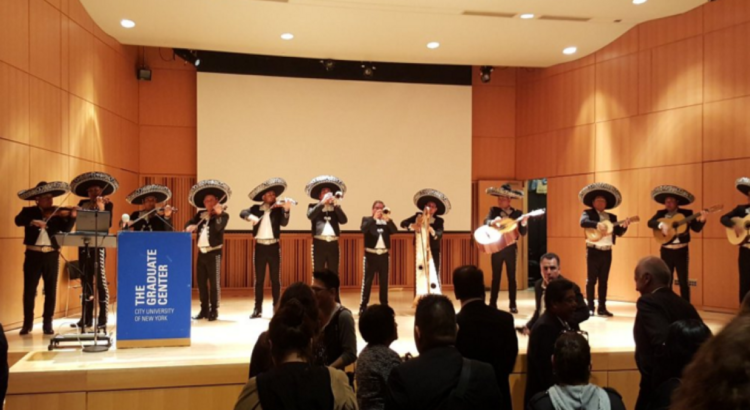
Representantes del alcalde de Nueva York y de la Asamblea neoyorquina entregaron las proclamas a Lucero durante una ceremonia en la que el Instituto de Estudios Mexicanos de la Universidad de la Ciudad de Nueva Yorkadoptó de manera oficial el nombre de su benefactor más importante.

Así, el primer centro de estudios sobre México en la costa Este de Estados Unidos adoptó el nombre de Instituto de Estudios Mexicanos Jaime Lucero, una entidad encargada de promover la educación universitaria de jóvenes sin importar su condición migratoria.

Originario de la sierra de Puebla, Lucero emigró en 1975 a Estados Unidos sin haber terminado siquiera sus estudios de secundaria y sin hablar inglés. Para principios de la década del 2000, no obstante, Lucero ya contaba con una empresa distribuidora de ropa con una flotilla de 25 camiones.

La proclama de la ciudad destacó que ahora Lucero “está allanando el camino para que otros jóvenes neoyorquinos mexicanos alcancen su pleno potencial”.

Creado en 2012, el Instituto de Estudios Mexicanos ha otorgado hasta el momento 63 becas universitarias a estudiantes que en su mayoría han sido inmigrantes mexicanos que llegaron al país sin documentos y en consecuencia con escasas oportunidades de recibir financiamiento para su educación.

Este año, el Instituto de Estudios Mexicanos Jaime Lucero entregó becas a 35 estudiantes, que pueden estudiar en cualquiera de los 35 diferentes campus del sistema de CUNY en la ciudad.

Lucero ha sido el principal donante para las becas, aunque el financiamiento ha provenido también del Instituto de los Mexicanos en el Exterior; de la Fundación Juntos Podemos; y de organismo como la Asociación de Profesionistas y Empresarios Mexicanos (APEM).

Por su parte, la proclama de la Asamblea de Nueva York asentó que el Instituto “sirve como una senda hacia el sueño americano para los mexicano-estadunidenses que viven en Estados Unidos y, más importante, encarna el lema de Lucero: empoderamiento político y económico mediante la educación”.

En la ceremonia, estuvieron presentes James Milliken, rector de CUNY; así como Alyshia Gálvez, directora del Instituto de Estudios Mexicanos Jaime Lucero; Carlos Menchaca, miembro del Concejo de la ciudad de Nueva York; y Sandra Fuentes Berain, cónsul general de México en Nueva York.

En su breve intervención, Lucero se dirigió a sus tres hijos: “deben dejar un mundo mejor al que encontraron. Ya ustedes lo harán, a su propio tiempo”.

Una de las graduadas este año de CUNY gracias al apoyo de una beca, Amalia Rojas Enríquez, traída por sus padres a Estados Unidos a los dos meses de edad, descubrió que vivió toda su vida como indocumentada en Estados Unidos hasta que fue aceptada en la universidad.

Con la voz quebrada, Rojas Enríquez recordó que sin posibilidad de acceder a financiamiento para emprender sus estudios universitarios, su madre le aconsejó que mejor olvidara sus ambiciones educativas.

“Mi mamá me dijo que mejor me dedicara a limpiar departamentos, pero gracias a Jaime Lucero ahora me estoy graduando de la universidad”, afirmó Rojas Enríquez.

Fuente de la noticia: http://www.radiolaprimerisima.com/noticias/inmigrantes/202798/nueva-york-reconoce-labor-de-inmigrante-mexicano-en-la-educacion-

Fuente de la imagen: http://www.radiolaprimerisima.com/img/noticia/280×280/nueva-york.png

Comparte este contenido:

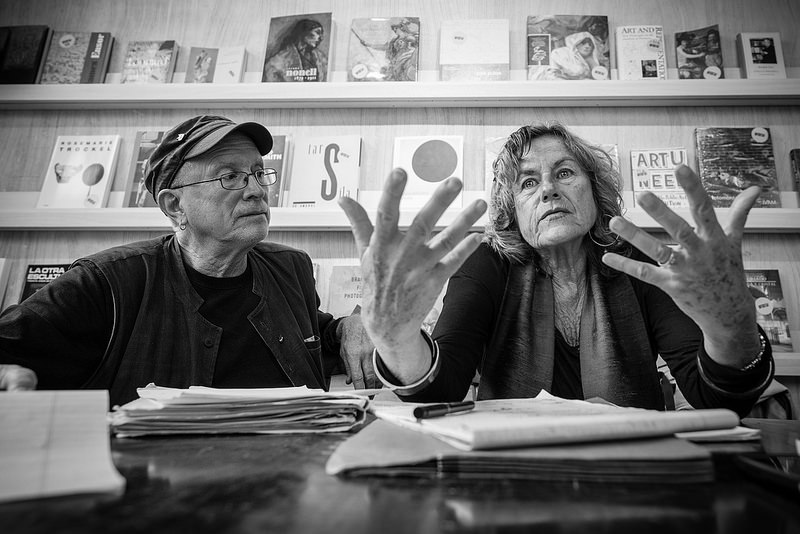
Bernardine Dohrn y Bill Ayers: «Violencia es quedarse en casa viendo la televisión mientras fuera se cometen injusticias»

Publicado por y

Bernardine Dohrn y Bill Ayers para Jot Down 0

La intervención militar de Estados Unidos en Vietnam durante los años sesenta y setenta dejó como mínimo tres millones y medio de muertos. Un historiador y periodista, Nick Turse, ha denunciado en Dispara a todo lo que se mueva (Ed: Sexto Piso, 2014) que las matanzas que se produjeron en la contienda no fueron errores, sino una estrategia organizada. Al menos, los estragos que continúa causando el agente naranja con el que se defolió la selva siguen siendo escalofriantes.

La Weather Underground fue una organización terrorista que se opuso a la guerra en la efervescencia ideológica de los años sesenta. Decidieron pasar a la acción directa, colocar bombas, para llevar el conflicto a suelo estadounidense. Siempre sin causar víctimas, las llamaban acciones simbólicas. Bill Ayers y Bernardine Dohrn fueron dos de sus militantes más destacados. Ella fue calificada por el FBI como la mujer más peligrosa de América.

Les atrapamos en un viaje que están haciendo por España presentando su nuevo libro Días de fuga (Hoja de Lata) y una novela gráfica sobre educación, Enseñar. Un viaje en cómic (Ediciones Morata). Queremos conocer sus motivaciones para llevar su movilización y su lucha a la clandestinidad, si creen que consiguieron algo y si se arrepienten de alguna cosa. Que nos cuenten su vida.

Vuestros padres son de la generación que vivió la Gran Depresión y la II Guerra Mundial. ¿Qué os contaban de aquella época?

Bernardine: Sufrieron. Mis abuelos, a los que yo nunca conocí, eran todos inmigrantes de Suecia, Rusia y Hungría. Imagínate lo que pasaron. Una experiencia tan dura como esa sirvió para que luego solo quisieran vivir con humildad y no dejar nunca de ahorrar.

Bill: Esa época fue tan sumamente dura que nuestros padres no querían ni hablar del tema, nunca mencionaban nada sobre el pasado. Como desde que nosotros nacimos todo había ido más o menos bien, ya estaba. Punto y aparte. Era un comportamiento que formaba parte de la cultura del momento: todo está bien ahora, vivimos sin grandes dificultades, así que no vamos ponernos ahora a hablar de recuerdos desagradables. Querían olvidar.

Bernardine: Y no solo fue la Gran Depresión, sobre la II Guerra Mundial crecimos sin que nos dijeran tampoco demasiado.

Bill: El inicio de los años sesenta que vivimos nosotros fue una época privilegiada, pero también de negaciones. Digamos que estábamos sumidos en un sueño profundo, no tenías conciencia de lo que había fuera de tu casita. Era todo como muy tranquilo… [risas].

El american dream.

Bill: Eso que llamaron american dream era en realidad un gran letargo en el que estábamos todos sumidos. Fue un fraude, pero era lo que había. Por eso cuando cumplimos dieciséis años y explotó el movimiento de liberación negro, a mi generación se le abrieron los ojos, apareció otro camino al margen del convencional, podías tomar la decisiones distintas sobre tu vida, elegir algo completamente nuevo.

Bernardine: Para mí empezó todo con un profesor en el colegio que nos hizo escribir sobre la guerra de Independencia de Argelia. Investigué y descubrí lo que era una guerra colonial, las torturas y demás… De modo que cuando luego entré en la facultad entendí rápidamente el significado de los movimientos por los derechos humanos que estaban apareciendo a nuestro alrededor.

Bill: También hubo una cosa más en los sesenta, el rock and roll y el béisbol. Los únicos dos ámbitos de la cultura popular donde podías ver que los negros existían.

¿El rock and roll fue una verdadera revolución?

Bernardine: Sí, en primer lugar porque los músicos eran negros. Luego aparecieron Elvis y otros blancos, pero la cultura negra estaba detrás del rock and roll. Con el rock entendimos el significado de la sensualidad en una sociedad muy reprimida.

Bill: Que el rock and roll estuviese inspirado en la cultura negra fue fundamental para romper la barrera que existía entre blancos y negros. Es interesante cómo el arte puede derribar muros hasta entonces infranqueables y enseñarte cómo es realmente la vida, el mundo y las posibilidades que tienes como persona. Tras el rock todo fue más vibrante, más intelectual, más creativo y de eso trata una revolución, ¿o no? Es un cambio político, pero también cultural, psicológico, imaginativo…

¿Cómo percibíais lo que era el capitalismo antes de entrar en contacto con los movimientos sociales?

Bernardine: Yo ni sabía lo que era el capitalismo cuando estaba en el colegio ¿Y tú, Bill? Algo sí, ¿no? Porque tu padre era capitalista… [risas].

Bill: Yo estaba en un colegio interno de cierto nivel y en las clases de Historia teníamos que leer a Marx, pero por supuesto desde la interpretación de que sus ideas conducían a la esclavitud. Sin embargo, solo con algunos puntos uno ya podía deducir que la vida era distinta de lo que nos habían enseñado. Recuerdo cómo nada más leerlo le pregunté a mis padres por qué teníamos una asistenta y por qué ella ganaba menos que mi padre. Mi padre me contestó que él trabajaba mucho para conseguir su sueldo y yo le contesté que la asistenta también trabajaba duro [risas]. ¿Cuál era la diferencia entonces?

¿De qué iban las primeras manifestaciones a las que asististeis?

Bernardine: Las primeras manifestaciones a las que yo fui fueron antinucleares, cuando iba al instituto. Recuerdo ir, alucinar con la que estaba montando la gente que tenía alrededor y no saber ni lo que había que hacer.

Bill: Ir por primera vez a una manifestación suponía romper con la comodidad del pasado. Eso era muy excitante. Aunque también daba miedo salirse de repente de lo que para ti había sido hasta ese momento la «vida normal». Y el hecho de que las primeras manifestaciones a las que fuimos fueran antinucleares es interesante porque, primero, nos dimos cuenta de que el único país que había usado ese armamento era el nuestro y eso era muy duro de asumir. Se supone que nosotros éramos los luchadores de la libertad, los que traíamos la paz, pero fuimos nosotros los que tiramos esas bombas en las ciudades japonesas.

Bernardine: El mes pasado me fui de viaje con mi hijo a Hiroshima y volví a sentir una indignación que no te la puedes ni imaginar.
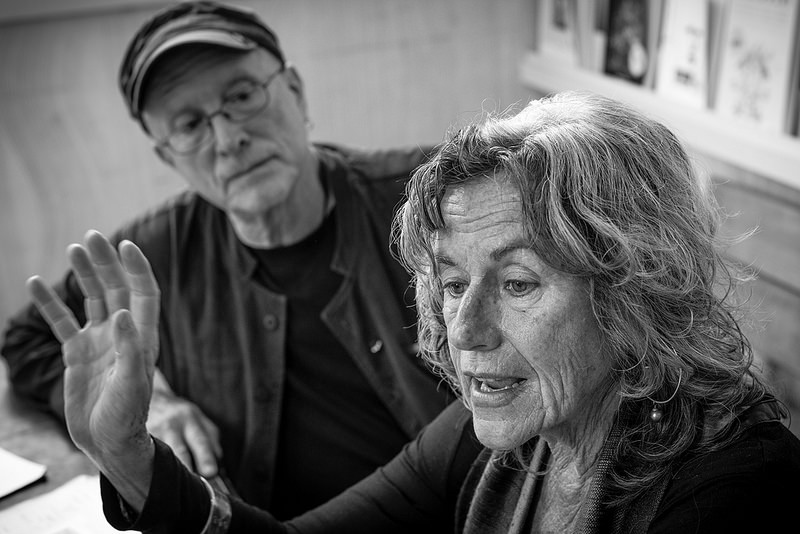
Bernardine Dohrn y Bill Ayers para Jot Down 1

Bill, lo dejaste todo y te enrolaste en la tripulación de un barco mercante.

Para mí supuso una gran experiencia. Estuve por primera vez en contacto con la clase trabajadora, un tipo de personas con las que nunca antes había convivido. Hacerme amigo de ellos fue genial, era uno más entre blancos y negros. Lo más didáctico de la experiencia fue comprobar que el propio barco estaba organizado como la pirámide social que dejábamos en tierra. Los negros hacían las labores más ingratas, los marineros algo cualificados eran de todo tipo de origen y los oficiales, todos blancos.

Cuando regresaste del barco empezó tu militancia.

Bill: No fui un militante precoz. Tardé en tomar conciencia. En esa época estaba estudiando Derecho y todos los estudiantes éramos blancos y todos menos seis chicas éramos hombres. Empecé a acercarme a movimientos sociales por afinidad, pero lo que supuso un verdadero cambio fue que Martin Luther King vino a Chicago. Antes, no reuní el valor suficiente para irle a ver al sur, pero cuando apareció por mi ciudad pensé que iba a arrepentirme toda mi vida si no me involucraba. King vino con diez activistas del sur. Nos preguntó a mí y a otros estudiantes si sabíamos quién era el propietario de la mayor parte de los pisos que se estaban arrendando en la ciudad a los pobres. Lo investigamos y nos fue imposible encontrar nada, todo iba por compañías y no logramos dar con un nombre, con un responsable. El problema era que los pisos estaban en muy mal estado. No eran siquiera habitables. No tenían ventanas, calefacción ni agua caliente. Estaban llenos de ratas y cucarachas. Así que nos pusimos a trabajar en poner de acuerdo a los vecinos para que reunieran dinero en una cuenta y pudieran reparar los edificios.

Bernardine: También nos dedicábamos a parar desahucios. Nunca olvidaré un día muy concreto en el que no pudimos detener a la policía, fallamos, y lograron entrar en el piso de una familia. Hacía mucho calor, recuerdo. Y los agentes empezaron a bajar los muebles, su ropa, las cosas de la cocina. La gente se puso muy furiosa, cada vez más. Yo estaba ahí metida en mitad de la masa rabiosa cuando de repente me empujaron, alguien enorme, miré arriba y se trataba de Muhammad Ali. Él me miró también, me pidió que le sujetase su chaqueta azul de mil dólares, se fue directo a los muebles que estaban tirados en la acera, cogió un sofá, se lo echó al hombro y lo volvió a subir al piso. Cuando la gente le vio hacer eso alucinó. Nos pusimos todos a imitarle y subimos las pertenencias de esa familia de vuelta a su hogar. La policía entonces volvía a cargarlas y las bajaba otra vez, pero, conforme las dejaban en la acera, nosotros las volvíamos a subir. Fue increíble. La acción directa en los barrios negros para mí fue una gran experiencia. Muchísimos vecinos se dirigían a mí a preguntarme cómo librarse de la guerra de Vietnam. Hubo un momento en el que empezaron a juntarse los mismos problemas: el racial, la pobreza y la guerra. Al final de verano ya empezaron a presionar a King para que se marchara de Chicago.

Bill: Ese gesto de Muhammad Ali de volver a subir el sofá y lo que supuso ha llegado hasta hoy. La gente se sigue oponiendo a los desahucios y hemos conseguido que muchos policías se nieguen a ejecutarlos.

El pretexto de Estados Unidos para su intervención en Vietnam fue la Teoría del Dominó. ¿Qué opinión os merece?

Bernardine: El capitalismo le tenía pánico a la revolución social en el tercer mundo. China y Vietnam les aterraban incluso más que la Unión Soviética por la cuestión latinoamericana y lo que les había sucedido en Cuba. Se sentían amenazados. Pero no creo que ellos se creyeran la Teoría del Dominó tal y como la formularon. Para ellos, más bien, con la demostración de fuerza que hicieron sobre Vietnam, persuadían a los demás países de no llevar a cabo una revolución social.

Bill: Para mí la Teoría del Dominó fue un mito en muchos aspectos. Aunque como metáfora era válida: la liberación nacional, el antiimperialismo, la emancipación de los trabajadores eran ideas peligrosas para el poder que no debían extenderse. Incluso tres años después de la ocupación de Vietnam, aunque estaban perdiendo, seguían matando; seguían los campos de concentración en el sur, arrasaron la poca infraestructura que el país pudiera tener. ¿Y por qué, para qué? Para que cuando los demás países vieran cómo había quedado Vietnam de destruida se lo pensaran dos veces antes de intentar ser libres, que liberarse tenía un precio inasumible. Y efectivamente, al final Vietnam ganó la guerra, pero las pérdidas fueron enormes.

Tengo aquí el libro de Nick Turse, Dispara a todo lo que se mueva. Es un estudio que detalla todos los crímenes que se cometieron allí. ¿En los sesenta teníais acceso a esa información?

Bill: Ese libro es fantástico. Explica perfectamente lo que ocurrió en Vietnam: Un genocidio.

Bernardine: La información nos llegaba a través de periodistas jóvenes que iban a cubrir la guerra. Sabían que las autoridades estaban mintiendo sobre el desarrollo de la guerra, en especial con las cifras de muertos. Por otro lado, teníamos a los soldados. No eran profesionales, eran de reemplazo, de leva, fueron obligados a ir. Y esta gente cuando volvía te contaba todos los horrores de la guerra de los que habían sido testigos. Contaban la verdad. Con lo que revelaban los periodistas y los veteranos ya sabíamos que estaban masacrando a miles de personas. Por eso se generó un pánico a la guerra, muchos jóvenes sabían que tarde o temprano iban a ser reclutados para ir a esa barbaridad.

¿Sabíais también lo de los campos de refugiados que, de facto, terminaban siendo campos de concentración?

Bernardine: Sabíamos algo, pero en realidad esa información no salió hasta 1969.

Bill: También obteníamos mucha información de Francia, de Europa, donde se contaba la guerra desde otro punto de vista.

Bernardine: Yo conocí vietnamitas en viajes que hice a Canadá y Cuba. La verdad es que llegó un momento en el que estábamos tan apasionados que llegamos a obsesionarnos con el conflicto de Vietnam. Teníamos mapas colgados en las paredes de casa, cocinábamos platos vietnamitas, leíamos a sus poetas. Llegamos a sentirnos muy identificados con ese pueblo. Por cierto, que en uno de estos viajes, conocí a un revolucionario español. Fue la primera persona que conocí que vivía en la clandestinidad.

Bill: Con toda la información que recibimos, al dejar de estar bajo la esfera de influencia del New York Times, tomamos conciencia de cuál era la situación real y nos propusimos como compromiso mostrar a nuestros compatriotas cuál era la cara humana de los vietnamitas, hacerles ver que se trataba de gente normal, con sus familias y sus amigos, y no una especie de seres extraños.
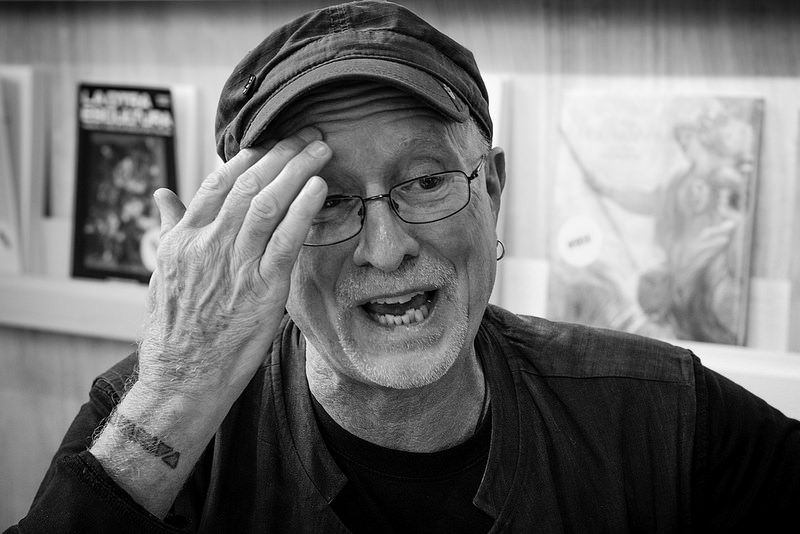
Bernardine Dohrn y Bill Ayers para Jot Down 2

¿Habéis visto la entrevista a Robert McNamara de Errol Morris?

Bernardine: A mí McNamara me saca de quicio. Verle llorar en esa entrevista…

Bueno, él cuenta tranquilamente cómo lanzaron miles de bombas sobre la población civil japonesa, cómo arrasaron Vietnam. Admite que murieron cientos de miles de personas por sus decisiones, que podría ser considerado un criminal de guerra, pero con lo que llora es cuando recuerda el asesinato de Kennedy.

Bill: Esa es su personalidad. Es uno de esos hombres que piensan todo en términos de números y categorías. Incapaces de pensar en términos de seres humanos que tienen sentimientos. Pasa lo mimo con Kissinger, que acaba de sacar un libro y en el New York Times hablan de él tranquilamente, como si fuera un intelectual más, cuando es un criminal de guerra. Posiblemente uno de los más grandes del siglo XX. De hecho, no puede viajar a ciertos países porque lo meterían en la cárcel, pero en Estados Unidos se le considera como un cerebro privilegiado de la política exterior. Lo que demuestra que es muy fácil justificar torturas, asesinatos, bombardeos y matanzas de civiles cuando eres tú el que las cometes. Si las hace otra persona entonces resulta que es terrorismo. McNamara y Kissinger son dos ejemplos de ese nacionalismo repugnante. Y ahora, en la actualidad, tenemos a John Kerry como ejemplo de esa brillante línea de pensamiento.

Bernardine: Aunque eso no quita que para nosotros siga siendo muy importante apoyar a los veteranos de guerra. No solo a los que cambiaron su opinión, sino también a los jóvenes que han pagado un precio muy alto por entrar en combate pensando que están cumpliendo con su deber o con una obligación moral. Además, muchos de ellos fueron a Irak o Afganistán respondiendo al 11S, y una buena parte solo para poder conseguir una vía económica para financiar sus estudios universitarios. De repente se encontraron metidos en una guerra de once años de duración…

Bill, en tus memorias, comentas que la primera vez que te pegó la policía te sentiste «en el paraíso».

Bill: Es una ironía, pero fue así. Nunca me había sentido tan libre. Es difícil de explicar. Cuando estuve en la clandestinidad, por ejemplo, también tenía miedo, pero la sensación de libertad que sentía era más intensa que si me encontrase como un ciudadano más. Aunque te pegue la policía o te detengan, cuando te defines ideológicamente, cuando tomas tu elección de vivir por una causa superior, te emocionas tanto que los golpes no los sientes, aunque te puedan doler.

Llegas a decir en tu libro que en la cárcel no podías sentirte más libre.

Bill: En la celda me sentía más libre que los que están en su casa viendo la televisión zampando del frigorífico. Os lo aseguro. Y no solo yo. Leí que entre los miembros de la resistencia francesa, tras la II Guerra Mundial, sentían que al acabar la guerra habían perdido su tesoro, el subidón de libertad que es la lucha clandestina. Se habían quedado vacíos tras perder el motivo de su lucha. Suena duro, pero ellos estaban plantándoles cara a los nazis, contraatacándolos, y cuando eso se acaba, te debe absorber de tal manera que parece como que has perdido algo.

Bill, por curiosidad, en tus memorias citas mucho Ann Arbor. Por aquellos años, en esa ciudad, estaba el grupo MC5. ¿Les conociste?

Bill: Sí, claro que sí. Éramos muy buenos amigos de John Sinclair, su manager. Cómo olvidar que le metieron diez años de cárcel por llevar encima dos porros. Él predicaba que la marihuana era una forma de liberación y se lo hicieron pagar. Los MC5 estaban llenos de energía, además era un grupo mitad político, mitad rock and roll, eso era muy inspirador. También andaba por ahí Iggy Pop, pero MC5 estaban siempre tocando en todas las fiestas que organizábamos. Luego solíamos terminar con ellos en la cocina bebiendo vino y fumando marihuana, hablando tranquilamente. Eran muy buena gente y muy buenos amigos.

Os sentíais parte de una revolución global contra el capitalismo.

Bernardine: Claro, nos sentíamos identificados con los movimientos de descolonización africanos, seguíamos de cerca la guerra de liberación de Angola. Apoyábamos la lucha del pueblo vietnamita. Estábamos con los movimientos pacifistas de todo el mundo. Considerábamos que la lucha del tercer mundo era la nuestra, solo que nosotros la librábamos desde dentro.

Bill: Luchábamos por la descolonización, éramos antinucleares, pacifistas, estábamos con los movimientos negros y creíamos que Estados Unidos era responsable de todos los problemas contra los que luchábamos.
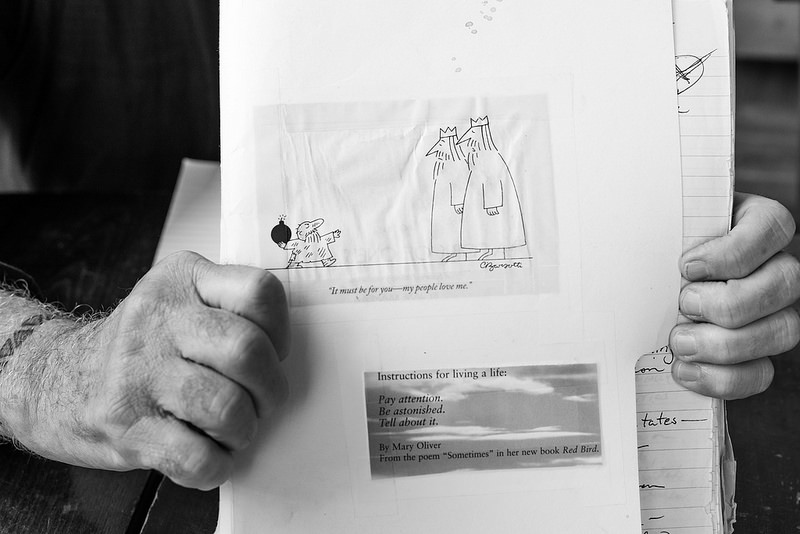
Bernardine Dohrn y Bill Ayers para Jot Down 3

Qué opináis de las nuevas generaciones, ¿son tan combativas como la vuestra?

Bernardine: Son mucho más globales de lo que nosotros éramos. Nosotros hicimos un cambio, digamos, hacia una mentalidad internacional. Pero ellos han crecido pensando de forma internacional. También creo que leen mucho y que están muy bien informados. Veo que son muy inteligentes. Mira cómo se organizaron este verano cuando la policía mató a un chico negro en San Luis. También han hecho triunfar a los movimientos gay…

Bill: Sobran los ejemplos. Ahora mismo hay jóvenes luchando por los derechos de los inmigrantes, por los derechos de las mujeres, contra la violencia de la policía, por el medio ambiente. No se puede comparar. Los años sesenta se han mitificado. Hay quien dice que en esa época pasaron todas las cosas buenas. La mejor música, las mejores manifestaciones, el mejor sexo. Y nosotros siempre respondemos que no, que el sexo sigue siendo bueno [risas]. No, incluso aún hay buena música y muchas cosas interesantes. Que no se engañe a los jóvenes metiéndoles en la cabeza que todo terminó con los años sesenta.

Bernardine: Los jóvenes cambian el mundo. Pasó en nuestra época, pasó después y ocurre ahora. Aunque haya una represión masiva, siempre son los jóvenes los que protagonizan los cambios. En nuestros tiempos, los medios siempre decían que los movimientos estudiantiles estaban muertos. Hasta en el año 68 lo decían, mientras el mundo explotaba y no encontrábamos espacios lo suficientemente grandes para poder reunirnos.

Bill: El poder siempre hace eso. Primero ignora al movimiento y luego lo ridiculiza.

En vuestra época había un libro de Mao en cada cajón de cada mesilla.

Bill: Sí, en algún momento todos tuvimos nuestro pequeño romance con el maoísmo. Pero para nosotros el Partido Comunista nunca fue interesante. Tampoco nos considerábamos una nueva izquierda. No éramos anticomunistas, no nos importaba que nadie viniese a nuestra organización siendo comunista.

El nombre de vuestra organización venía de una canción de Bob Dylan.

Bernardine: Estaban siendo asesinados seis mil vietnamitas por semana y la policía estaba asesinando a los miembros destacados de los Panteras Negras. Discutimos en una reunión de urgencia qué estrategia seguir y redactamos un documento de muchas páginas, como un informe interno de la organización. Después de leerlo, teníamos que ponerle un título y Terry Robins, gran fan de Bob Dylan, eligió ese título.

La primera norma de vuestra organización: sexo libre.

Bernardine: No fuimos solo nosotros. Pasó en muchos movimientos. Las píldoras anticonceptivas acababan de cambiar nuestros esquemas morales sobre el sexo, que la mujer podía tener placer formaba parte de su liberación. Dimos un paso adelante rechazando la monogamia.

Bill: Pensábamos que todo lo viejo, lo antiguo, lo anterior, tenía que ponerse en duda. Digamos que fue una idea experimental.

Bernadine: Pero no fue inútil. Con la propuesta del sexo libre muchos se encontraron a sí mismos; muchos amigos nuestros, por ejemplo, descubrieron que eran gais. Funcionó de maravilla porque conseguimos que cada uno fuese capaz de vivir su propia sexualidad, que es diferente en cada persona. Yo no quería casarme nunca [risas] y aquí estoy, pero porque consideraba que el matrimonio suponía para las mujeres convertirse en propiedad del marido.

Bill: También hay que decir en defensa del sexo libre que antes éramos jóvenes y guapos. ¡Quién quería ser monógamo!

¿Había muchos miembros de vuestra organización que provenían de familias acomodadas?

Bernardine: Había de todo. Mucha gente que vivía de familias ricas, otros eran de clase media. Otros inmigrantes. Pero en general la mayoría veníamos de las universidades, aunque también había gente que solo tenía la educación secundaria. Éramos una gran mezcla. El punto de ruptura fue cuando decidimos convertirnos en una organización que iba a vivir en la clandestinidad, a realizar acciones ilegales. Rompimos con la ley y las manifestaciones en las que participamos empezaron a ser violentas, con destrozos de mobiliario. Pero tenéis que entender que Estados Unidos es uno de los países más violentos que te puedas encontrar. En vuestra sociedad, en Europa, la gente no va armada. En nuestro contexto, estábamos ya rodeados de violencia de modo que hay que valorar en su justa medida que en nuestras manifestaciones hubiera actos vandálicos. En aquellas fechas estaban muriendo seis mil personas a la semana en Vietnam, dime ¿qué ibas a hacer, qué podías hacer para pararlo? Los grupos católicos de izquierda, curas y monjas, iban por ahí quemando cosas con gasolina. Que las autoridades nos consideraran violentos a nosotros era como de broma. Nunca matamos a nadie. Solo hicimos acciones que se pudieran entender como un mensaje.

Bill: Violencia es quedarse en casa viendo la televisión mientras fuera se cometen injusticias. La mayoría de la población americana piensa que si no hacen nada no están siendo violentos. Nosotros apoyamos la acción directa. Es otra cosa. Si le preguntas a Martin Luther King te diría que nuestra acción directa contra el militarismo o el racismo no es violencia.

Bernardine: Cuando salió el documental sobre nosotros se presentó en Sundance. Fuimos invitados al estreno y recuerdo que una periodista del LA Times nos preguntó que cómo podíamos ser violentos si nos gustaban Gandhi y Mandela. Yo le dije: ¿Cómo? ¿Mandela? En Estados Unidos la gente se piensa que fue un gentleman que estuvo en la cárcel y él solito acabó con elapartheid. Pensé: «Anda, vete a casa y lee un poco aunque sea en Google sobre lo que hizo Mandela y luego seguimos esta discusión». En Estados Unidos tenemos una imagen muy distorsionada de lo que es la verdadera violencia.

Bill: Es como cuando el presidente de Estados Unidos dice que King fue un ejemplo a seguir, un hombre recto. Y yo pienso que no, que no actuaba solo. Él era parte del movimiento. King no creó el movimiento, el movimiento creó a King.

Bernardine: Me gustan los movimientos juveniles actuales que se niegan a tener un líder.
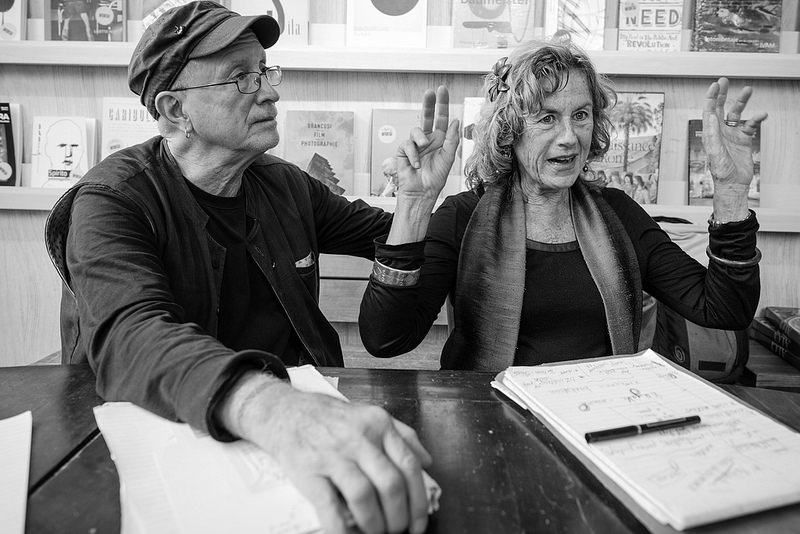
Bernardine Dohrn y Bill Ayers para Jot Down 4

Bernardine, el FBI dijo que eras la mujer más peligrosa de América.

Bernardine: Ya me gustaría…

Bill: ¡Esa es mi chica! [risas]

Bernardine: Antes de mí, ¿sabes quién dijeron que era la mujer más peligrosa de América? Jane Addams, una feminista que era socialista y lesbiana. Se había opuesto a la I Guerra Mundial. Edgar Hoover, que estaba empezando, dijo que era la mujer más peligrosa de América y después de unos años la dieron el Premio Nobel de la Paz  [risas].

Bill: A Bernardine la pusieron en una lista de los diez delincuentes más buscados. Las listas de los más buscados habían estado siempre llenas de criminales, mafiosos, de asesinos terribles y, a partir de los setenta, se empezaron a llenar de estudiantes guapos [risas].

Bernardine: Fracasaron. Iban de organización poderosa, pero les pillamos por sorpresa. Durante años mandaron a gente a que preguntara por mí de puerta en puerta. Creían que nuestros padres o nuestros compañeros de la universidad iban a decirles algo, pero nuestra campaña de convencer a la gente de que no colaborase en absolutamente nada funcionó.

Bill: Incluso en la investigación del FBI podías ver reflejada la pirámide social. Cuando fueron a hablar con mi padre, un profesional considerado, le pidieron una cita para verle en su oficina. Cuando fueron a hablar con el de Bernardine, que era un inmigrante, aparecieron en mitad de la noche en su casa diciéndole que tenían un cuerpo en la morgue que querían que identificase a ver si era su hija. Le intentaron aterrorizar, mientras que a mi padre le guardaron una distancia y un respeto.

Bernardine: Como sabéis, una vez conseguimos robar los archivos del FBI. Ahí vimos que había dos estrategias. Para los negros, asesinar a sus líderes; para los blancos, infiltración y destrucción desde dentro.

Bill: Sí, con los movimientos negros hicieron eso, matarlos. Tardó siete años en salir a la luz, en que los abogados lograran demostrarlo, pero al final se vio que eran ciertos algunos asesinatos.

Bernardine: Pero ya os digo, nadie colaboró con ellos para atraparnos a nosotros. Porque, además, no éramos los únicos que estaban en la clandestinidad en aquel entonces. Había mucha gente indocumentada, traficantes de LSD, insumisos que huían de la mili, desertores, no estábamos solos. Estados Unidos estaba lleno de gente furtiva.

¿Cómo era la vida en la clandestinidad?

Bernardine: Trabajábamos. Yo lo hacía de camarera, limpiando casas, recogiendo fruta, vendimiando. Y entretanto, muchas reuniones. Mientras, sabíamos que parte importante de la sociedad nos apoyaba, tenían ese gran romance americano con losoutlaws, como si fuésemos Bonnie & Clyde.

Un antes y un después en vuestra organización fue cuando le explotó la bomba en Nueva York a unos militantes de vuestro grupo, una bomba que iban a colocar en un baile de oficiales para matar al mayor número de ellos posible. Ahí decidís no atentar contra vidas humanas.

Bill: Unos del grupo decidieron hacer ese ataque en una base militar. Prepararon la bomba, les estalló y murieron los tres. Pero ya habíamos pasado a la clandestinidad y esta decisión la tomó un grupo por su cuenta porque funcionábamos de forma descentralizada. De todas formas, lo que pasó en ese edificio donde explotó la bomba no lo sabe nadie. La bomba estaba hecha con metralla para matar personas, no para hundir un edificio. En lo que a nosotros respecta, cuando descubrimos lo que habían planeado, fue un shock. Estábamos muy asustados. Horrorizados. Nos reunimos para decidir si apoyábamos esa clase de violencia y, tras meses de discusiones, optamos por realizar acciones meramente simbólicas, sin víctimas. ´

Bernardine: No queríamos ser una fuerza militar, asesinar a gente, sino una fuerza política. Los que estuvieron de acuerdo se quedaron y los que no, abandonaron la organización. Nos llevó un año definirnos.

¿Qué acciones realizasteis según ese modelo?

Bernardine: Los objetivos de la Weather Underground, donde pusimos bombas, fueron todos militares. El Pentágono, comisarías… La verdad es que no tengo un atentado favorito. [risas] [Lista de todas sus acciones N. del R.]

Aparte de las bombas, organizasteis la fuga de prisión de Timothy Leary.

Bernardine: De eso sí nos arrepentimos, de no haber hecho más acciones donde estaba presente el sentido del humor como en esa, que fue una operación tan divertida. Nadie nos lo ordenó jerárquicamente, simplemente vimos que era una buena oportunidad y lo hicimos. Timothy Leary era un intelectual que experimentaba con LSD y promovía esta droga como forma de romper con las costumbres e iniciar una nueva forma de vida, encontrar una nueva manera de ver el mundo. Él tonto no era, entendía nuestra lucha contra la guerra de Vietnam y el racismo. Era un activista más. Sencillamente, estaba en la cárcel por el asunto de la droga, como tantos otros, y quería escaparse. Su gente se puso en contacto con nosotros, nos pareció bien, nos financiaron y desarrollamos el plan. Fuimos capaces de sacarle de la cárcel y del país.

¿Cómo hacíais las bombas, qué materiales empleabais?

Bernardine: De eso no hablamos.

¿Conocíais a la Baader Meinhof?

Bill: Sí, sabíamos que existía, fue un fenómeno más de los sesenta. Formaciones revolucionarias que intentaban luchar. Entonces tenías ese tipo de resistencia en todas partes, en Inglaterra, en Francia, en Japón, en Alemania, en España…

Bernardine: Pero nosotros tomamos la decisión de nunca abandonar nuestro país. Éramos hijos de América. Veíamos lo que hacía la Baader Meinhof por televisión, pero nuestras estrategias, las decisiones que tomamos, fueron diferentes.
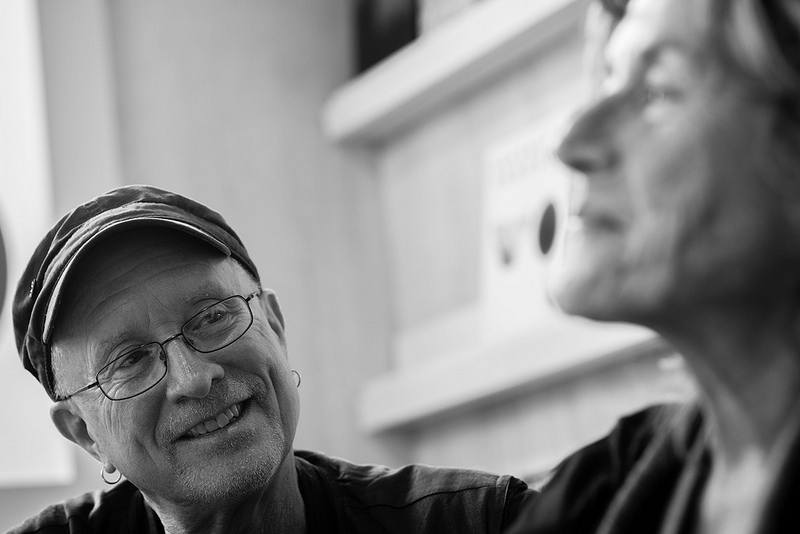
Bernardine Dohrn y Bill Ayers para Jot Down 5

Decís en el documental que en los setenta vuestra vida en la clandestinidad y vuestros atentados empezaron a ser como una rutina. Decidisteis dejarlo.

Bernardine: Teníamos una regla que no era muy habitual en las organizaciones que operaban en la clandestinidad. En Weather Underground los militantes podían irse cuando quisieran. No había consecuencias por abandonar. Durante los setenta unos entraron, pero también muchos se fueron. Cuando acabó la guerra de Vietnam, la cuestión de seguir siendo fugitivos se puso sobre la mesa. Hubo diferentes opiniones, unos querían seguir y otros queríamos volver a disfrutar de una vida privada normal, tener familias e hijos. Muchos lo dejaron pero se unieron al movimiento gay, otros al sindicalismo… Yo odiaba tener que rendirme y entregarme, pero Bill fue adorable y me dejó tomarme mi tiempo. Al final nos entregamos cuando nació nuestro segundo hijo.

Bill: Estábamos también deseando militar en una organización más grande. Fuimos a Chicago, resolvimos nuestros problemas legales y no entendimos que nuestra reinserción fuese en contra de nuestras ideas revolucionarias.

Bernardine: Yo hice mi discurso militante: «Me niego a entregarme, pero aquí estoy» [risas]. No sabíamos qué iba a pasar. Teníamos dos críos. Le dijimos a nuestro hijo mayor lo que pasaba y al menos se quedó con que íbamos a cambiarnos los nombres, nunca habíamos ido por ahí con los verdaderos. La noche siguiente vimos a los padres de Bill por primera vez en once años y luego fuimos a que yo le presentara a los míos.

Bill: Lo que más me gustó es que el primer comentario de mi padre al verme fue que necesitaba un buen corte de pelo. Y lo primero que dijo el padre de Bernardine fue «¿Estás casada?». Seguían siendo unos padres como los de toda la vida.

Bernardine: Ahora bromeamos con eso pero la verdad es que los pobres pasaron por un auténtico infierno. Pero bueno, llegado el momento estaban muy felices de ver a sus nietos.

¿No tuvisteis problemas con la ley?

Bernardine: Yo tenía cargos por las manifestaciones violentas, unos dieciséis o diecisiete. Cargos federales por destrozar propiedades públicas. Pero el FBI había llevado las investigaciones de forma tan claramente ilegal que no pudieron acusarnos de nada. Tampoco tenían muchas pruebas a esas alturas, la verdad. De todas formas, muchos militantes de Weather Underground sí que terminaron en la cárcel, pero por otros cargos al margen de nuestras acciones. Por no querer revelar nada sobre mis compañeros yo ya me había chupado en su momento siete meses de cárcel.

Bill: Las acusaciones fueron muy débiles. Nos acusaban de haber planeado acciones pero no tenían pruebas de que las hiciéramos. Con esas acusaciones ridículas nos habían puesto en la lista de los diez más buscados. Además, el FBI pretendía secuestrar al hijo de la hermana de Bernardine y retenerle hasta que nos entregáramos. No llegaron a hacerlo, pero con esos métodos ningún juez les hubiera podido haber dado la razón.

Bernardine: Los agentes que planearon eso terminaron condenados. Tras el final de la guerra de Vietnam y la guerra sucia del FBI América estaba en shock. Nos colamos por la puerta que abrió el presidente Jimmy Carter, aunque nos entregamos justo cuando Reagan fue elegido presidente [risas].

Hoy en día seguís recibiendo amenazas de muerte.

Bill: Es que uno de mis libros lo publiqué justo el 11 de septiembre de 2001. Esa misma mañana el New York Times llevaba en portada de su sección cultural una foto de nosotros dos con la reseña. El diario salió a las seis de la mañana y los atentados contra los Torres Gemelas fueron a las nueve. A raíz de eso, nos llovieron más amenazas que durante la guerra de Vietnam. En esos días de auténtica paranoia con el terrorismo, nosotros nos convertimos en los terroristas domésticos de Estados Unidos. Recibimos amenazas de muerte prácticamente todos los meses. Si vamos a dar un discurso a algún lado, siempre hay amenazas, pero no las tomamos en serio. Es solo gente muy ruidosa pero nada más. Nos los imaginamos como el típico tío bebiendo demasiado whisky delante del ordenador, quién sabe si viviendo en el sótano de la casa de su madre [risas].

¿Qué habéis hecho contra la guerra de Irak y Afganistán?

Bill: Estuvimos en muchos movimientos. En especial en un movimiento colectivo en Chicago [Movement Building Colective] Pero creemos que no puedes limitarte solo a estar en un movimiento ni quedarte en tu casa sentado. Hay que hacer algo más. Por eso hemos estado profundamente involucrados en proyectos pacifistas que van de la educación a la justicia, aunque la guerra sea la idea central.

Bernardine: Yo también estuve en el movimiento en contra de que la OTAN se reuniera en Chicago hace dos años.

Bill: Esas manifestaciones fueron un gran éxito. Vimos cómo el Gobierno se lo tomaba como un ensayo general para la represión. Nunca habíamos visto la ciudad tan vacía. Los únicos que quedamos fuimos nosotros, los manifestantes, y la policía y los militares. Todo lo demás, drones, helicópteros, quitanieves ¡en mitad del verano! Hacía un calor infernal, pero los trajeron.

Bernardine: Lo más impresionante es que los que más daban la cara en las manifestaciones eran veteranos de la guerra de Irak. Los líderes de estos movimientos habían estado en la guerra. Iban los primeros, encabezaban la protesta y lo más espectacular fue cuando les lanzaron sus medallas a los generales de la OTAN, fue una imagen imborrable.

Bill: Estados Unidos tiene una larga historia de ocupaciones militares y guerras. Invasiones de terceros países que no solo son injustas e ilegales, sino que además acaban con las aspiraciones de paz y justicia de todos los ciudadanos del planeta. Lo más grave de todo, además, es que las guerras por petróleo no responden a una causa política, que implique a mucha gente, sino solo a los intereses de un 1%. En este contexto, nosotros no podemos influir en el Congreso, pero sí en nuestras áreas de influencia más cercanas, como es la educación. Por eso tratamos de organizarnos de abajo a arriba. Promovemos nuestros valores en la comunidad, en las aulas, en la iglesia, en la universidad. No te creas que esto no le preocupa al Gobierno. Si miras la historia de todos los grandes cambios, siempre vienen desde abajo.

Bernardine: De hecho, en política, nunca harás nada bueno sin el poder de abajo.

¿Ha cambiado algo con Obama?

Bill: Obama en 2008 dijo que era pragmático y moderado. Pero la derecha dijo que era un musulmán encubierto, que estaba con los terroristas, que tenía una agenda socialista. Y ya veis, creo que iba en la buena dirección, pero al final no tardó en disgustarnos con todas estas guerras.

¿Os arrepentís de algo?

Bernardine: Ahora, hablando como una mujer de setenta y tres años, creo que no nos equivocamos. No me arrepiento de nada.

Bill: Nunca causamos muertos. Como dice Bernardine, no nos arrepentimos de haber causado destrozos con bombas de una forma simbólica. No nos arrepentimos de haber luchado contra un Gobierno que llevaba a cabo un genocidio en Vietnam y pretendía acabar con la cultura negra por la violencia. Con setenta años, por supuesto que me arrepiento de muchas cosas. Políticamente, el arrepentimiento más profundo que siento es el de haber formado un movimiento tan sectario. Desde ese punto de vista, tan reducido, nunca actúas bien. Ahora hemos aprendido más y crecido como personas.
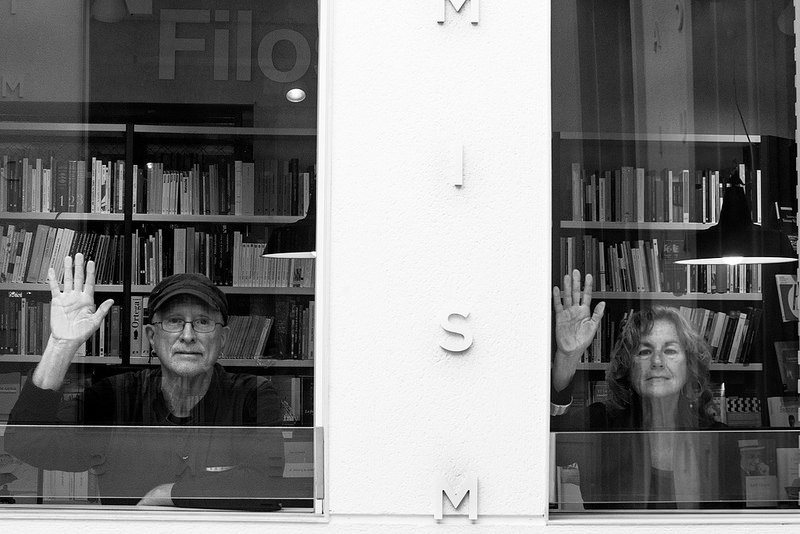
Bernardine Dohrn y Bill Ayers para Jot Down

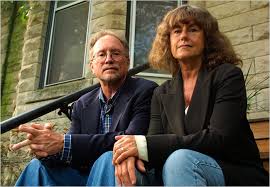
Fotografía: Begoña Rivas


Enlace original en: http://www.jotdown.es/2014/11/bernardine-dohrn-y-bill-ayers-violencia-es-quedarse-en-casa-viendo-la-television-mientras-fuera-se-cometen-injusticias/
 

Comparte este contenido:

Sexual Self-determination in Cuba and the Decolonial Epistemic Turn

Antonio Carmona Baéz

Globally, the concept of self-determination in sexuality is used in legal theorywith reference to the rights of individuals to be free of rape, coercion, forcedprostitution and abuse; it implies reproductive rights in some societies, while inothers it is the right to exercise free will over one’s sexual functions (Jansen, 2007;Munro, 2008; Smith, 2007; Walsh and Foshee, 1998). In Cuba, the term ‘sexual self-determination’ (autodeterminacio´ n sexual )1

is associated with the process of emancipation that is linked to the construction of socialist society, and the useof sex education as established by the country’s feminist movement, in order totranslate the political discourse on gender and sexuality, specifically Lesbian, Gay,Bisexual, Transgender (LGBT) sexuality, into social policy (Figueroa, 2009). Morerecently the concept has been used as a counter discourse to the pathologicalapproach to transgender experiences and identities and it is recognized as a fun-damental human right.
In this article, we suggest that the use of ‘decolonial’ and ‘border thinking/epistemologies’ as developed by Walter Mignolo (2000, 2007) and ‘epistemicturn’ as elaborated by Ramon Grosfoguel (2007), based on the critique of the‘geo-politics of knowledge’ (Dussel, 1977; Fanon, 1963, 1967), can help us under-stand the changes associated with sexuality, ethics and public policy that sprangout of Cuban feminism and its emphasis on sex education.
Considering that literature on the intersections of race, class and gender is his-torically rooted in radical feminist and latterly queer critiques of Western capitalistsociety, the political nature of the use of emancipatory discourse in Cuban socialinstitutions comes as no surprise (Glenn, 1985; Lugones, 2007; Namaste, 1994;Wolf, 2009: 19–20). In a similar vein this discourse and recent changes in Cubansocial policy pose a challenge to global conceptions of sexual health in the medicalsciences, the idea of emancipation of sexual identities, and a dissonance in theformation of ethics and human rights discourse internationally. What is particu-larly novel is the institutionalization of such critique and discourse at the statelevel. In addition, the autochthonous Cuban critique of homophobic society andself-evaluation promoted by militants and leaders of the Communist Party of Cuba(PCC), have exposed a narrative that is bent on the decolonisation of politics,policies and practices. The Cuban experience regarding social policy on sexualdiversity is in no way free of contradictions. Sexual self-determination is not anaccomplished project but part of a continuous process.
We do not intend to place a value judgement on these processes, but instead tomap debates and controversies. We will do this by briefly presenting the concept of  epistemic decolonial turn, by reviewing the genealogy of Cuban homophobia andthe history of sexual emancipation, and by showing how policies concerning sexu-ality that are assumed by the Cuban state and applauded by broad sectors of itscivil society is based on a discourse that embraces the epistemic turn presented inthis article. The implications of this turn for ethics in medicine and science inter-nationally will be elaborated.We have found that the decolonial project of sexual emancipation in Cuba ismanifested in three essential aspects: (1) Sex education as envisaged by the feministmovement of subalterns; (2) Depathologization of non-heteronormative genderidentities and (3) Sexual self-determination presented as a human right.Ultimately, the Cuban experience presents a dual dynamic: first, decolonizingCuban post-revolutionary politics through the changes in sexual codes, publicpolicy and health ethics on the one hand, and on the other, a  displacement of  medical-scientific authority over gender and sexuality. Alongside this last issue, theestablishment of new centres of knowledge production in both science and socialtheory will be identified as a challenge to conventional bodies of authority.
Decoloniality and the epistemic turn
There is a growing body of literature in the humanities and social sciences thatlooks at the production of knowledge and its institutionalization as part and parcelof the modern world system of hierarchies (Walsh, 2012). Starting with the premisethat colonialism or coloniality is the flipside of modernity, those who challenge thecentres of power in knowledge production by recognizing other epistemologies,attempt to decolonize knowledge and call their perspective  decoloniality .Mignolo (2003), Maldonado Torres (2004) and Grosfoguel (2008) for instance,have concentrated their efforts on, first, recognizing the epistemological violencecommitted by dominant power structures in suppressing or excluding other narra-tives and, secondly, uplifting and taking into consideration the excluded/subalternnarratives, giving them equal if not more value when it comes to socio-politicalphenomena. Decolonial thinkers challenge the universality of modern knowledge,describing it as a ‘provincial pretense’ or largely Eurocentric, and introduce theconcept of the geo-politics of knowledge (Mignolo, 2007: 493). Mignolo, followingLatin American liberation philosopher Dussel (1977), refers to  geo-politics  in orderto argue for the importance of locating the construction/production of knowledgeand its dissemination. Starting from the premise that all geographies and historiesare local, these recognize that some – specifically those of modernity – have a globaldesign, albeit controlled by certain types of local histories (Mignolo, 2000: 66). Thecontrol of both the local and universal can be found in academia, what Grosfoguel(2012: 9) refers to as Westernized universities – as well as in law, political institu-tions of the state, social movements and political projects for transforming society. Additionally, the decolonial school of thought foregrounds  border thinking, whichis an attempt to rescue and employ narratives and histories that have been inten-tionally supressed precisely because they challenge the universal project of euro-centric modernity/coloniality (Mignolo, 2000: 739–45).
Decoloniality looks specifically to the place where knowledge is produced.In order to decolonize knowledge, the geo-political location of theology,European secular philosophies, and later scientific reason (including scientificsocialism which is dependent on European epistemologies exclusively) must beunveiled, and the principles and modes of knowledge that have been ignored byChristianity, Western – i.e. subaltern epistemic perspectives (ethnic/racial/sexual/territorial), must be uplifted along with the epistemic decolonial turn (Mignolo,2007: 463; Grosfoguel, 2007: 212).
For the purpose of this article, we should emphasize that it is not so muchEurocentrism that needs to be underscored in understanding coloniality. Rather,it is the unequal structure of governing bodies of knowledge that have determinedthe course in which ethics have been developed. Cuban social policy has not shed  itself completely of colonial epistemologies. At the same time, the striking resem-blances between the trajectory by which Cuban social policy regarding sexualityhas developed and the epistemic decolonial turn, as suggested by Dussel,Grosfoguel, Maldonado Torres, Mignolo and others, merits attention.

To analyse the changes being made in Cuba regarding social policy towardssexual diversity, health and ethics, it is worth looking at where knowledge has beenproduced prior to and under the current political regime. In order to accomplishthis, the genealogy of trans/homophobia can be reviewed from both local andglobal historical frameworks, the transformation of social policies and sexual pol-itics can be considered, and the conceptualization of  sexual self-determination examined. Since education throughout the process of social transformation iskey to this study, it is appropriate to identify the influence of Paulo Freire(1970) in understanding popular education and the

 pedagogy of the oppressed ,whereby the teacher–student relationship is broken down in order to facilitate adialectics of emancipation (liberation), and to recognize this Latin American heri-tage as an essential tool in the process of decolonizing sexuality, science, humanrights and health.
For Freire, those who are in a position of power must constantly go through aprocess of self-examination (Freire, 1970/1996: 64), contemplating their own role ina world of inequality. Parallel to this is the issue of building an ethically soundrelationship between those who are ‘treated’ by state institutions and the scientificcommunity, including health professionals working with those identified as trans-gender or intersex. While commenting on the question of good treatment of transpersons in the age of de-pathology, Judith Butler concludes: ‘the question is notsimply would you, the authority, permit and recognize my change; rather, wouldmy request produce radical changes in your practice and in your ethical self-under-standing as a professional or practitioner’ (Butler, 2010: 12). Today, as will beargued, the re-education of Cuban society was an essential breakthrough in thatcountry’s experience of depathologization. We identify an epistemic decolonialturn within science, ethics and the Marxist-Leninist-Martiano discourse of egali-tarian socialism. This turn is presented as a challenge to what we call the
 religious-modern-socio-scientific bloc  that until recently has dominated Cuban society and itsmanagement of sexuality.
Human rights is also a field of study that has undergone critical review from thedecolonial perspective. Mignolo (2009) notes that the notion of human rights fol-lows a modern/colonial trajectory in both theoretical and practical applications.Human rights, reserved for white men of privilege first, and later extended to therest of the world’s population, continues to be shaped by discourses and epistemol-ogies based on the Western experience. The socialist experiment in Cuba, as inmany other places, has challenged universal conceptions of human rights, payingmore attention to socio-economic rights as access to food, housing, health services,education and employment. In 2008, the government of Cuba hosted an inter-national conference of intellectuals, politicians, lawyers, artists and activists,entitled ‘The Universal Declaration of Human Rights: 60 years later’, where in a final statement participants recognized the incompatibility of what they called‘predatory, exclusive, exploiting, racist and patriarchal capitalism’ with the repro-duction of life and the meeting of human needs. In this context, participants upheldcivil, cultural, economic, political, social and sexual rights (MINREX, 2008). Aswill be demonstrated further on, this re-framing of human rights requires a deco-lonial reading of the institutional treatment of non-heteronormative genders andsexualities.
A genealogy of homo- and transphobia
The critique of homophobic society in Cuba stems from two distinct groups of narratives, that are similar only in that they are both politicized. On the one hand,there is the critique of ‘communist state-homophobia’, originating in the politicaldiscourse of Western liberal democracy in opposition to Cuban experiments of radical social change. The reading largely depends on anecdotal documents, vari-ous forms of journalism found in Western media, the writing of biographies andfiction (Epps, 1995; Young, 1981; Sanchez, 2011), and sometimes Western, radicalsocialist discourse which dedicates a considerable amount of attention to the hor-rors of Stalinism and other authoritarian experiments (Farber, 2011: 184–221).Reference is made to ‘concentration camps’ for gays, the maltreatment andforced hospitalization of persons infected with HIV, and the deportation of homo-sexuals and transgendered people, together with the mentally ill or handicappedand individuals prosecuted for anti-social behaviour, petty crimes and religiousfundamentalism (Bejel, 2001; Capo´, 2010; Negro´n-Muntaner, 2008).
The other trajectory of critique of Cuban homophobia is grounded in anautochthonous re-evaluation of social policies and public culture concerning sexu-ality and hegemonic masculinitiesthroughout that nation’s history. 4
This readingis closely faithful to the methodology of decolonial thinking, linking historic-colo-nial (modern) constructions of dehumanizing exclusion and compartmentalizationson sexual identities with prejudices, attitudes, and popular and state positionstowards sexual diversities. Here, the story begins with the European, specificallySpanish-Catholic, colonization that brought to Cuba a series of codes, norms,typographies and ideas concerning sexuality that generally prevail throughoutmodern times: ideas about the family, masculinity and exclusive male–femalegender identities. Otherness in sexuality was often racialized and attributed to‘inferior’ cultures, ethnic groups and civilizations.Thereafter, with the replace-ment of religion by secular science and its reach to the Americas (Grosfoguel,2008), some of these norms were reinforced by academia and medical science. 6

Marxism-Leninism, as an imported ideology of European origin (albeit with Martiano  adjustments made in Cuba), in its ‘anti-reactionary’, anti-religiousstance depended heavily on medical science which was evident at the time inEurope, the United States and the Soviet Union, to create an ideological andsocietal-normative response to sexualities.These are found in the pathologizationand treatment of homosexuality, transexuality, and the biomedical treatment of  cases of intersexuality. Below, we expose a narrative that takes into considerationthe role of the feminist movement, its emphasis on education and the evolution of astate policy to combat trans/homophobia.

Revolution and emancipation
When it comes to understanding social policy on sexuality, it is important to con-textualize the Cuban revolution within the framework of the Cold War, wherebythe socio-economic, domestic and foreign policies adopted by revolutionary forcessituated the country and its post-revolutionary development trajectory within whatwas called the Soviet bloc. The composition of the Communist Party of Cuba(PCC) and the formation of civil society groups, the Constitution of 1976 and allthe laws and political structures that shaped public policy, education and everydaylife, were largely influenced by the Soviet experience (Carmona Ba ´ez, 2004: 72–9).Although some elements of Soviet-styled public policy proved to be progressive,especially in the advancement of women’s rights, other areas of concern, such asthe pathologization of non-heterosexual practices continued to reinforce the colo-nial and scientific reasoning that perpetuated trans/homophobic postures.Nevertheless, the 1959 Cuban revolution unleashed a complex process of socio-economic and cultural change that provided the basis for dialogue and(violent) confrontation between generations and social classes. During andthroughout that process a reconfiguration of gender relations also, questionedhegemonic masculinities (Castro Espı ´n, 2011a).
In 1960, the Federation of Cuban Women (FMC), an organized mass movementof women participating in the national political process, became the vehicle thatarticulated a project of women’s empowerment as subjects entitled to rights andparticipation in the process of socialist construction. The incorporation of womeninto the field of work outside the home had an impact upon both sexuality andreproductive patterns. Women took on a new public role, including participation innational defence during times of US aggression (Nun ˜ez, 2011; Sa ´nchez Parodi,2011; Waters, 2012).
By 1965, abortion had been legalized and institutionalized as a service providedby the national healthcare system free of charge and, on demand performed byspecialist medical personnel in hospitals with the women’s consent. This measurenot only contributed to the reduction of maternal deaths but also ensured women’srights over their bodies. (Espı ´n Guillois; Sosa, 2008) The initiatives taken up duringthe 1960s were institutionalized in the Family Code of 1975, which advocated equalresponsibilities for the education of children and for household tasks (Stone, 1981:182–200).
This repositioning of women in Cuban society cannot be divorced from otherrelated processes of emancipation, including the partial repositioning of Blackpeople and, the uplift of social sectors such as the unemployed, provincial migrantsand prostitutes (Garcı ´a, 2009). All of these claimed a stake in the revolutionaryprocess and were able to situate themselves in the context of building a radically new society. But it was the new position of women that enabled the questioning of hegemonic masculinities and practices. What it meant to be a ‘man’, a ‘woman’ anda ‘revolutionary’ were topics that enjoyed or suffered decades of public debate.
It was also the country’s feminist movement that brought about changes inattitudes towards sexuality both in the public sphere and in state institutions. Aparticularly remarkable breakthrough was the FMC initiative of facilitating thepublication of numerous scientific books by foreign authors, including  El hombre y la mujer en la intimidad (Mann und Frau intim) and En Defensa del Amor (Pla ¨ doyer fu ¨ r die Liebe) by German sexologist Siegfried Schnabl, in 1979. For the first time inCuba, it was possible to read the uncensored opinion of a scientist asserting thathomosexuality was not an illness. It was not until Cuban scientists had access tothese foreign documents that a thorough re-evaluation of state positions on homo-sexuality began, and it was not until after the de-penalization of homosexuality inCuba in 1979, that these documents were made available to the general public.
Sex education
One of the principal actors in organizing feminist demands was chemical engineerand MIT student Vilma Espı ´n Guillois, who headed the FMC from its foundationuntil her death. In 1972, Espı ´n Guillois set up a multidisciplinary National SexualEducation Group (GNTES) to establish the National Programme of SexualEducation, which was recognized as state policy by the first Congress of theCuban Communist Party in 1975 under two resolutions: ‘On the formation of children and youth’ and ‘On the full exercise of the equality of women’ (Rojas,1978: 529–610). These emphazised the eradication of all forms of discriminationagainst women and included sex education in school curricula.Despite great resistance by the Ministry of Education, subjects related to repro-ductive function were formally introduced in school textbooks during the 1970sand 1980s. Still, it was not until 1996 that the Sexual Education Programme inSchool was established under the name of   For a Responsible and Happy SexEducation
, with state support for research and publication (Castro Espı ´n, 2002:4–9).
In 1989, GNTES established the National Centre for Sexual Education(CENESEX), a state-financed institution under the Ministry of Public Health,whose mission was to coordinate a permanent but dynamic national programmeof sex education involving both central state administration and civil society organ-izations. The agenda and projects of the national programme were established bythe ministries of Public Health, Education and Culture and by the FMC and theUnion of Communist Youth (UJC). Since then, CENESEX has established a net-work of provincial and municipal working committees to carry out and monitor itsgoals and impact. As will be elaborated later on, its activities are focused ondeveloping sex education strategies in schools and more publicly, promotingsocial research and therapy, the provision of care for the Lesbian, Gay, Bisexualand Transgender (LGBT) community, as well as victims of violence and sexual abuse, and the production of educational materials. Cuba’s national sex educationpolicy evolved from an emphasis on women and their reproductive rights to a morecomprehensive outlook including gender diversity and the rights of individuals todecide over their bodies and identities (Castro Espı ´n, 2011a).
Combatting homophobia
Cuba continues to be a country where male chauvinism and homophobia is dom-inant in popular culture. These characteristics have been endorsed by RomanCatholic doctrine, the legacy of the Spanish Code of Social Defence – later theRepublic of Cuba’s 1938 Code of Social Defence (Roque Guerra, 2011: 218–26)and by modern scientific knowledge that stigmatized homosexuality, and otherbehaviour deviating from the heterosexual norm.
Literature produced in Cuba throughout the 20th century, including postrevolutionary literature concerning sexuality, only enforced homophobic ideas inpsychology, medicine, sociology, ethics and law. A notable exception waSexologı´ a I,  by Angel Arce Ferna ´ndez (1965) (Horta Sa ´nchez et al., 2011) aBlack revolutionary communist and physician who was later recognized as thefounder of Cuban sexology. Fernandez promoted the idea that homosexualitynot be considered an aberration or illness. According to a recent reflection writtenby his daughter, he was harshly criticized and censured (Arce Henderson, 2012).His work and experience provides evidence of debate and confrontation aboutsexual diversity, within medical and political communities of the time.
The existing medical sciences in Cuba acted at the time of the revolution as abloc against practices that were considered as signs of illness, the prelude to insan-ity and a mark of social moral decay. This  religious-modern-socio-scientific bloc inhibited the process of shedding the colonial legacy of homophobia. The Cubanvariant of socialism, in which Che Guevara’s ‘new man’ became the central subject,was impotent in resolving this colonial legacy (Roque Guerra, 2011: 218–25). Therevolutionary project of breaking down social structures remained trapped in ahomophobia that was sustained by universal science. Arguelles and Rich (1984:691) attribute this, in part, to the influence that the pre-revolutionary, Stalinist,Popular Socialist Party had on the formation of political discourse regardinghomosexuality. They place responsibility on the ‘lesbian and homosexual intelli-gentsia’ concentrated in the National Union of Cuban Writers and Artists(UNEAC), which provided no public counter critique. However this displacementof blame masks essential structural aspects of homophobia in Cuban society,ignoring the colonial continuities that are to be found in state socialist positionsand social policies concerning sexual diversities.
The religious-modern-socio-scientific bloc favoured discriminatory towards les-bians, gays, bisexuals and transgender people for years. It gave rise to the estab-lishment of the Military Units for Production Support (UMAP) in 1965. Acompulsory civil-military service of forced agricultural labour for idle youth, religious dissidents and homosexuals in a context of continuous aggressions by theUS government, the UMAP was known for its reproduction of homophobia.UMAPs were closed three years later in 1968, as a result of an in-depth militaryinvestigation starting in the province of Camaguey and protests launched by asso-ciates of the UNEAC (Ramonet, 2006: 225).
Recently, Maria Isabel Alfonso, writing on racial dynamics in state policies of the 1960s, noted that the closing down of publishing houses and the censorship of certain authors by institutions like the UNEAC, aided the silencing of homosexu-ality in public culture (Alfonso, 2012). This can be seen as a form of epistemicviolence committed by the revolutionary state against Afro-centric writers, as wellas those belonging to non-heterosexual communities. It is only now, in criticalspaces like the journals  Temas  (on Culture Ideology and Society),  Casa  (onLetters and Ideas from Casa de las Americas) an Sexologı´ a y Sociedad  (onSexuality and Society, produced by CENESEX) that the extent of the injusticescommitted are being exposed and debated.

The elimination of groups like the UMAP three years after its inception exem-plifies the huge contradictions prevailing during that period. It testifies to the factthat homophobia was contested by some of the progressive sectors of the revolu-tionary leadership. Nevertheless, discrimination resurfaced in other spaces such asthe First National Congress of Education and Culture in 1971. The final declar-ation of this meeting called for depriving homosexuals of the possibility of workingin the areas of education, culture and the media given their substantial influence onchildren and youth (MINED, 1971: 203). This was at a time when medical sciencesconsidered homosexuality to be a mental disorder, and the reinforcement of thismeasure was later called the ‘ parameterization’ (Fornet, 2006: 16). The Ministry of Education’s resolution was annulled in 1975 by the Supreme Court, which con-sidered it unconstitutional, and in 1976, the policy was changed on the initiative of the Ministry of Culture. It was not until 1979, however, that Decree-Law 175 liftedthe penalization of homosexuality in private, although public display of homosex-ual acts was still punishable until 1987 (Fornet, 2006: 19).

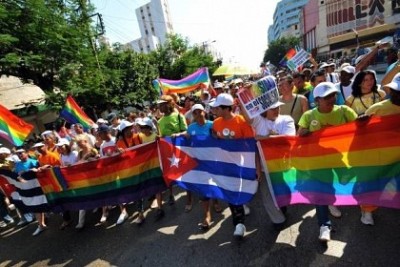
Throughout the 1990s, CENESEX carried out public education campaigns, thescreening of queer films and rallies against homophobia. In 2007, CENESEX ledthe first national International Day Against Homophobia, which has become anannual week-long campaign filled with activities and commemorative acts thatpublicize the state’s intention to eradicate homophobia. Central to their educa-tional campaign is the participation of non-heterosexual and transgender personstrained at CENESEX to carry out workshops on discrimination and HIV preven-tion at workplaces and schools. Following methods inspired by Brazilian Marxistpedagogue Paolo Freire, the activities are based on a needs-assessment defined bythose sectors of society most affected by discrimination. What has become veryvisible through these campaigns is the intersection of discrimination from gender,class, racial and territorial (provincial) perspectives, and a recognition that indi-viduals from poorer areas of the country and places where there is less care and support of LGBT people, are more disadvantaged and have greater complexitiesto deal with in their personal development and integration into society. Throughout the provinces, participants in the workshops have identified theneed to work closely with families, especially in the case of transgender individuals,in order to create a support base in the immediate geographical community(Rodriguez et al., 2008: 105–48). Focus groups composed of transgender personsin urban areas have identified problems related to transphobic attitudes exhibitedby the police force (Castro Espin, 2011). Cuba has begun a process of pathologiz-ing sexist and trans/homophobic society. Including the voices of those traditionallypathologized, along with their communities and families, has constituted a shift inthe geo-politics of knowledge. This is where we can identify striking resemblancesbetween the reconstitution of Cuban social policy regarding the LGBT communityon the one hand, and decolonial thought and practice on the other.
Since 2008, the FCW has advocated for a bill modifying the Family Code,including new articles concerning respect for a free sexual orientation and genderidentity, as well as the legal recognition of same-sex couples. (Castro Espı ´n, 2011a)Cuba also signed the UN Declaration on Sexual Orientation and Gender Identityin 2008, an initiative made by the Republic of France (Worsnip, 2008).
Another institution that has been essential in the work to eradicate trans/homo-phobia has been the Cuban Multidisciplinary Society for the Study of Sexuality(SOCUMES), a professional association that through its working commissionsprovides a scientific framework for national public policy. The Commission forSexual Diversity is an associate organization of the International Lesbian, Gay,Bisexual, Trans and Intersex Association (ILGA) and like CENESEX adheres tothe Yogyakarta Principlesfor the application of International Human Rights inrelation to sexual orientation and gender identity (O’Flaherty and Fisher, 2008).

In January 2012, the Communist Party of Cuba (PCC) held a first-time nationalconference as a follow up to the sixth PCC Congress held in April 2011. In the finaldocument which was approved at this conference, the Party adopted a policy forthe active confrontation of racial, gender, religious, sexual orientation and other prejudices that may give rise toany form of discrimination or limit the exercise of people’s rights, among them publicpositions and those who participate in the political and mass organizations and in thedefence of the country. (PCC, 2012: 6)

This was the first time that a PCC document made an explicit statement concerningdiscrimination as regards to sexual orientation. Paragraph 69 of the same docu-ment speaks explicitly to public policy, encouraging the production of audio-visualmaterials and the orientation of the media, to reflect Cuban reality in all its diver-sity, specifically including sexual diversity the and diversity of sexual orientation(Garcı ´a, 2012). The inclusion of gender and sexual orientation in this clause reflectsthe government’s intention of implementing a social policy favouring the rights of LGBT people within the framework of Cuban socialism.
Contradictions and inconsistencies
The evolution of Cuba’s social policy regarding sexual diversity and self-determi-nation has taken an uneven course throughout its national institutionalpractices. This became evident in November 2010 when the UN GeneralAssembly’s Social, Humanitarian and Cultural Affairs Committee held its biennialvote on a resolution condemning extrajudicial, arbitrary or summary executionsbased upon discrimination. The resolution was amended by a number of Africancountries and supported by Caribbean, Asian and Arab States, alongside theRussian Federation. It sought to eliminate the term ‘sexual orientation’from the document and replace it with ‘discriminatory reasons on any basis(Acosta, 2010). The Cuban delegation voted in favour of the amendment, contra-dicting Cuba’s vote in 2008 for the same resolution. Outraged by this act,a host of Cuban LGBT activists expressed their disenchantment with theMinistry of Foreign Affairs.
SOCUMES, headed by Dr Alberto Roque, together with LGBT activists andrepresentatives from different organizations10 successfully secured a meeting withForeign Minister Bruno Rodriguez Parrilla, who had to explain Cuba’s vote andlisten to grievances. Communist militant and blogger, Francisco Rodriguez Cruz(2010a), pointed out the contradictions between Cuba’s domestic policy and itscompromizing postition in diplomatic manoeuvres. Taking it a step further,Rodriguez Cruz (2010b) stated that professionals and activists had to workharder within Cuba to ensure that all national laws explicitly prohibit andpunish acts of discrimination on the basis of sexual orientation so that the countrycould maintain ‘a leading, coherent and steadfast position at the internationallevel’. One month later, at the 65th UN General Assembly meeting, where theresolution was finally approved, the Cuban delegation read an explanatory notereiterating Cuba’s interpretation of ‘discriminatory reasons on any basis’, whichexplicitly included discrimination against people according to their sexual orienta-tion (Republic of Cuba, 2010).
Scenarios such as the 2010 UN vote and the subsequent debate provideevidence to suggest that sectors of civil society composed of self-identifiedLesbian, Gays, Bisexuals, Transsexuals and Transgender persons are engagedat different levels of the state bureaucracy, combatting the marginalization of these groups in Cuban society and internationally. At the same time, the inter-pretation of official social policy continues to be an arena that presents a chal-lenge to the concept of sexual self-determination and emancipation in thisCaribbean country.
Transgender care and the decolonial epistemic turn 
If the production placement and institutionalization of knowledge to be consideredpart and parcel of the modern world system of hierarchies, at few moments is thismanifested more than in the pathologizing of sexualities by governing bodies of  scientific/medical authority. Until recently, the hegemonic paradigm for the treat-ment and care of non-conforming sexualities and gender identities was dictatedglobally by institutions vested in the medical sciences. By non-conforming we meanthose sexualities and gender identities that conflict with the modern societal normthat adopts the male–female dyad replicated within scientific literature and clinicalpractices. The most important of these institutions is the American PsychiatricAssociation (APA), which, since 1952 has produced the Diagnostic andStatistical Manual of Mental Disorders (DSM), a text widely used as an authori-tative reference for the diagnosing pathology. Due to debates carried out in themedical communities of Western societies, the DSM has seen the elimination, add-ition and re-articulation of pathologies related to gender and sexuality; amongthese, the pathology and de-patholigization of homosexuality and the separatecategorization of ‘gender disorder’ and gender dysphoria in children and adults(Jorge, 2010).
Within the family of the United Nations, the World Health Organization hassince 1948 endorsed the International Classification of Disease (ICD), also a widelyused text, which has likewise gone through various revisions concerning sexualpreferences and gender identities. The ICD, currently the ICD-10, continues touse the term ‘gender identity disorder’ and ‘transexualism’ to classify a variety of psychiatric disorders related to the incongruences between gender identity assignedat birth and identities assumed by children and adults, i.e. gender non-conformity(WHO, 2102). Finally, there is the World Professional Association for TransgenderHealth (WPATH), previously the Harry Benjamin International GenderDysphoria Association, that publishes and updates its non-diagnostic Standardsof Care (SOCs) and Ethical Guidelines for Health professionals but continues todepend on the DSM and ICD for medical reference and WPATH (2012: 4–20).

Throughout the last decade, the first two governing bodies, APA and WHO,which prepared the publication of revised versions of the DMS-V in 2013 and ICD-11 in 2015 respectively, have had their authority questioned by trans-activistsgroups and various professional associations worldwide, including associates of WPATH (Misse and Coll-Planas, 2010: 15–16). With much media attention,these institutions became the target of campaigns by those who reject the path-ologization of their sexualities. A crisis, of sorts, in the hegemonic paradigmadopted by most contemporary societies has opened the stage to new actors chal-lenging those authorities, that have often committed epistemic violence against thesubjects of scientific debate, i.e. those diagnosed, labelled, treated or cared for. 11

In a country where health care is considered to be a human right and thereforecovered completely by the state, all illnesses and perceived threats to health con-sidered by modern Western medicine are to be treated indiscriminately by health-care professionals. This is also the case with what, in Cuba, was previously called‘gender identity disorder’.
In 1979, at the behest of the FMC, the Cuban Ministry of Public Health createda multidisciplinary workgroup coordinated by GNTES – later CENESEX, for thediagnosis and treatment of transsexual persons. After the team conducted an international comparative study in different countries, it recommended that theMinistry of Public Health adopt the standards and protocols of care suggestedby the Harry Benjamin International Association of Gender Dysphoria (CastroEspı ´n, 2011c). In 1988, Cuban surgeons performed their first (male to female) sexreassignment operation. This action caused uproar at different levels of society andmost importantly within the National Health System, which disapproved the med-ical action (Castro Espı ´n, 2008). It was not until 20 years later, in 2004, that asecond sex reassignment surgery was permitted. Between those years, the multidis-ciplinary team took legal initiatives in assisting 13 individuals to change their firstnames and their identity card photos. It was impossible to change their sex onofficial documents, since during that time legal sex was to be determined accordingto the individual’s genitals (Castro Espı ´n, 2008: 24).
In 2004, CENESEX broadened the composition of the multidisciplinary work-group in charge of diagnosis and care for transgender persons, redefining its object-ives and bringing forth a national care strategy. Initially, this workgroup was calledthe National Commission for Gender Identity Disorder Care. But after havingconducted in-depth research in Cuba and other countries, and leading to the con-struction of a national narrative reflecting a Cuban need to depathologize, thegroup changed its name to the National Commission for Integral Care forTranssexual Persons. Mariela Castro (2008) notes:
We can confirm that transsexual people demanded that they be considered healthymen and women, socially responsible and therefore do not accept that they be treatedas people who are ill and much less as a threat to the social order. (2008: 24)
Currently, the Commission is composed of professionals from the various fields of medicine, psychology and the social sciences. The objectives of this Commissionare to: develop the protocol of care and integral health treatment for transsexualpersons; promote interdisciplinary research on dysphoria; develop educationalcampaigns directed at fostering respect and understanding among the public fortransgender individuals; propose a legal mechanism concerning Transcare; and,implement educational programmes for transgender persons and their families. Anational Strategy for Integral Care has been implemented through dialogue andconsultation with the Supreme Court, the Attorney General’s Office, and theNational Organization of Law Firms, as well as political and civil society organ-isations, including groups associated with the Trans community (Castro Espı ´n,2008: 15–43).

From 2004 onwards, CENESEX and SOCUMES began working from the per-spective of Human Rights, as they started to document the testimonies of trans-gender persons who had conflict been in with the law, police agents and reactionaryelements among the civil population in Havana. Many of those who testified andsought help from CENESEX were found in precarious situations. With the par-ticipation of transgender volunteers, CENESEX developed a needs assessment thatset the stage for depathologization. These same transgender volunteers, formed focus groups and became agents within the national educational strategy, settingup committees throughout the country.

Second only to France, Cuba became among the first in the world to depatho-logize transgender and the first in Latin America to incorporate all transgendercare into an equally accessible national healthcare system. Along with this, thepolicies and strategies adopted by the multidisciplinary Commission since 2010reverses pathologization, looking at hetero-normativity, sexist and traditionalhomophobic postures rampantly existing in contemporary society as the rootcause of gender dysphoria. This is what constitutes the decolonial epistemic turnin Cuba regarding social policy on sexual diversity. Both CENESEX and theabove-mentioned host of organs, commissions and civil society organisations con-tinue to work on the complete institutionalisation of depathologization through thelegal recognition of sex and gender change.
The underlying principle, as has been repeatedly recorded in Cuba, is sexual self-determination. It is the subject who should be empowered to decide over his/heridentity as male, female or other, without having any pressure from the medicalcommunity to modify his/her body. The role of professionals is to ‘accompany’ theindividual in his/her process of self-identification and possible change (CastroEspı ´n, 2011c). Education, which becomes a shared task between professionalsand those affected by trans/homophobia, is geared towards the transformationof society through laws, codes and shared values concerning gender and identity.
Global relevance
Writing on transgender care in the Netherlands, Kuyper (2012: 129) concludes thattransgender needs are not sufficiently taken into consideration and that a signifi-cant portion of the transgender population in the Netherlands does not feel suffi-ciently understood by the medical-scientific community and Dutch societygenerally. This is noteworthy, if one considers that the Netherlands is a countryknown for its advances in the treatment and care of transgender persons. Althoughthere is no room here for exhaustive comparisons of countries, assertions such asthat provided by Kuyper make the Cuban experience much more significant. Theepistemic turn in Cuba is remarkable in that the decolonial critique of sexual andgender pathology is now being incorporated into political discourses as well as theinstitutional treatment of transgender people. This process signals an acknowledge-ment and acceptance of sexual diversity on behalf of the representatives of theCuban state, its army of health professionals and sectors of society.
The consensus to depathologize non-confirming sexuality and gender in Cuba,especially transgender individuals, has had a significant impact upon the debatesthat have occurred worldwide, although this is not always recognized by health careprofessionals or activists in mainstream media. Since 2006, CENESEX andSOCUMES have organized an annual Congress on Sex Education, Orientation andTherapy that is attended regularly by scientists, professionals and activists from over30 countries, including representatives from WPATH, which in 2010 finally issued a declaration urging de-psychopathologization among the global medical community,and producing the WPATH (2011) Standards of Care for the Health of Transsexual,Transgender, and Gender Nonconforming People. WPATH President Dr Lin Fraser(WPATH (2012c)) observed that the 2012 symposium was significant in that it pro-vided a synopsis of their DSM, ICD and SOC consensus process, demonstrating theclinical application of WPATH’s evolution and a snapshot of their human rights andpublic policy work. Furthermore, Cuba has proven to be a bridge linking the work of this international association with professional groups and organizations throughoutLatin America and the Caribbean.
Argentina followed Cuba in the depathologization of transsexuals and trans-gender persons but took it a step further in the legislative field, recognizing andrendering complete sexual and gender-self-determination. The 2012 Argentine Lawof Gender Identity recognizes depthologization, allowing for citizens to decide theirown gender identity and thereby entitling them to change their sex on officialrecords by judicial declaration without the need for any medical intervention what-soever (FNLIG, 2012). The changes in legislation have come under the discourse of human rights, citing the Yogyakarta Principles. US-based physician and ExecutiveDirector of Gender Rights Maryland, Dana Beyer, has remarked that ‘[I]t is arecognition of innate human variation, and the ability of human beings to knowthemselves sufficiently, to live free and pursue happiness. It is the new standard forglobal human rights’ (IGLHRC, 2012).
Finally, on 1 December 2012, the APA announced that its Board of Trusteesapproved the publication of the DSM-V to be published in 2013 (APA, 2012). Thisnewly revised edition has proven to be a step forward in the depathologization of transsexuals and transgender persons, replacing the term Gender Identity Disorderwith Gender Incongruence. While applauding APA efforts, WPATH (2012a) akesissuewiththetermGenderIncongruenceasitcontinuestosuggestthat‘congruenceisthenormandthatincongruenceisperdefinitionproblematic,whichisnotnecessarilythe case’. The professional association prefers the term Gender Dysphoria, the termnow used in Cuba, in order to recognize that diagnosis is only needed in cases wheretransgender individuals experience significant distress associated with their gendervariance. The stress is recognized as fundamentally induced by society and culture.

The call on behalf of transgender persons worldwide to healthcare professionals,as well as to legislators and other governmental authorities, to radically changetheir practices and ethics, as Butler has suggested in 2010, found allies in Cuba’snational health care system. As has been demonstrated, this was made possiblethrough a long process of decolonizing knowledge, drawing on a Cuban feministperspective with an emphasis on popular education and the principle of sexual self-determination.

Final considerations
Our intention here has been to provide a conceptual framework for understandingpublic policy on gender and sexual diversity in Cuba and how it was shaped. Key to this study has been the principle of sexual self-determination as a human right,allowing for each individual to define his or her own orientation, condition andgender identity without the stigmatization proposed by psychiatric pathology orthe religious-modern-socio-scientific bloc that until recently has dominated Cubansocialism and its management of sexuality. This process of emancipation, whichhas its roots in Cuban feminism and its influence upon sex education, cannot beseen as an accomplished deed but as an ongoing process that at times finds itself caught in a battle with state bureaucracy domestically and with internationalbodies.Border thinking, the rescuing of epistemologies of subalterns marginalized bymodernity/coloniality science, medicine and law, has, in the case of Cuba, provento be a useful tool in the reformulation of ethics. What the Cuban experience sug-gests is that universal ideas of emancipation and good treatment cannot be exclu-sively contained in definitions provided by Westernized, scientific hierarchies.Contrarily, the solutions to the problematic of non-conforming identities, sexualor otherwise, can be found in a decolonial reading of the institutions and socialrelations that constitute contemporary society. This requires Cuban policymakersto reconsider the political trajectory of the country, recognizing and denouncing thehorrors committed against non-heterosexual communities, and to shed itself of sci-entific dependency on Western pathology and the legacy of Cold War alliances thatbring to the fore inconsistent positions in the area of human rights.The methodology used in educational programmes and in shaping social policyfocuses on the needs assessment carried out among communities and families of LGBT individuals, exercizing the means proposed by Paolo Freire, and reveals thepossibilities that are to be located within the current political framework.Paramount to this work is an intersectional approach that considers trans/homo-phobia to be related to other forms of discrimination; namely of race, class andgender.What we have found is that the changes in social policy and health care practices,which the Republic of Cuba is now undergoing in its legal application of sexual self-determination, has been guided by the narratives of diverse autochthonous groups,educators, social activists and professional health care providers within a highlypoliticized context. Leading figures of the LGBT community saw to it that socialpolicy fell into the framework provided by the country’s ruling Communist Party.For nearly a decade, between the fall of the Soviet bloc in 1990 and the buildingof friendly relations between Cuba and Venezuela since Hugo Chavez’ rise topower in 1999, Cuba was isolated politically. It is interesting to note that preciselyduring this time of seclusion, social policy regulating gender and sexuality madegreat advances in favour of non-heterosexual communities. These developmentsreceived scant attention in academic journals in North America and Europe. Thepoliticized nature by which the case of Cuba has been studied, however, should nothinder the expansion of research on sexuality and social policy in this country.

The authors of this article recommend that rigorous ethnographical research beconducted in order to assess the impact of the changes in social policy and the way  it is experienced by the concerned population in Cuba. This can be done by takinginto consideration the work that has already been achieved by Cuban institutions,which throughout the last two decades have built stronger ties with both scientificbodies that are willing to revise or at least question their own standards, as wellas with LGBT communities internationally. A cross-sectional study of the impactof social policy change, depicting improvement in the quality of life, may prove tobe beneficial in concretizing the notion of sexual self-determination. To this end,the authors also endorse further analysis of the operationalization of new ethicalstandards in clinical practices and research endeavours in Cuba, so as to criticallyidentify areas that need more support in carrying out social and public policy-making regarding gender and sexuality.

Funding
This research received no specific grant from any funding agency in the public, commercial,or not-for-profit sectors.
Notes
1. Also called,
 Libre orientacio´ n sexual e identidad de ge´ nero  [Free sexual orientation andgender identity]. See Castro Espı ´n (2008: 172); CENESEX Code of Ethics: http://www.cenesex.org/socumes/codigo-de-etica-para-profesionales-de-la-sexologia-en-cuba/(accessed 27 July 2014); Declaracio ´n Hombres por la Diversidad para la Vta JornadaCubana Contra la Homofobia: http://hxdcuba.blogspot.nl.
2. Martiano thought refers to the legacy of Cuban national hero Jose Marti, as stated in theConstitution of the Republic of Cuba.
3. In the late 1980s, Canadian intellectual and bioethicist Blye Frank introduced the conceptof hegemonic masculinities to political economy, arguing that heterosexuality and mas-culinity are ‘social accomplishments of political nature located within a larger set of political, economic and social relations’ (Frank, 1987: 160–1).
4. In 1984, Arguelles and Rich argued: ‘The need for a distinctively Cuban socialist counter-critique on behalf of homosexuality is increasingly evident. It must reconcile lesbian andgay male experiences with the island’s realities and offer the international gay communitycritical insights into the immensely complex, rich, expressive and problematic nature of those experiences. Until such a countercritique exists, the manipulation of the Cuban gayissue by anti-Cuban interests will remain largely unchallenged, and homosexual experi-ence will continue to be marginalised within Cuban society’ (1984: 684–685).
5. For a good read on the racialization of sexual practices and codes, see Stolke (1992).
6. The first documented statement on the need to pathologise homosexuality in Cubawas from Dr Luis Montane ´, author of infamous article ‘La Pederastia en Cuba’, whichwas presented at the first Regional Medical Congress of the Island of Cuba inJanuary 1890.

7. It is particularly the influence of Stalinism in both Cuba’s pre-revolutionary Communistparty (PSP) and the political organisations, which were consolidated into the PCC in 1968that is regarded as the source of politically charged persecution of non-heterosexuals inCuba during the first two decades of the revolution. See Roque Guerra (2011) and Evans(2011). Lilian Guerra (2010: 270) provides the counter argument that assault against homosexuality as well as youth culture in general ‘was intrinsically connected to essen-tialist standards of judging what made a citizen ideologically reliable and worthy of inclusion in the category of ‘‘revolutionary’’’. The problem with this line of argument isthat her depiction of totalitarian society leaves absolutely no room for the changes thatare taking place now, which are rooted in debates that can be found throughout theentire revolutionary period. The debates, other than scant mention of denunciations bywell-known public figures in the article’s abstract, are not documented.

8. It might be interesting to note here that in a 2011 interview conducted by the authorsof this article, CENESEX director Mariela Castro Espı´n commented on the absence of aGay Pride parade in Cuba: ‘We do not have a gay pride parade. We make a   Congaa Cuban dance form that is very satisfactory and more pleasuring from a rhythmicand sound standpoint, visualising among the population the need to work-off prejudice.We do not uphold ‘gay pride’ because there is also heterosexual pride, lesbian pride,the pride of trans people, we do not see just gay. We focus the eyes of the population onhomophobia, that is what we believe should be changed; you must unravel homopho-bia in order to articulate the full respect for the dignity of individuals. Furthermore,homophobia is closely linked to other forms of discrimination that LGBT peoplealso experience, namely: racial discrimination, discrimination by geographical area,between those living in rural and non-urban areas, in being an immigrant and notnative, as a non-white person, as a woman, age, etc. Thus, there are many forms of discrimination and we identify homophobia as a form of discrimination that has notbeen sufficiently dealt with, and it is not yet contemplated by international and nationallaw; and where it is recognised, it is not sufficiently treated by law.’ (Castro Espı ´n,2011b).
9. In 2006, in response to well-documented patterns of abuse, a distinguished group of international human rights experts met in Yogyakarta, Indonesia to outline a set of international principles relating to sexual orientation and gender identity. The result wasthe Yogyakarta Principles: a universal guide to human rights which affirm bindinginternational legal standards with which all States must comply. They promise a differ-ent future where all people born free and equal in dignity and rights can fulfil thatprecious birthright: http://www.yogyakartaprinciples.org/principles_en.htm
10. In Cuba there are over 17 organisations and online blogs promoting sexual diversity andproviding service to sexually diverse communities. See CENESEX website: http://www.cenesex.org/.

11. See Manifesto of the International Network for Trans Depathologization, on StopTrans Pathologization: http://www.stp2012.info/old/en/manifest

Comparte este contenido:

EE.UU: Georgia’s governor vetoes bill to allow concealed weapons at public colleges

América de Norte/EE.UU/Mayo 2016/Fuente: Thechronicle/Autora:Katherine Mangan

Resumen: El gobernador, un republicano que ha apoyado la ampliación del derecho a llevar armas de fuego en lugares tan sensibles como bares e iglesias, esperó hasta el último día para anunciar su decisión. Se emitió una orden ejecutiva para líderes de sistemas de la universidad pública del estado para informar acerca de las medidas de seguridad antes del 01 de agosto.

Protesters rallied against the campus-carry legislation last month in Athens, Ga., home of the U. of Georgia. Gov. Nathan Deal said the measure failed to give campuses flexibility to set their own rules.

Gov. Nathan Deal of Georgia vetoed legislation on Tuesday that would have made his state the 10th to allow licensed gun holders to carry concealed weapons in most locations on public-college campuses.

The governor, a Republican who has supported expanding the right to carry guns in places as sensitive as bars and churches, waited until the final day of a 40-day bill-signing period to announce his decision on the politically explosive issue of campus carry.

«From the early days of our nation and state, colleges have been treated as sanctuaries of learning where firearms have not been allowed,» the governor wrote. «To depart from such time-honored protections should require overwhelming justification. I do not find that such justification exists. Therefore, I veto HB 859.»

All of his options on the campus-carry bill carried risks. Sign the law and anger those in higher education who have flooded his office with emails and letters saying they would feel less safe — not more — if guns were allowed on their campuses.

Or veto it and further enrage conservatives who are still stinging about his veto of a «religious liberty» bill that critics said would discriminate against gay people.

If Governor Deal neither vetoed nor signed the legislation by Tuesday, it would have automatically become law.

That’s the approach Tennessee’s governor, Bill Haslam, took late Monday, when a bill allowing faculty and staff members — but not students — to be armed on public-college campuses became law without his signature.

Both governors had expressed misgivings about the bills introduced in their states, and wanted more flexibility for campuses to set their own rules.

The Georgia measure would have allowed anyone 21 or older with a weapons license to carry a concealed gun anywhere on a public-college campus unless the area was specifically excluded. The areas lawmakers carved out for exclusions included dormitories, sporting-event venues, and fraternity and sorority houses.

In the final days of the legislative session, Mr. Deal asked lawmakers to tweak HB 859, to give individual colleges the flexibility to ban guns from campus day-care centers, disciplinary hearings, and faculty and administrative offices. He also expressed concern about the safety of high-school students who are also enrolled in college courses.

Lawmakers refused to change the bill, saying that doing so would gut the intent of the legislation.

Fuente de la noticia: http://chronicle.com/article/Governors-Veto-Wont-End/236343
Fuente de la imagen: https://chronicle-assets.s3.amazonaws.com/5/img/photos/biz/photo_76769_landscape_850x566.jpg
Comparte este contenido:

Higher education and neoliberal temptation A conversation with Henry Giroux

Fuente: Eurozine / 7 de Mayo de 2016

Henry Giroux, Almantas Samalavicius

Higher education and neoliberal temptation

A conversation with Henry Giroux

If the university is to survive, faculty are going to have to rethink their roles as critical public intellectuals, connect their scholarship to broader social issues and learn how to write for and speak to a broader public. Of this much, the cultural critic and doyen of critical pedagogy Henry Giroux is convinced.

Almantas Samalavicius: The neoliberal agenda that came into being a few decades ago in the northern hemisphere, and was eventually globalized, now seems to threaten systems of higher education worldwide. The persistence of this phenomenon has become alarming to many who care about its social consequences. As you have correctly and insightfully observed in your 2014 book Neoliberalism’s War on Higher Education, «a full-fledged assault is also being waged on higher education in North America, the United Kingdom and various European countries. While the nature of the assault varies across countries, there is a common set of assumptions and practices driving the transformation of higher education into an adjunct of corporate power and values». Why is this agenda taking over societies that are so different from each other? What makes neoliberalism so overwhelmingly powerful and resistant to criticism as well as to social action? Why do governments give themselves up to neoliberal ideology, even if they claim to represent quite different ideological positions?

Henry Giroux: For all of its differences, neoliberalism brings together a number of elements that makes it appear almost insurmountable, if not universal, in its ability to normalize itself and convince the rest of the world that there is no alternative as Margaret Thatcher once argued.

First, it has created a new set of power relations in which power is global and politics is local. The financial elite now operate in the global flows of capital and have no allegiance to the nation-state or to the social contract that mediated between labour and capital in the post-war period. This separation points to a crisis of agency on the part of the state and a crisis of politics in terms of the ability to develop social formations that can challenge capital on a global rather than simply a local scale. The nation-state can no longer make concrete decisions on the economic level or create social provisions necessary to limit the effects of the market and offer the most basic services for people.

At the nation level, state sovereignty has been transformed into economic sovereignty. Governments don’t give themselves up, they have been hijacked by the institutions, power and wealth of the global elite. There is no way for states to challenge global forms of governance. We must remember that neoliberalism is very powerful not only because of its economic structures but also because of its pedagogical and ideological power. It not only consolidates wealth and power in different wars for the ultra-rich, it also controls all of those cultural apparatuses and pedagogical sites that function to produce identities, desires and values that mimic the market. In this sense it is a mode of governance that controls all of social life and not simply the market.

As a mode of governance, it produces identities, subjects and ways of life free of government regulations, driven by a survival of the fittest ethic, grounded in the idea of the free, possessive individual and committed to the right of ruling groups and institutions to accrue wealth removed from matters of ethics and social costs. As a policy and political project, neoliberalism is wedded to the privatization of public services, the selling off of state functions, the deregulation of finance and labour, the elimination of the welfare state and unions, the liberalization of trade in goods and capital investment and the marketization and commodification of society. As a form of public pedagogy and cultural politics, neoliberalism casts all dimensions of life in terms of market rationality.

AS: As public higher education withers in a number of countries, either various policies of privatizing higher education are introduced or the logic of the market takes over. More and more universities and other institutions of higher education are being run as if they were large multinational companies seeking immediate profit; politicians and administrators speak out for efficiency, marketability of knowledge, institutional sensitivity and adaptability to the market, etc. What do you think will be the social and cultural price if this tendency continues to retain the upper hand? And do you see any possibilities to resist this global transformation of universities as well as higher education in general?

HG: If this tendency continues, it will mean the death of critical thinking and higher education will simply become another ideological apparatus dedicated to training rather than education, stifling critical inquiry rather than nurturing it – and will narrow if not kill the imagination rather than cultivate it. One consequence will be that knowledge will be utterly commodified, students will be defined in utterly instrumental terms and the obligations of citizenship will be reduced to the private orbits of self-interest, consumption and commodification. This nightmare scenario will reinforce one of the central tendencies of totalitarianism; that is, a society dominated by thoughtlessness, stupidity and diverse modes of depoliticization.

In the United States and in many other countries, many of the problems in higher education can be linked to low funding, the domination of universities by market mechanisms, the rise of for-profit colleges, the intrusion of the national security state and the lack of faculty self-governance, all of which not only contradicts the culture and democratic value of higher education but also makes a mockery of the very meaning and mission of the university as a democratic public sphere. Decreased financial support for higher education stands in sharp contrast to increased support for tax benefits for the rich, big banks, military budgets and mega corporations. Rather than enlarge the moral imagination and critical capacities of students, too many universities are now wedded to producing would-be hedge fund managers, depoliticized students and creating modes of education that promote a «technically trained docility».

Strapped for money and increasingly defined in the language of corporate culture, many universities are now driven principally by vocational, military and economic considerations while increasingly removing academic knowledge production from democratic values and projects. The ideal of the university as a place to think, to engage in thoughtful consideration, promote dialogue and learn how to hold power accountable is viewed as a threat to neoliberal modes of governance. At the same time, higher education is viewed by the apostles of market fundamentalism as a space for producing profits, educating a docile labour force and a powerful institution for indoctrinating students into accepting the obedience demanded by the corporate order.

However, it is crucial to remember that power is never without resistance and this suggests that faculty, students, unions and broader social movements must fight to regain higher education as a democratic public sphere. In addition, it must be made clear to a larger public that higher education is not simply about educating young people to be smart, socially responsible and adequately prepared for what ever notions of the future they can imagine, but that higher education is central to democracy itself.

Without the formative culture that makes democracy possible, there will be no critical agents, no foundation for enabling people to hold power accountable and no wider foundation for challenging neoliberalism as a mode of governance and political and ideological rationality. The struggle over higher education and its democratic misuse cannot be separated from the struggle to undo the reign of markets, neoliberalism and the ideologies informing this savage market fundamentalism. We see this struggle being taken up in precisely these terms in many countries in Latin America, the United Kingdom and the United States. Time will tell if they can spark a global movement to transform both higher education and the political and economic system that holds it hostage.

AS: The American research university has been a model institution of higher education during the last half-century in many places of the globe. Despite the spectacular ascent of multiversity, proclaimed as early as 1963 by Clark Kerr in his famous book The Uses of the University, the production of research is in fact just one of the university’s functions. However, this function is taken for granted and even fetishized. Meanwhile, the teaching and education of informed, responsible citizens, capable of critical scrutiny as well as many of the other tasks of higher education, have been largely neglected and ignored. Do you see this imbalance in the functions of the university as threatening? What are the potential dangers of imagining the university exclusively as a research enterprise that relinquishes any commitment to teaching and cultivating a critical consciousness?

HG: The role of research in the university cannot be separated from the modes of power that influence how research is defined and carried out. Under the reign of neoliberalism and given the encroaching power of the military-industrial complex, research is prioritized and rewarded when it serves the interests of the larger society. In this instance, research becomes armed and instrumentalized, serving largely the interests of powerful corporations or the ongoing death-machine of the military and its corporate allies. Research that matters informs teaching and vice versa. Universities are not factories and should not be defined as such. They are there to serve faculty, students and the wider community in the interests of furthering the public good. When the latter become subordinated to a research agenda that is simply about accumulating capital, the critical, moral and political essence of the university withers and everybody who believes in a democracy is marked for either failure, exclusion or punishment.

The corporate university is the ultimate expression of a disimagination machine, which employs a top-down authoritarian style of power, mimics a business culture, infantilizes students by treating them as consumers and depoliticizes faculty by removing them from all forms of governance. Clearly all of these defining relations produced by the neoliberal university have to be challenged and changed.

AS: Traditionally, the university has been understood as community of scholars and students. However, there are multiple reasons for the university hardly existing any more in these terms. Back in the 1970s, the American social thinker Paul Goodman still articulated a vision of a community of scholars but during recent decades, academics either function simply as obedient personnel afraid to lose their diminishing rights and «privileges» (if there are any at all) or otherwise their collective voice is hardly heard. How can public criticism get back to where it should belong – i.e. in the universities?

HG: The increasing corporatization of higher education poses a dire threat to its role as a democratic public sphere and a vital site where faculty can address important social issues, be self-reflective and learn the knowledge, values and ideas central to deepening and expanding the capacities required to be engaged and critical agents. Unfortunately, with the rise of the corporate university which now defines all aspects of governing, curriculum, financial matters and a host of other academic policies, education is now largely about training, creating an elite class of managers and eviscerating those forms of knowledge that conjure up what might be considered dangerous forms of moral witnessing and collective political action.

Many faculty have bought into this model because it is safe for them and they get rewarded. If the university is to survive, faculty are going to have to rethink their roles as critical public intellectuals, connect their scholarship to broader social issues and learn how to write for and speak to a broader public. Neoliberal modes of governance reinforce the worse dimensions of the university: specialisms, a cult of distorted professionalism, a narrow empiricism, unwillingness to work with others and a mode of scholarship steeped in obtuse and often mind-numbing discourse. All of this must change for faculty or they will not only be unable to defend their own labour as academics, they will continue to lose power to the corporate and managerial elite.

AS: Higher education is intrinsically connected to what is usually termed as a public good, however, as you penetratingly observe «under the current regime of neoliberalism, schools have been transformed into a private right rather than a public good». Do you think it is possible for higher education to reclaim its role in creating and providing a public good or at least providing a setting where a public good might be created? Under what conditions can are universities able to perform such a task? How can they get support from the public? Can one count on public intellectuals at all?

HG: Universities are suffering from a crisis of legitimacy and a crisis of agency. If they are going to regain their role as a public good, faculty, students and other educational progressives are going to have to strongly challenge the current role of higher education. This means that faculty, students and various groups outside of the university are going to have to engage in a range of acts of civil disobedience extending from occupying classrooms to mobilizing larger populations in the street to force the hand of corporate power and its allies.

We saw this happen in Quebec a few years ago and such actions must be repeated on a global level. Public intellectuals are absolutely necessary to participate meaningfully in this role. We rarely hear about them but there are plenty of academics acting as public intellectuals, not only in the liberal arts, social sciences and humanities, but also in the health sciences where faculty are working closely with communities to improve the conditions of the often poor residents who reside in these communities. While public intellectuals can ask important questions, provide a critical language, help write policy and work with social movements, any real change will only come from the outside when social formations, educators and other progressive groups can force the hands of political power, governance and legislation.

AS: Despite higher education’s present orientation toward the market and the reign of an ideology that glorifies the market even in those spheres where it is not supposed to and cannot work, what is your vision of the coming tendencies in higher education during the next decades? Do you expect the present trends concerning the marketization of higher education to be finally reversed? Or will we witness the final triumph of neoliberalism?

HG: I am not optimistic but hopeful. That means, I don’t think progressive change will come by default, but only by recognizing the problems that have to be faced and then addressing them. The latter is a matter of real hope. The cruelty, barbarism and violence of neoliberalism is no longer invisible, the contradictions it produces abound and the misery it inflicts has become extreme. Out of the ashes will hopefully rise the phoenix of hope.

Link original: http://www.eurozine.com/articles/2016-05-04-giroux-en.html#.VywfBucKSeU.facebook
Comparte este contenido:

EEUU: Planned Parenthood Defunded in Kansas

América del Norte/EEUU/Mayo 2016/Autor: Gabriella Dunn/ Fuente: McClatchyDC

Resumen: El centro de Planificación Familiar del estado de Kansas manifestó que recibió una carta de la oficina del gobernador, de dicho estado, en la que les informa que serán retirados los fondos a partir del 10 de mayo del año en curso.

Planned Parenthood says it received a letter from the state announcing that it will be defunded beginning May 10.

The governor’s office, the Kansas Department of Health and Environment and the Centers for Medicare and Medicaid Services did not immediately comment.

“This is an outrageous attempt by Governor Brownback to punish the women and men who have freely chosen Planned Parenthood for their health care for decades,” Laura McQuade, president and CEO of Planned Parenthood of Kansas and Mid-Missouri, said in a written statement.

The state money comes through , which provides health care for low-income and disabled Kansans. Some of the services it covers include annual exams, birth control, preventative care and breast exams. Medicaid does not cover abortions.

Gov. Sam Brownback previously promised to defund Planned Parenthood in his State of the State address in January and cited video images that anti-abortion activists say show Planned Parenthood executives arranging for the sale of fetal tissue and organs for medical research.

He did not apologize to Planned Parenthood when the videographers were indicted a few days later.

Eileen Hawley, the governor’s spokeswoman, said in an e-mail Wednesday that the governor called for this action “in order to protect the unborn and support a culture of life in Kansas. Planned Parenthood has been fully informed of the reasons for this decision, including their own refusal to submit to a lawful inspection of their premises.”

The letter from the Kansas Department of Health and Environment says the order was made at the direction of the governor, through the head of the state health department.

Brownback cited these reasons for taking away Planned Parenthood’s funding: noncompliance with laws, administrative regulations or with providing medical provider information; noncompliance with provider agreements; unethical or unprofessional conduct; and “other good cause.”

Kansas Department of Health and Environment Division of Health Care Finance notified Planned Parenthood of the state’s plan to defund the program in a March 10 letter, which alleges that Planned Parenthood’s Overland Park facility prevented a waste inspector from KDHE from completing a December inspection and photographing certain portions of the facility. The letter notes that Planned Parenthood’s attorneys have rejected this claim.

The March 10 letter also cites the videos from Houston as evidence “that warrant termination of (Planned Parenthood Fedaration of America) PPFA’s Kansas affiliates.”

Lawyers representing Planned Parenthood on April 29 presented arguments about why it shouldn’t be defunded during an administrative review with representatives from the Division of Health Care Finance.

“After a thorough review of all information presented, it is the decision of DHCF (the Division of Health Care Finance) that your participation in KMAP (the Kansas Medical Assistance Program) will be terminated effective May 10, 2016,” the letter read.

A statement from the American Civil Liberties Union of Kansas said 10 other current and former Planned Parenthood medical providers were also terminated.

The statement went on to say that the Centers for Medicare and Medicaid Services does not allow states to exclude providers for offering abortion services.

“Medicaid recipients have the right to receive services from any Medicaid-eligible provider,” the ACLU statement read.

Sen. Laura Kelly, D-Topeka, the ranking Democrat on the Senate Public Health and Welfare Committee, called it an attack on women, saying that it would affect low-income and young women who rely on Planned Parenthood for gynecological services.

“By withdrawing these funds, which were not used for abortions, all you’re doing is taking away primary healthcare for women,” Kelly said.

“If people were truly concerned about reducing the number of abortions they would be enhancing funding for entities like Planned Parenthood and our community health clinics, so that women could get good family planning care,” she added. “The only way we’re ever going to reduce abortions is to reduce the number of unintended pregnancies.”

Troy Newman, president of Operation Rescue, an anti-abortion group, said “hallelujah” when he heard about the announcement.

“Mark my words, this is the beginning of the end of Planned Parenthood,” he said, adding that he foresees federal legal issues for Planned Parenthood.

“Really, the stripping of their money is the least of their worries,” Newman said.

If it disagrees with the decision, Planned Parenthood has a month to formally request a hearing with the state’s Office of Administrative Hearings.

Planned Parenthood announced March 22 that it was expanding access to the abortion pill in Wichita as well as treatments for menopause and HIV prevention medicine along with transgender care.

Fuente de la noticia: http://readersupportednews.org/news-section2/318-66/36698-planned-parenthood-defunded-in-kansas

Fuente de la imagen: http://readersupportednews.org/images/stories/article_imgs20/020916-pp-050516.jpg v

Comparte este contenido:

Hacen falta más maestros minoritarios en las aulas de EEUU

Un informe presentado hoy refleja la brecha entre los estudiantes y los maestros de minorías y propone soluciones para lograr una educación más rica y completa

FOTO: J.EMILIO FLORES / LA OPINION/ POR: MARÍA PEÑA 

WASHINGTON.- Casi la mitad de los estudiantes en las escuelas públicas de EEUU pertenece a minorías pero, al frente del salón de clases, la mayoría de sus maestros son de raza blanca, un síntoma de los problemas relacionados con la diversidad racial que persisten en el país.

Según un informe divulgado este viernes por el Departamento de Educación, la escasez de maestros de minorías en las primarias y secundarias de EEUU impide una buena preparación de los estudiantes para la fuerza laboral del país, cada vez más multicultural y multiétnica,  y refleja además las trabas que persisten para la formación y retención de maestros.

El documento, titulado “El Estado de la Diversidad Racial en la Fuerza Labora de Maestros”, destacó que apenas el 18% de los maestros en escuelas públicas pertenece a minorías,pese a que el 49% de los estudiantes en primarias y secundarias proviene de éstas.

El patrón actual es problemático si se toma en cuenta que, según proyecciones del gobierno federal, el porcentaje de estudiantes blancos bajará del 51% que registró en 2012 a 46% en 2024. Mientras, los estudiantes hispanos pasarán del 24% en la actualidad al 29% en tan solo ocho años.

Los estudiantes asiáticos subirán un uno por ciento al 6% en ese periodo, mienras que los afroamericanos bajarán del 16% al 15%.

El informe del Departamento de Educación fue divulgado en el marco de una cumbre de maestros precisamente para fomentar la diversidad de docentes en las aulas.

¿Quiénes educan a los niños?

La fuerza laboral docente en las escuelas públicas de EEUU sigue siendo homógenea: el 82% de los maestros es de raza blanca, al igual que lo es el 80% de los líderes educativos,y aunque la contratación de minorías va en aumento, no es suficiente para los cambios demográficos en las escuelas.

Hay menos estudiantes de minorías preparádose para ser maestros. Foto: Archivo

Así, el “canal” de maestros afronta una suerte de “avería” en lo que se refiere a la preparación, contratación y retención de maestros minoritarios y,  según el estudio, los problemas comienzan en las universidades, donde hay menos estudiantes negros y latinos en programas de formación de maestros.

Las minorías conforman el 38% de la población universitaria, y sólo el 25% de los que se matriculan en programas de preparación de maestros.

Y los estudiantes minoritarios que se inscriben en esos programas tienen menores índices de graduación que sus contrapartes de raza blanca.  El 73% de los blancos se gradúa de esos programas, en comparación con el 42% de los negros y el 49% de los hispanos.

¿Por qué importa?

El dictamen unánime del Tribunal Supremo en el caso “Brown v. Board of Education”, el 17 de mayo de 1954, condenó las leyes estatales de entonces que establecieron la segregación de las escuelas públicas, y sentó las bases para su integración racial.

Pero este logro histórico del movimiento de los derechos civiles se ve amenazado por patrones de re-segregación racial en las escuelas públicas, sin duda agravada por divisiones económicas.

En ese contexto, el secretario de Educación, John King, dijo hoy que la falta de diversidad de maestros priva a los estudiantes minoritarios de “ejemplos a seguir”,  lo que a su vez afecta los resultados académicos y la integración en los sitios de empleo y en las comunidades.

“Es importante que los estudiantes minoritarios tengan modelos a seguir que luzcan como ellos y compartan experiencia comúnes… que los maestros minoritarios ocupen puestos de liderazgo en sus aulas y comunidades”, dijo King.

Por ello, consideró importante que los estados y distritos escolares tengan apoyo institucional para la formación, contratación, apoyo y retención de maestros minoritarios.

La escasez de diversidad también perjudica a los blancos porque los priva de nuevas perspectivas y entendimiento del cambiante rostro del país.

Para el Instituto Albert Shanker, que se especializa en estudios en este campo, el mayor obstáculo para la presencia de maestros minoritarios en las aulas no está en el proceso de contratación  – nueve ciudades,  incluyendo Los Angeles, tienen buen récord en esa área-sino en el éxodo de éstos de la profesión.

Los maestros minoritarios, en general, están abandonando la profesión no por la calidad u origen de sus estudiantes sino por las condiciones laborales en sus escuelas, según el instituto.

Las quejas principales tienen que ver con “la falta de una voz colectiva en la toma de decisiones y una falta de autonomía profesional en las aulas”, indicó.

Randi Weingarten, presidente del sindicato Federación de Maestros de EEUU (AFT), señaló que el informe de hoy deja en claro que queda mucho por hacer para diversificar aún más la fuerza laboral de docentes.

Andrea Prejean, encargada del programa para promover la calidad de los maestros en la Asociación Nacional de Educación (NEA, en inglés), pidió una mayor inversión de fondos públicos para aumentar el número de maestros minoritarios en las aulas.

Para conocer el informe haga clic aquí

Fuente de la noticia: http://www.eldiariony.com/2016/05/06/hacen-falta-mas-maestros-minoritarios-en-las-aulas-de-eeuu-dice-informe/

Comparte este contenido:
Page 366 of 396
1 364 365 366 367 368 396