Los primeros 72 cursos de formación continua que serán impartidos a más de 15 mil maestros y directores de prescolar, primaria y secundaria que obtuvieron un resultado insuficiente en la evaluación del desempeño, serán asignados mediante contratos “por invitación”, y no por licitación, reconoció el Subsecretario de Educación Básica, Javier Treviño Cantú.
“Este primer proceso es por invitación, y luego, ya para todos los demás, viene por licitación”, destacó el funcionario federal.
Lo anterior debido a que la Secretaría de Educación Pública (SEP), busca tener una oferta inmediata para atender la necesidades de los maestros.
“…lo que queríamos era tener inmediatamente una oferta. Hay un proceso que se está llevando a cabo por invitación a diferentes instituciones de educación superior para que puedan participar en esta primera etapa”, abundó.
Cabe señalar que el pasado 7 de marzo, Aurelio Nuño, titular de la SEP, presentó la Estrategia de Formación Continua de Profesores de Educación Básica y Media Superior, en donde detalló que la dependencia a su cargo invertirá un total de mil 809 millones de pesos para atender las necesidades de formación continua de los maestros, en base a las evaluaciones en el marco de la reforma educativa.
Puntualizó que los cursos que se ofertarán a los maestros serán impartidos por prestigiadas Universidades tanto públicas y privadas, previa licitación de dicho cursos.
La educación –un derecho fundamental de un niño– está en mayor riesgo durante las emergencias.
En la actualidad, los niños ocupan el epicentro de las situaciones de emergencia de todo el mundo. Casi 250 millones de ellos se ven perjudicados por conflictos, y millones más afrontan los riesgos derivados de las amenazas naturales y las epidemias de rápida propagación. UNICEF ha realizado un llamamiento de 2.800 millones de dólares destinados a atender a 43 millones de niños que se encuentran en situaciones de emergencia en todo el mundo. Una cuarta parte del llamamiento está dedicada a la educación.
La educación –un derecho fundamental de un niño– está en mayor riesgo durante las emergencias.
En la actualidad, los niños ocupan el epicentro de las situaciones de emergencia de todo el mundo. Casi 250 millones de ellos se ven perjudicados por conflictos, y millones más afrontan los riesgos derivados de las amenazas naturales y las epidemias de rápida propagación. UNICEF ha realizado un llamamiento de 2.800 millones de dólares destinados a atender a 43 millones de niños que se encuentran en situaciones de emergencia en todo el mundo. Una cuarta parte del llamamiento está dedicada a la educación.
Con el fin de proteger los beneficios de la educación y garantizar un progreso continuado, los niños, y especialmente las niñas, necesitan contar con un acceso permanente a una educación segura y de calidad. Varias estudiantes en una tienda de campaña que sirve temporalmente de clase en el campamento de Al-Takya Al-Kaznazaniya, establecido con la ayuda de UNICEF cerca de Bagdad, la capital.
En épocas de crisis, la educación es esencial durante las situaciones de emergencia. Rauaa, de 12 años, desplazada de Mosul junto a su familia hace más de un año, asiste al primer día de escuela en Harsham, el campamento de desplazados internos de Erbil, Iraq.
Los sirios afrontan la mayor crisis humanitaria del mundo. El futuro de toda una generación de niños y jóvenes –privados de educación– está cada vez más condicionado por la violencia. Fatima (de verde) y su familia escaparon a Homs cuando Palmyra, su ciudad de origen, se convirtió en zona de riesgo.
Las crisis prolongadas que están viviendo algunos países siguen llevándose por delante cada vez más vidas y futuros de gente joven. Las escuelas mantienen a los niños a salvo y protegidos contra los riesgos. Varios estudiantes de tercer grado aprenden árabe en la escuela primaria de Yasin Bay, establecida con la ayuda de UNICEF en la ciudad de El Fasher, en Darfur del Norte, Sudán.
Millones de niños, incluidos los de la República Centroafricana, se ven implicados en conflictos violentos. Alison, una niña de 14 años que vive en Bangui, la capital, vive en un refugio provisional para desplazados internos. Su progreso en la escuela es bueno, pero le preocupa su futuro.
La educación contribuye a que los niños recuperen la sensación de normalidad y las esperanzas de futuro en medio de la violencia, la inestabilidad y el desastre. Unos niños desplazados participan en una actividad organizada en un espacio seguro establecido con la ayuda de UNICEF en el campamento de Dalori, en la ciudad de Maiduguri, Estado de Borno.
La escolarización también proporciona a los niños las destrezas necesarias para construir vidas mejores, más seguras y más sanas para ellos, sus familias y sus comunidades. En el Estado de Palestina, unos estudiantes han recibido material escolar nuevo en la escuela Abdel Rahman Ben Ouf de la ciudad de Gaza, en la Franja de Gaza.
Las crisis de gran escala, como la del brote del virus del ébola en África Occidental, obligaron a por lo menos 5 millones de niños a dejar las escuelas durante meses. En Conakry, Guinea, el control de niños a la entrada de las escuelas forma parte de los nuevos protocolos de seguridad que se pusieron en práctica para reducir el riesgo de transmisión de ébola cuando se reabrieron las escuelas.
En Ucrania, donde los niños han sufrido los mayores efectos del permanente conflicto existente en el país, las condiciones meteorológicas extremas también constituyen una grave amenaza para su educación. Unos niños en la escuela del pueblo de Staromykhailovka, en el frente de batalla, en la región de Donetsk.
Cuando los niños regresan a la escuela, recuperan la oportunidad de lograr un futuro estable. “Es importante ir a la escuela, porque allí haces amigos y después te ayuda a encontrar trabajo”, asegura Michel Lerios, un niño de 13 años procedente de Tanauan, una ciudad de la provincia de Leyte que quedó devastada por el tifón Haiyan. En la actualidad, el niño asiste a clase en una tienda de campaña.
Algunos servicios indispensables, como la educación, ayudan a millones de niños afectados por el conflicto y la crisis a curarse y reponerse de las tremendas adversidades que tienen lugar durante las emergencias. Unas niñas de Tanauan juegan en su escuela, establecida con la ayuda de UNICEF. Las clases se dan en tiendas de campaña o en aulas provisionales o rehabilitadas.
Conozca más acerca del llamamiento de UNICEF para la Acción Humanitaria por la infancia.
Uno de los factores por los que las niñas y adolescentes de Siria y otros países del mundo dejaron de estudiar fue a raíz de la guerra emprendida por EE.UU., que destruyó sus escuelas y hogares.
Se calcula que en el mundo uno de cada ocho niños y niñas de entre seis y 15 años de edad no recibe educación en la escuela. De esta muestra, 63 millones son niñas, y la cifra va en aumento, alertó la Organización de las Naciones Unidas para la Educación, la Ciencia y la Cultura (Unesco, por su sigla en inglés), publicó La Jornada.
En el estudio determinaron que 52 por ciento de esas niñas están en edad de cursar la primaria y no estudian.
Por su parte, 59 millones de niños y niñas que entran en esa categoría, tampoco entran en el sistema de educación formal. De esta cantidad, 31 millones son niñas.
En ese orden, las investigaciones arrojaron que 10 por ciento de las niñas entre seis y 11 años de edad se les niega el derecho a la educación, en comparación con ocho por ciento de todos los niños.
>> Ejército sirio retoma Palmira y continúa avance contra el EI
Los países en donde las niñas quedan fuera de la educación se encuentran en África subsahariana, los Estados árabes, y en el sur y oeste de Asia.
En el caso de la educación secundaria, la Unesco detectó que en 32 por ciento de los países son los varones engrosan la lista de matriculación, mientras que para las adolescentes es de 21 por ciento, en una de cada cinco naciones.
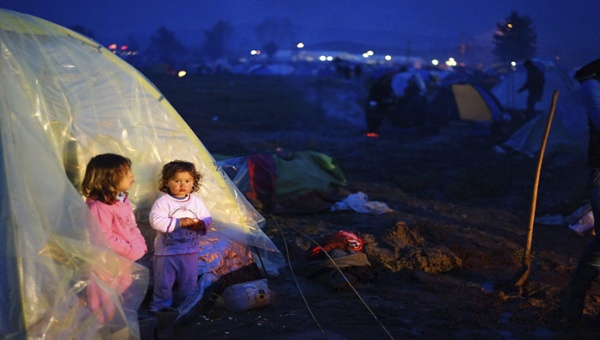
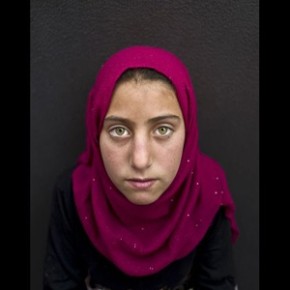
“Todo lo que quiero es volver a mi escuela en Siria”
La niña Yasmeen Mohammed, de 11 años de edad, extraña la vida que llevaba con su familia en la localidad de Ghouta Oriental, cerca de la capital siria, Damasco. También tuveron que abandonarla por la guerra. “Todo lo que quiero es volver a mi escuela en Siria y ver a mis amigos”, dijo el pasado 16 de marzo.
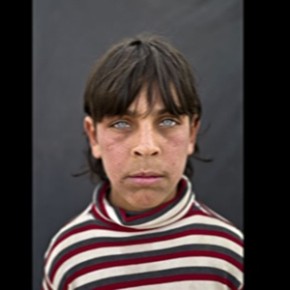
Rakan Raslan, un niño de 11 años de edad, recordó que cuando vivió en la ciudad de Hama, a 50 kilómetros de Homs, en Siria, iba a la escuela y tenía amigos ahí, pero “nuestra casa fue destrozada en la guerra y tuvimos que huir a Jordania”, citó AP.
Él cree que sin educación su futuro es incierto. “Lo máximo que puedo ser es conductor”, indicó.
Solamente en Siria hay casi tres millones de niños sirios sin escolarizar por la guerra de Occidente, de los cuales 700 mil niños son refugiados, reveló la Unesco semanas atrás.
Una madre de cincos hijos, Raddah So’od, que tiene 48 años de edad, manifestó que llegó a Jordania hace dos años, luego de huir de la localidad de Hassakeh, al norte de Siria.
«Dejamos nuestra casa por los proyectiles y las bombas», dijo. «La escuela de mis hijos también fue bombardeada. No queda nada allí para nosotros».
En Jordania tampoco tiene muchas expectativas de mejorar su vida.
Educación secundaria en América Latina y el Caribe
La tendencia en esta parte del hemisferio es que tres de cada cuatro adolescentes que cursan la secundaria logran graduarse.
Pero, los números indicaron que aún con las desventajas para las niñas y adolescentes, ellas continúan con sus estudios, por lo que la probabilidad de repetir grado o dejar por la mitad su formación es menor a la de los varones.
>> Unión Europea y Turquía: el polémico acuerdo contra los refugiados
En 2013, se calcula que 15 millones de ellas repitieron un año en la escuela, frente a los 18 millones de niños.
En el indicador de las niñas que abandonaron la escuela primaria contabilizaron 16 millones, pero niños aumentó a 19 millones.
La organización informó que aunque se ha ampliado el acceso a la educación en todo el mundo, no han superado los números de niños y niñas que no finalizan la etapa escolar.
De hecho, 136 millones de niños y niñas que comenzaron la primaria en 2013, alrededor de 34 millones dejaron los estudios sin concretar la educación primaria.
Las maestras juegan un rol importante
En más de 200 países, las maestras pueden influir de manera positiva en las alumnas en la etapa de aprendizaje.
Entre 1990 y 2013 aumentó de 56 a 63 por ciento las mujeres que trabajan en el área docente.
25 marzo 2016/Naciones Unidas y UNICEF/ Fuente: Prensa Latina. Agencia Informativa Latinoamericana.
Casi 87 millones de niños menores de siete años en el mundo vivieron toda su vida en zonas de conflicto, una situación que afecta su desarrollo cerebral, reveló hoy un reporte de Unicef.
Según el Fondo de Naciones Unidas para la Infancia (Unicef), los primeros siete años resultan clave para el desarrollo cerebral, una etapa en la cual existe el potencial para activar mil neuronas por cada segundo, las que a su vez pueden conectarse con otras 10 mil una enorme cantidad de veces por segundo.
Por tanto, las guerras ponen en peligro el futuro de los pequeños, a partir de su impacto en las conexiones cerebrales, que sirven para definir su salud, bienestar emocional y habilidad para aprender, advirtió la agencia especializada.
Unicef recordó el trauma al que se exponen los menores de siete años cuando viven en escenarios de conflicto, donde la violencia genera estrés y con ello la inhibición de las conexiones cerebrales.
Las consecuencias irreversibles son significativas, sobre todo en el desarrollo cognitivo, social y físico, señaló.
De acuerdo con la experta de Unicef Pia Britto, las afectaciones emocionales constituyen una condición muy negativa, por las cicatrices que dejan.
Los conflictos no solo roban a los niños su seguridad, familia, amigos y rutina de juegos, también sus posibilidades de aprendizaje, con un impacto devastador en la economía y la sociedad, subrayó.
Unicef llamó a multiplicar las inversiones dedicadas a los pequeños, en particular a los azotados por la guerra.
Los niños nacen con 253 millones de neuronas funcionales, pero que su cerebro alcance la total capacidad de mil millones de neuronas conectables depende en gran medida del desarrollo temprano de la niñez, según estudios científicos
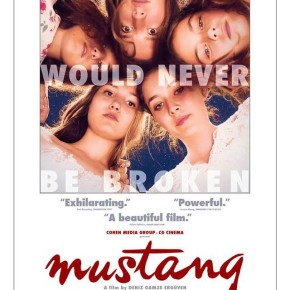
La película de Deniz Gamze Ergüven, nominada al Óscar en 2015, narra la vida de cinco hermanas que viven con su abuela y su tío en Turquía. Las jóvenes se enfrentan a una educación y moral que marcan su destino: una boda pactada por su familia.
24 Marzo 2016/Autor: F. J. F./ Fuente: http://www.diariomedico.com/
La vivencia de un hecho traumático (un accidente, una muerte…) se produce muchas veces como en una nube; en una suerte de realidad paralela en la que se asiste a lo que ocurre pero sin acabar de tomar conciencia de ello.
Salvando las distancias, es la sensación que provoca la proyección de Mustang, el celebradodebut en el largometraje de la joven cineasta Deniz Gamze Ergüven, turca emigrante en Francia. Cuenta la historia de cinco muchachas, hermanas adolescentes y huérfanas que viven con su abuela y su tío en algún lugar de la Turquía de hoy, y que sufren una educación exclusivamente orientada a un casamiento pactado por los adultos.
Cuesta entrar en la película. No se acaba de entender bien el mundo cerrado en el que viven las protagonistas. Y el relato está trufado, en especial en su primer tramo, de referencias demasiado claras (Las vírgenes suicidas, de Sofia Coppola, es una de ellas) y apuntes obvios. Y a ello se suma el recurso, éste ya en todo el filme, a situaciones pocos verosímiles.
No muestra a las claras la cineasta qué busca y, mientras confunde con decisiones como las citadas sobre a dónde quiere llegar, amenaza con quedarse en un discurso feminista de corto vuelo.
Pero poco a poco el relato va envolviéndole a uno. Al principio, de una manera sutil, entre las dudas ya expresadas. Luego de un modo más concreto. Es como si cada nueva reja que los adultos colocan ante las ventanas de la casa para evitar las salidas sin permiso de las chicas (o como cada visita nocturna del tío a la habitación de una de ellas) fuera reduciéndole el suministro de aire al espectador y aprisionándole como a las mismas protagonistas.
«El infierno es la imposibilidad de la razón», afirmaba el protagonista de Platoon, la película con la que Oliver Stone echaba las muelas con brillantez contra el absurdo de Vietnam. El joven veinteañero, universitario que se alistaba voluntario merced a un tan sincero como inocente espíritu patriótico, representaba él mismo el sinsentido de aquel sangriento galimatías, aquel horror irracional.
Vuelve a la mente
al ver Mustang. Y tal parece revelarse el objetivo de la directora y coguionista (ha colaborado en el libreto con la guionista y directora Alice Winocour). No se acaba de entender que unas chicas guapas, que ríen, se mueven, visten y reaccionan como cualquier muchacha de una ciudad española se vean sometidas a un trato y unos usos de épocas pasadas. Son ese desconcierto y esa incredulidad ante tan incomprensible contraste los que alimenta la cineasta, consciente de la potencia sugerente de lo que no se muestra y de las lecturas que extramuros ofrece un filme que transcurre en la Turquía que aspira a formar parte de la moderna Unión Europea y que se refiere a unas prácticas de autoritarismo y sometimiento a la mujer propios de unas costumbres que ganan presencia en el continente.
No necesita mostrar los aspectos más terribles de un drama que las jóvenes parecen vivir al principio casi como un juego del gato y el ratón con unos adultos que no las comprenden.Poco a poco irán tomando conciencia del alcance de su tragedia, al tiempo que lo va haciendo el espectador, envuelto como ellas en esa atmósfera irreal, como de cuento de hadas, que cubre todo el relato.
La directora se acoge a esa cualidad casi fantástica para recurrir a salidas poco verosímiles, como se ha dicho, o para componer planos rebuscados, que son tan reprochables como su pesimismo, que ni siquiera la condición metafórica parece justificar.
Pero su historia cala, conmueve y deja huella. Es al final, tras el precipitado y excelente desenlace y cuando la pantalla funde a negro, cuando uno sale de su ensueño y toma conciencia de lo que ha visto. Y ahí quedan, largo tiempo, el estupor y la angustia que deja esta imperfecta y escalofriante película.
Ficha
Título original: Mustang. FR/Tur/Ale., 2015.
Dirección: Deniz Gamze Ergüven.
Guión: Deniz Gamze Ergüven y Alice Winocour.
Fotografía: David Chizallet y Ersin Gok.
Música: Warren Ellis.
Intérpretes: Günes Sensoy, Doga Doguslu, Tugba Sunguroglu, Llayda Akdogan, Elit Iscan.
Dulmar Pérez. Candidata al Doctorado Pedagogía, Magister en Docencia Universitaria, Especialista en Docencia para la Educación Inicial. Ha publicado artículos internacionales y nacionales PEII-A Investigadora adscrita al CIM. Coordinadora CNIE en Barinas.
What the studies say about early childhood education
MotherJones/04-03-2016/Por: Kristina Rizga
Resumen: Liberales de California y New York y conservadores de Oklahoma y
Florida apoyan la idea de una reforma educativa en la educación de la
primera infancia, así lo deja ver una encuesta realizada hace días, donde
se mostró que el 76 por ciento de los encuestados expreso estar de acuerdo
con gastar dinero federal para ampliar la educación pública de la primera
infancia. En el artículo David Kirp, uno de los principales expertos en
educación infantil y profesor de políticas públicas en la Universidad de
California-Berkeley, dijo que otorgar el acceso a los preescolares a los
niños más necesitados es una política que debe implementarse en el país,
debido a los beneficios que otorga a lo largo de la vida. Un estudio
realizado en la Universidad de California por dicho investigador, así lo
demuestra, en el que los niños que entran a los preescolares o reciben
educación en la primera infancia son mucho más propensos a tener mejores
calificaciones y resultados de exámenes y más probabilidades de ir a la
universidad. Otro estudio similar se inició en 1972, denominado Proyecto
Abecederian, dándose seguimiento a 111 recién nacidos en Carolina del Norte
hasta que éstos tuvieron los 35 años de edad; en este particular el
análisis lo propicio el economista Steve Barnett, quien calculo que cada $1
que el gobierno invierte en la educación de alta calidad puede llegar
ahorrar más de $7 más adelante al aumentar las tasas de graduación,
reducción de embarazos y la delincuencia. Por su parte, el profesor de
trabajo social de la Universidad de Columbia, Jane Waldfogel, evaluó
resultados de pruebas de 8000 estudiantes en los Estados Unidos y encontró
que había una enorme brecha en las habilidades de lectura en niños que
habían empezado la escuela a temprana edad antes de niños. Marjorie
Wechsler, otro investigador de educación de la primera infancia encontró
que los docentes de preescolar tienen estudios universitarios con
conocimientos especializados en el desarrollo del niño, utilizan el
currículo enfatizando más en el juego hacia la resolución de problemas y
saben cómo enseñar habilidades cognitivas, sociales, emocionales y físicas
en los niños. Sin embargo, pese a estos estudios, existe un grupo de
oponentes que apuntan a elementos que contravienen el impacto del
preescolar en la primera infancia, asociado a factores determinados por las
pruebas que miden las habilidades de alfabetización, lenguaje y
matemáticas, que en algunos estados como Tennessee no han dado buenos
resultados. No obstante, para los estados unidos la idea de destinar
recursos presupuestarios a la educación en la primera infancia responde a
estudiar las cifras de inversión, las cuales varían entre $8000 y $1000 por
estudiante, y en muchos casos responde a intereses de los gobernantes de
los estados.
It’s hard to think of another education reform idea that has garnered as
much support among advocates of various ideological stripes as early childhood education.
California and New York liberals support it, and so do conservatives in
Oklahoma and Florida. A 2015 national poll by First Five Years Fund showed that 76
percent of voters support the idea of spending federal money to expand
public preschool, and the new federal Every Student Succeeds Act includes more
funding for early childhood. Helping the idea along is decades of research
(which continues to pour in) that suggests effective preschools can benefit all
children, especially those from disadvantaged backgrounds. «We have better
evidence that preschool works and has long-term effects than we do for any
other social policy,» David L. Kirp, one of our country’s leading experts on early childhood education and a professor of public policy at the University of California-Berkeley, told *Mother Jones*.
But can we identify what a good preschool looks like and make that
accessible to the kids most in need? That topic has been debated fiercely
by parents, preschool advocates, and policymakers all over the country.
This week, early childhood education experts and city chiefs of preschools came
together in Sacramento, California, to talk about the latest research.
As presenter Abbie Lieberman, an early-education policy analyst at New
America, put it: «When we step into a preschool, how can we tell what is
actually learning through play and what is true chaos?»
What the Studies Say:
The growing pile of evidence on the long-term benefits of high-quality
preschool stretches all the way back to a 1961 Perry Preschool Study. Researchers at the High
Scope Educational Research Foundation decided to follow 123
three- and four-year-olds from public housing projects in Ypsilanti,
Michigan. Fifty-eight toddlers were randomly placed in a preschool class
for two years; 65 kids from the neighborhood were left without preschool.
Researchers then collected data on the students until they turned 40—an
astonishingly long time in education research. They found that the kids in
preschool were much more likely to have better grades and test scores and
more likely to go to college, earn a higher income, and own a house. In
fact, their income and other assets pushed them well above the poverty
line, as Kirp documents in his book, *The Sandbox Investment*.
A similar study started in 1972, the Abecederian Project.
It followed 111 infants in North Carolina until
they turned 35. The results were similar, piquing the interest of
economists. Steven Barnett , a professor of economics and the executive director of the National Institute
on Early Childhood Research, eventually calculated that every $1 the government invests in high-quality early
education can save more than $7 later on by boosting graduation rates,
reducing teen pregnancies, and even reducing crime. Such arguments about
long-term savings made preschool appealing to conservatives and big
philanthropists in the business world.
More recently, other scholars were able to show the disparities between
students who had some form of early childhood education and those who
didn’t. Jane Waldfogel , a professor of social work and public affairs at Columbia University and the
author of *Too Many Children Left Behind,* looked
at the test scores of 8,000 students in the United States and found there
was a huge gap in reading abilities before kids even arrived at first
grade. «If we are going to give teachers a fighting chance at narrowing our
achievement gaps later in school, our kids have to come in more equally
prepared,» Waldfogel told *Mother Jones*.
So What Does a Good Preschool Look Like?
Marjorie Wechsler, an early-childhood-education researcher at the Learning Policy Institute , recently
synthesized research from a number of preschool systems and identified 10 common foundational
building blocks among programs that demonstrated positive impacts on a
variety of measures. Wechsler, who presented her findings in Sacramento,
found that the best preschools have college-educated teachers with
specialized skills in child development; they also use curriculum that
emphasizes problem-solving rather than unstructured play or
«repeat-after-me» drills. Successful educators know how to teach cognitive,
social-emotional, and physical skills. Plus, high-quality preschools
support their teachers with experienced coaches, and classroom sizes don’t
get bigger than 10 kids for every teacher.
The Roadblocks:
While expanding preschool for low-income students might have garnered more
advocates than almost any other school reform idea in the country, there
are inevitable problems: Grover J. Whitehurst, a senior fellow at the
Brookings Institution, has pointed out that
studies like the Perry Preschool research have only looked at small school
programs that are difficult to replicate on a large scale. Other opponents
point to a recent large-scale study looking
at the impact of Tennessee’s state-funded preschool; the study found that
by second grade, students who attended preschool actually performed worse
on tests measuring literacy, language, and math skills. The researchers,
however, blamed in part repetitive, poorly structured teaching for these
results.
Steven Barnett, the director of the National Institute of Early Education
Research, argued in the *Hechinger Report* that
the Tennessee study mostly provides additional evidence that preschool on
the cheap doesn’t work. Perry and Abecedarian students had
highly trained and well-paid teachers, and these programs cost about $14,000 to
$20,000 per child in today’s dollars, compared with $4,611 that Tennessee
spends currently.
And unsurprisingly, the numbers and research bolster Barnett’s point: The
strongest preschools have been well funded—some estimates vary
between $8,000 and $10,000 per student. Barnett pointed to New Jersey,
Boston, and Tulsa, Oklahoma—places that spend energy and money on highly
trained teachers, coaching, and strong curriculum—as examples of where
governments are serving children well.
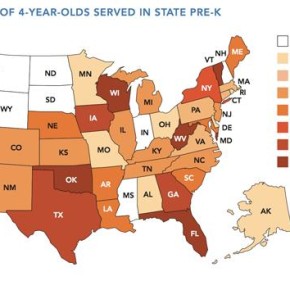
Image courtesy of the National Institute of Early Education Research
Is There Hope?
The dollar figures show the United States has a long way to go. While the
city of Boston spends $10,000 for each preschooler, in 2014 the average
expenditure, nationwide, was $4,125 of government spending per kid. That’s not much more
than the government was spending a decade earlier.
The good news is that after years of dismal cuts following the recession, a
movement to increase funding and enrollment for preschool is regaining its
momentum—driven mostly by local and state policymakers. What’s more, both
the federal Every Children Succeeds Act and California’s state budget
include more funding to increase the number of low-income kids in high-quality
preschools.
Getting the United States all the way to universal preschool, of course, is
a long road. The nation ranks 30th out of 44 for preschool enrollment among developed nations; 66 percent
of American four-year-olds went to preschool in 2012. Of those, only 13
percent of low-income children were enrolled in high-quality early
childhood programs, according to a study by RAND Corp.
«Six years ago, we started talking about what does quality look like? How
does it work?» Camille Maben, the executive director of First 5 California,
a state agency, said at the end of the Sacramento
gathering. «We know now that quality works in all kinds of different ways.
One size truly does not fit all. But when there are so many of us, changes
are like turning an elephant in the bathtub. It’s an enormous challenge.»
Con esta entrevista continua la segunda temporada (2015) de las entrevistas sobre calidad de la educación que realiza el profesor Luis Bonilla-Molina. En el 2015 las entrevistas iniciaron el abordaje de la relación de calidad de la educación con las reformas y contrarreformas educativas que se implementan a nivel mundial. Igualmente respecto a las propuestas y modelos de evaluación de los sistemas educativos a nivel internacional, así como respecto a agendas emergentes en el debate educativo mundial. Constituyen un esfuerzo de investigación y de pedagogía política sobre las transformaciones educativas a escala planetaria. El trabajo colectivo es de un equipo de voluntarios en toda Venezuela quienes forman parte del Centro Nacional de Investigaciones Educativas (CNIE).
Entrevistado(a): Gary Anderson / Nuevo México, Albuquerque, Estados Unidos
Perfil del Entrevistado(a): Ex maestro de escuela intermedia y secundaria y director de escuela secundaria. En el periodo 1982-1984 fue director de escuela secundaria en el Colegio Americano de Puebla. A nivel universitario ha impartido cursos sobre las políticas educativas, liderazgo educativo, investigación cualitativa, investigación-acción, el análisis del discurso, teoría de la organización, la política de educación, desarrollo docente, la promoción de Educación y el papel del director de la escuela.
Se interesa en la investigación interdisciplinaria. Está particularmente interesado en hacer investigaciones en el marco de las tensiones entre la teoría y la práctica en la educación. Como resultado de este interés, es coautor de dos libros de Investigación Acción (Anderson, Herr, y Nihlen, 1994; Herr y Anderson, 2015), y ha escrito extensamente sobre temas de producción de conocimiento. Su trabajo más reciente es en el campo de las políticas educativas. Está interesado en la investigación educativa focalizada en los problemas de movilización política y el conocimiento en general. Acaba de publicar un estudio sobre la nueva gobernanza y las nuevas redes de políticas centradas en grupos de trabajo de educación a través de la American Legislative Exchange Council (ALEC) y actualmente está trabajando en un estudio de la Red de Políticas de Estado y su impacto en la política educativa.
Ha publicado ampliamente en el campo de Liderazgo Educativo. Su trabajo intenta reorientar los análisis en el campo educativo a través de la utilización de teorías críticas y postestructurales. También ha realizado investigaciones sobre la micropolítica de la organización escolar, y más recientemente sobre la privatización de las escuelas y el impacto del neoliberalismo mundial sobre la educación. Ha recibido dos premios Fulbright. Una preocupación central de su investigación ha sido la dimensión simbólica del liderazgo educativo y las formas mediante las cuales los administradores «gestionan los significado» Su tesis doctoral fue un estudio etnográfico sobre los directores de escuela en la que desarrollo un modelo que explora cómo los administradores median demandas políticas de manera vertical, así como horizontalmente ocurre entre los profesionales de la escuela y la propia comunidad escolar. (Anderson 1989, 1990). Esta investigación se orienta a la comprensión de la micropolítica de la escuela.
Entrevistador Luis Bonilla-Molina
Perfil del Entrevistador: Docente con 36 años de labor pedagógica. Coordinador de la Red Global/ Glocal por la calidad educativa
LUIS BONILLA-MOLINA: ¡Bienvenidas y bienvenidos todos y todas a esta nueva edición de “La otra mirada educativa”! En esta oportunidad conversaremos desde Albuquerque, Estados Unidos, con Gary Anderson. Gary es escritor, académico, pedagogo, profesor del Departamento de liderazgo, política educativa y tecnología de la Escuela de Cultura de la Universidad de New York en los Estados Unidos, además es un prolífero investigador sobre el tema del cambio educativo, sobre el tema de la reforma educativa; con muchas publicaciones en el área. Bienvenido Gary, a este contacto en “La otra mirada educativa”.
GARY ANDERSON ¡Gracias por la invitación!
LUIS BONILLA-MOLINA: Gary, tú has trabajado en los últimos años el tema de las reformas educativas, de los cambios educativos. Comencemos por esa parte: ¿Que es una reforma educativa? Porque cada quien tiene una visión muy particular de lo que es una reforma. Para ti ¿Qué es reforma educativa?
GARY ANDERSON: En realidad hemos estado reformando desde hace varias décadas, así que,
el tema se ha convertido en una especie de industria continua. Se supone que una reforma es así, apenas se termina una y luego surge otra reforma sin que se evalúen sus alcances; por lo que parece que es una cosa continua en sí misma. Considero Luis que el tema sobre la calidad educativa que desarrollaste en la primera temporada de entrevistas en el año 2014, resulta muy importante para poder responder tu pregunta. Fue en los años 80, cuando por lo menos aquí en los Estados Unidos, las reformas empezaron a desarrollarse de manera más estructural a partir del reporte que se llamó “Un país en riesgo”. En este documento se construyó una especie de idea socialmente aceptada respecto a que el fin de la educación era la competencia internacional y que la educación estaba al servicio de la economía. A partir de ese momento empezamos a pensar en los estudiantes como capital humano que tenemos que desarrollar para competir. En esa época la mirada estaba centrada en Alemania y Japón, ahora en La India y China. Comenzamos a elaborar una definición de calidad educativa muy vinculada al paradigma cuantitativo. A partir de esta definición se pretendió hegemonizar la idea que la calidad educativa se podía medir a través de exámenes estandarizados. Ahora tenemos internacionalmente expandidas en varios países las pruebas PISA, con exámenes parecidos. Entonces, en sus orígenes la reforma, fue en realidad una preocupación por la calidad de la educación pública y su capacidad de formar capital humano. Eso fue en realidad -en resumen- el inicio del ciclo de las reformas que hoy conocemos.
En realidad en muchos países hubo un despertar del interés respecto a las desigualdades expresadas en la educación pública; o sea, el problema no era tanto la educación pública en sí, sino la educación pública que recibían los sectores de menores ingresos, sectores en pobreza. Eso ocurrió también en los Estados Unidos. Hubo debates respecto a precisar en qué consistía la crisis: si la crisis era la crisis de la educación pública y su capacidad de formar capital humano, o si la crisis se expresaba en lo desigual o lo segregadas que eran las escuelas públicas; sobretodo, racialmente aquí en los Estados Unidos.
LUIS BONILLA-MOLINA: Has señalado que el discurso de la reforma educativa se inicia con el debate de la calidad, a partir de eso, ¿Cómo definirías calidad de la educación o qué es calidad? Porque es un término polisémico, al cual cada quien le da una connotación, según el punto de vista ideológico, político, económico; pero para ti, cuando hablamos de calidad de la educación, ¿De qué estamos hablando?
GARY ANDERSON: Bueno, idealmente, creo que la calidad de la educación tiene mucho que ver con la equidad. En valorar si todos los chicos están recibiendo una educación buena, tanto los chicos pobres como los chicos ricos.
En Latinoamérica en un primer momento hubo bastante énfasis sobre al acceso a la educación. Después la calidad de la educación que se estaba recibiendo se convirtió en una preocupación. En ese sentido, se lograron avances en algunos países con las políticas sociales vinculadas a la permanencia de los estudiantes en los sistemas escolares, como es el caso de las llamadas bolsas familiares. Esa idea de dar ayuda a las familias pobres ha posibilitado un aumento del acceso. Cada vez más chicos están llegando a la escuela y ahora existe el problema de la calidad educativa. En ese sentido es un avance que estamos empezando a mirar más la calidad.
Pero cuando definimos la calidad educativa, tomando solo en cuenta cómo salen los chicos en exámenes estandarizados; eso tiende a distorsionar un poco la realidad de la calidad educativa en el aula. Los docentes que son sometidos a estas presiones y deben aplicar los exámenes estandarizados empiezan a enseñar de otra manera; de una manera menos creativa, más memorizante, etc. Así que, considero que la calidad educativa realmente debería consistir en mayor preocupación por dar una educación relevante a las comunidades, a los alumnos. Una educación de calidad debería posibilitar que los alumnos se puedan ver así mismos reflejados en el currículo, que el currículo sea motivante para todos los chicos. Esto lo digo porque ahora hay un currículo bastante estandarizado para todas las comunidades. No importa la idiosincrasia de las comunidades, las experiencias de los estudiantes. Así que yo creo que una definición de calidad educativa debe ser más integral, mucho más compleja, que algo que se puede medir a través de un examen.
LUIS BONILLA-MOLINA: Como señalabas desde hace décadas, se inicia una especie de carreras por las reformas educativas. Cada vez son menores los ciclos de duración de esa reforma, pero ¿Quién evalúa las propias reformas?
GARY ANDERSON: ¿Quién evalúa a los evaluadores de las reformas? Porque eso es un poco de lo que estoy hablando, que las reformas están utilizando herramientas un poco débiles para evaluar. Estoy refiriéndome a los exámenes estandarizados, no sé si en Venezuela hay tanta obsesión con los exámenes; estoy pensando más bien en Chile y ahora más en México.
Considero que no se puede entender la reforma educativa sin entender los cambios de la economía política mundial en los últimos 30 años. Hay que tener una macro visión de los cambios para entender las micro reformas que ocurren en las escuelas y en las aulas. Mi trabajo de investigación ha estado orientado a tratar de entender, no tanto cuales han sido los cambios económicos que estos macro cambios económicos mundiales han generado. Cambios económicos que en realidad derivan en un ataque sobre el sector público en muchos países, expresados en la privatización y la marketización del sector público. Insisto, los cambios en la economía mundial han derivado en un intento de explotar económicamente al sector público con fines de lucro, pero también hay efectos políticos y culturales, esos son los efectos que estudio. Es decir, cuáles son las nuevas formas de gobernanza que han surgido a partir de estas nuevas redes políticas y nuevos actores; actores que por cierto no tenían un papel relevante en la educación hace 30 años. Estos cambios afectan directamente a la vida cotidiana del docente. Me interesa conocer cómo el docente vive la nueva cultura de la escuela, una cultura de constante evaluación por exámenes que han modificado un poco el concepto de cada uno de nosotros como profesionales de la docencia.
Hay un nuevo profesionalismo que está menos regido por las normas clásicas de la profesión y sus organizaciones profesionales; y ahora aparece mucho más regido por las reformas, por la cultura de los exámenes y lo que llamamos acá la accountability o rendición permanente de cuentas.
Así que creo que hay que tener una visión mucho más amplia de las reformas y conectarlas con los cambios que están ocurriendo en todo el mundo. Estamos estudiando ahora Inglaterra, Estados Unidos y Chile, porque son tres países que tempranamente adoptaron políticas neoliberales de mercado: Inglaterra bajo Thatcher, acá en los 80 con Reagan y en Chile con Pinochet. Hay paralelos importantes entre esos tres países y en ese sentido, por contraste, es importante Suramérica que es el lugar en el mundo donde varios países han rechazado esa tendencia de las reformas. Considero que es importante comparar países como Chile donde la reforma neoliberal ha sido bastante arraigada, donde tienen un sistema bastante marketizado y un país, digamos, como Argentina que rechazó la mayoría de esas reformas. Conozco menos de Venezuela, pero supongo que Venezuela también es un país en el cual no han entrado con mucha fuerza la perspectiva neoliberal de la educación. Así que creo, que hay mucho trabajo importante en Suramérica, para entender y comparar países que han adoptado diferentes reformas y cómo han sido sus resultados.
LUIS BONILLA-MOLINA: Señalabas que hay nuevos actores en el tema educativo. Recientemente, el 9 de julio, 233 educadores de 34 países entregaron una carta a la Directora General de la UNESCO, Dra. Irina Bokova, en la cual expresaban la preocupación del riesgo cierto que se genere un Apagón Pedagógico Global ante la mercantilización de la educación. Cuando hablas de esos nuevos actores ¿Te estás refiriendo a los organismos económicos, te estás refiriendo a las comunidades, a quiénes te refieres, cuando señalas nuevos actores?
GARY ANDERSON: Me referiré más al contexto de los Estados Unido que es el que más conozco y creo que eso varía de país en país. En el pasado los educadores teníamos mucha influencia en la aplicación de las reformas educativas, o sea, los sindicatos, las asociaciones profesionales, los sectores académicos, mayormente influían en la educación. Diría que desde los años 30 hasta los 70 los actores principales éramos los educadores, los sindicatos y las asociaciones profesionales. Desde los 70 y 80 empezaron a entrar unos nuevos actores, como por ejemplo la filantropía de riesgo (Veneture Philanthroppy), el Sr. Bill Gates por ejemplo, que es el caso que todos conocen. Esos billonarios, millonarios, que con su dinero ahora pueden influir en las políticas públicas. Por ejemplo, Gates aquí en los Estados Unidos ha sido responsable de muchas reformas; acaba de donar 200 millones de dólares para promover lo que se llama básicamente el Currículo Nacional que ha promovido el propio Gates.
Entonces uno de los nuevos actores son estas personas con mucho dinero que pueden usar ese dinero para influir en las políticas públicas. Otros actores son los llamados Think Tank (Tanques de pensamiento), que normalmente tienen un sesgo socioeconómico, típicamente a la derecha, aunque hay también algunos de izquierda. La mayor cantidad de dinero para apoyar el trabajo de esos Think Tank viene de conservadores para promover ideologías; y en algunos casos, hasta se sientan con los líderes de las corporaciones a escribir leyes sin pasarlas por la magistratura.
Otro actor nuevo sería las Charter Schools que en algunos países tienen diferentes nombre, en España, Escuelas Concertadas, en Inglaterra ya son academias. En realidad son grupos de escuelas, que son públicas en el sentido que reciben fondos del gobierno, pero en realidad operan como si fueran escuelas privadas. En algunos países son escuelas subsidiadas por el gobierno, tanto como en Chile y Argentina, cuyo ejemplo ilustrativo son las escuelas católicas que aun teniendo subsidios estatales pueden cobrar mucho.
Otros actores serían los Comercios – business, los llamamos acá- que son corporaciones grandes que ahora venden productos educativos a los Distritos Escolares, tipo Universidades Privadas. Son empresas con fines de lucro que ahora han entrado en el mercado de la educación superior; sobre todo en países donde las universidades públicas no alcanzan a cubrir las necesidades educativas de la población, como Brasil, por ejemplo, y esos actores nuevos forman redes, están intercomunicados entre ellos.
Otro actor son las Consultoras (Consultans) que son muy importantes ahora en Inglaterra, que son las personas que van de país en país como expertos que asesoran a los gobiernos sobre las reformas educativas.
Y por supuesto, están también las organizaciones internacionales como el Banco Mundial, el Fondo Monetario Internacional (Internacional Monetary Fund) y la Organización para el Desarrollo Económico de Europa (OCDE), por ejemplo que también promueven reformas. Por ejemplo, leí el informe que salió de la OCDE sobre México hace unos años y ahora Peña Nieto está implementando en ese país una reforma educativa con una clara y directa influencia de esa organización.
Entonces esos actores, esas redes políticas globales, tienen cada día una mayor influencia sobre la reformas educativas, muy superior a las que conservan los actores tradicionales como los maestros. Por ello, los docentes, están empezando a organizarse porque están viendo que las reformas propuestas por estos grupos tienen poco entendimiento de las realidades de las escuelas y las aulas; y por lo tanto, en realidad, en lugar de mejorar -aunque tengan buenas intenciones- no tienen suficiente conocimiento de las realidades educativas para hacer reformas eficaces.
LUIS BONILLA-MOLINA: Gary, ¿Cuáles son las líneas centrales de la reforma Educativa que implementa la Administración Obama en la actualidad en los Estados Unidos?
GARY ANDERSON: Claro son esas. Lo que pasa con esas redes políticas es que están asociadas a ambos partidos políticos, tanto a los republicanos como a los demócratas. Bill Gates es un demócrata que influye sobre Obama y Arne Duncan, que es la actual Secretaria de Educación Pública. Lo mismo sucede en Inglaterra con el Partido Laborista (New Leber), también apoya las mismas reformas que impulsan los conservadores.
Por eso los sindicatos de los docentes se sienten un poco aislados de ambos partidos que están más influenciados por esos nuevos actores político educativos. En algunos casos son actores políticos con buenas intenciones, preocupados porque la calidad de educación pública dirigida a los chicos pobres no es buena y señalan que hay que hacer algo al respecto. Como ellos han tenido éxito en el mundo de los negocios, suponen que es positivo manejar más a la educación como un negocio. Para ellos la relación perspectiva gerencial y la educación tiene sentido. Para ellos tiene sentido práctico que una escuela se maneje como un negocio, así como tiene sentido que las escuelas compitan entre ellas por alumnos y docentes, etc. Para estos nuevos actores económicos en la educación, las instituciones escolares deben comportarse más y más con la lógica del mercado. En consecuencia consideran que los sistemas educativos deberían medir los resultados escolares en una forma cuantitativa como miden los ciclos productivos en sus fábricas.
El problema es que la transferencia de esas ideas del sector de los negocios al sector de la educación requeriría en el mejor de los casos, una traducción y una reflexión muy intensa. El centro de actividad de lo que hace un negocio y el centro de acción pedagógica de una escuela son muy diferentes. En un negocio tiene sentido eliminar la varianza de producto; en educación tenemos que trabajar con la varianza de los estudiantes. Cada estudiante es único, difícil y diferente, no son productos en serie, entonces lo que funciona en un negocio no necesariamente funciona en una escuela. Incluso haciendo esto puede hacerse más daño en una escuela. Yo creo que allí es donde tenemos que concentrar la investigación sobre el cambio educativo, en esa transferencia de un sector a otro, porque hay ideas que pueden funcionar bien en un sector y no en otros. Y eso no es sólo un problema que tienen en el presente la educación y los docentes, sino también los médicos, las enfermeras, los trabajadores sociales; es decir, todos los sectores públicos están teniendo la misma reacción.
LUIS BONILLA-MOLINA: Hace aproximadamente dos años vimos una reactivación del movimiento pedagógico en los Estados Unidos, específicamente en Chicago; movilizaciones como no lo habíamos visto desde la Guerra de Vietnam, con un componente de contratación colectiva, pero también oponiéndose algunas de las reformas, ¿Ese movimiento se apagó o se sigue extendiendo en los Estados Unidos como un movimiento de resistencia a la reforma economicista?
GARY ANDERSON: Si, muy interesante. Aquí uno lo puede ver con bastante pesimismo cuando uno piensa en esos nuevos actores y sus perspectivas de mercado en la educación. Por otro lado, con la implementación de esas reformas se han comenzado a generar unas resistencias populares en muchos lugares las cuales cuentan con un especial protagonismo de los educadores. Chicago fue el más importante -siempre el movimiento de Chicago ha sido el más importante por cuestiones de sindicalismo y trabajadores-, pero eso fue un caso en el que el sindicato, en lugar de simplemente proteger los derechos laborales – como usted dice- empezaron a tomar posiciones en cuanto a las reformas y -más importante aún- empezaron a crear alianzas con las organizaciones de las comunidades. Entonces, cuando hubo una huelga magisterial las comunidades los apoyaron, cosa que muchas veces no sucedía cuando los docentes salían en huelga. Estamos viendo esas tendencias en otras ciudades, estamos viendo otros tipos de organizaciones de resistencia. Por ejemplo, muchos padres se han organizado para promover que sus hijos no tomen el examen de las pruebas de medición de la calidad. Hay muchos distritos donde los padres se niegan a mandar a los chicos a la escuela el día del examen estandarizado. Hay otros grupos de docentes que están formando círculos de discusión-como círculos freudianos- para crear espacios de autonomía para hablar de su pedagogía y generar pedagogías críticas, a pesar de las presiones desde arriba.
Entonces, hay bastantes cosas sucediendo y sé que en Latinoamérica hay presencia de movimientos pedagógicos importantes; en todos los países de Suramérica hay algo así. Así que estamos viendo unas reacciones importantes de los docentes y hasta de directores de escuela que están empezando a rechazar esas reformas.
LUIS BONILLA-MOLINA: ¿Qué ha ocurrido con el tema de los estándares curriculares? Había toda una polémica cuando la administración Obama intenta colocar estándares nacionales para el currículo. ¿Se adaptaron, se implementaron o hay todavía resistencia?
GARY ANDERSON: Es lo que decía. Aquí se llama el Can-Course, un Ciclo Común, que es un intento de armonizar el currículo. Aquí tenemos un sistema muy descentralizado en el cual cada estado y cada localidad determina su currículo y, lo que tienen en cada estado son estándares diferentes. En algunos estados el examen es mucho más vigoroso que en otro estado, por ello lo que querían hacer era armonizar un poco para lograr un estándar común de aprendizaje en todo el país.
Eso tiene bastante oposición de la derecha, porque no quieren que el gobierno central tenga tanta influencia, pero también tienen cierta resistencia de la izquierda, por la estandarización del currículo que no deja, no permite suficiente flexibilidad para incorporar la idiosincrasia de las y los estudiantes. Estos estándares están siendo implementados en todos los estados; pero ha habido mucha presión desde abajo, mucha que viene de la derecha política, en contra y algunos estados están empezando a detenerse en implementarlos.
El tema de los estándares se ha vuelto bastante controversial ahora y no sabemos cómo esto va a terminar. En teoría, era un intento de elevar la calidad con exámenes más sofisticados y con un currículo más creativo, más riguroso. El problema era que con los exámenes estandarizados todo se empezaba a reducir a su nivel más bajo a través de los exámenes. Entonces, hay una contradicción entre los exámenes y la reforma que quiere algo más complejo. Estamos justo en la política del “can-course” y eso es otro ejemplo de la influencia del Gates en las reformas educativas en los EEUU.
LUIS BONILLA-MOLINA: Gary, hace unos meses la revista Time nos sorprendió con una portada que hablaba que los maestros éramos las manzanas podridas del Sistema Educativo a raíz del caso Vergara. El caso Vergara consiste en la iniciativa particular mediante la cual le abrieron juicio a un docente para destituirlo por su supuesta mala praxis educativa. Algunas voces señalaban que detrás del cuestionamiento al docente, además del denunciante, estaban grandes corporaciones de negocios educativos. ¿El caso Vergara es un caso aislado o es parte de toda una ofensiva para romper con la estabilidad de los docentes?
GARY ANDERSON: Bueno, eso es parte de una estrategia. El docente ha llegado a ser el chivo expiatorio de los problemas del sistema escolar. Es una manera de abordar las crisis del Estado y en el caso de la educación echarle la culpa a los docentes y a las escuelas. El problema real reside en la variable económica, la falta de creación de empleo y la falta del Estado de bienestar. Por eso, ante las demandas sociales terminan echándole la culpa a las escuelas públicas por cosas que van más allá de su responsabilidad. Los nuevos actores tienden a culpar a la escuela de aspectos sobre los cuales ellas no tienen control. Los docentes no controlan los factores que influencian a los estudiantes fuera de la escuela: por ejemplo falta de comida, problemas de función, problemas de comunidades donde hay mucha pobreza y poca infraestructura, etc. Entonces empiezan a acusar a los docentes de todo lo que ocurre en la sociedad globalizada como un pretexto para lograr pasar las reformas educativas que ellos postulan y hacer que la escuela enseñe a los estudiantes lo que el mercado requiere.
Ello deriva en un debate un poco manufacturado que se orienta a disminuir la legitimidad de los que trabajan en el sector público. Repito, es un ataque contra el sector público. Básicamente los trabajadores sociales, los docentes y todos los que trabajan en el sector público están bajo crítica permanente. Yo creo que ello se relaciona al intento de privatizar el sector público, es decir básicamente es una estrategia más. No sé porque el “Times” se presta a eso, no sé por qué no ponen en la portada de su revista buenos docentes que están teniendo mucho éxito con los estudiantes, que hay mucho más ejemplos de ellos.
LUIS BONILLA-MOLINA: Gary, tú también has trabajado el tema del liderazgo y las culturas juveniles en buena parte de tu trabajo académico y de investigación. ¿La escuela de hoy responde a las necesidades y expectativas de jóvenes?; Ello, porque todos conocemos que la mayoría de los docentes que laboramos los sistemas educativos hoy nacimos en los 50, 60, 70 u 80 del siglo pasado mientras que la inmensa mayoría de quienes hoy van a las aulas nacieron a partir de los 90, en medio de la revolución científico – tecnológica. La revolución científico tecnológica de los 90 implicó en buena parte un cambio de los imaginarios de nuestra juventud y de nuestros niños, ¿La escuela ha estado actualizada a esos cambios o todavía tiene tareas pendientes en ese sentido?
GARY ANDERSON: Esa es una pregunta muy difícil. La tecnología en las escuelas ha sido un tema de hace muchas décadas, empezando con el tema de la televisión en el aula, en los años 50. Creo que las escuelas nunca han sabido utilizar las tecnologías en una forma creativa. En muchas escuelas ahora – sé que en Latinoamérica hay muchos programas de poner laptops en las escuelas, supongo que en Venezuela hay eso también- existe un renovado interés por las nuevas tecnologías. Yo he visitado escuelas en Buenos Aires con laptops y el problema es que muchas de ellas no tienen, no pueden utilizar las computadoras porque no tienen el acceso a Wifi, a internet y los docentes no están desarrollados profesionalmente para saber realmente cómo usarlas en una forma que no sea como un libro más. Muchas veces la forma en que las usan son formas pasivas, de bajar información del internet y no en formas proactivas, creativas en las que los chicos producen. Incluso hay un artículo donde los chicos en Latinoamérica, en los Estados Unidos, tienden a usar los medios en una forma pasiva, fundamentalmente bajando información. Según este trabajo, en Latinoamérica, con excepción de las escuelas de clase alta, en general los estudiantes se limitaban a estudiar bajando información.
Entonces, es muy importante debatir respecto a la forma en que las escuelas se apropian de las posibilidades creativas de estas tecnologías. Considero que es sumamente importante este tema pero ello va a requerir bastante desarrollo profesional de los docentes para que puedan usar en todo su potencial creativo esa tecnología. Creo que los docentes más jóvenes probablemente tengan la ventaja sobre nosotros, que digamos que tenemos más de 30 años, pero también van a necesitar desarrollo profesional.
Otra aspecto preocupante es que muchas compañías que venden esos productos (TICs) ven un mercado importante en la educación. Su responsabilidad no puede culminar al vender los productos ni la de los gobiernos en comprar equipos para dotar escuelas. Tenemos que buscar la forma de hacer posible que una vez que el gobierno gasta en comprar la tecnología se garantice que quede dinero para el desarrollo profesional de los docentes. Solo así es posible usarlas bien en términos pedagógicos y creo que en ello es donde hay que concentrar recursos.
LUIS BONILLA-MOLINA: Gary, para ir culminando este contacto internacional nos gustaría que nos comunicaras cuál es tu opinión respecto a los mayores desafíos que tenemos los docentes en la actualidad para contribuir, de manera importante, a garantizar la educación como derecho humano.
GARY ANDERSON: Bueno, creo que, a pesar de todo lo que he dicho, lo más importante es la relación del docente con el alumno en el aula. Es decir, es en esa relación donde está centrado el éxito de la actividad escolar. Habiendo sido docente y Director de escuela durante más de 10 años, tengo una valoración muy fuerte respecto a la tarea del docente en su aula, que no va a cambiar el mundo por enseñar bien, pero si va a cambiar la vida de muchos chicos y mejorar sus posibilidades en la vida. Creo que este es un trabajo importantísimo que tiene mucha satisfacción. Un desafío importante, además de ser un buen docente en el aula, es lograr que el docente sea un activista para defender los derechos humanos de los estudiantes, con un papel destacado en los movimientos para mejorar las condiciones, tanto educativas como sociales de los chicos en sus comunidades, y proteger los derechos laborales de los docentes. Es necesario destacar que si no tenemos una profesión relativamente bien pagada y respetada no vamos a poder reclutar docentes y los jóvenes van a escoger otras carreras. Este es un desafío muy grande en el presente, porque muchas veces ser docente hoy implica trabajar más de 60 horas por semana. Además tenemos que buscar formas de organización que permitan tener mayor influencia como educadores en las reformas educativas.
LUIS BONILLA-MOLINA: Conversamos hoy, desde Nuevo México, Albuquerque, Estados Unidos con Gary Anderson. Gracias, Gary por tus comentarios y opiniones que contribuyen a esta consulta internacional de la calidad educativa enfatizando en las reformas.
GARY ANDERSON Gracias, Luis
LUIS BONILLA-MOLINA: ¡Un fuerte abrazo!
Ver la entrevista:
Equipo de pre producción: Luis Bonilla-Molina, Luz Palomino, Marianicer Figueroa.
Equipo de producción y post producción digital: Dilanci May Sierra, Luis Bonilla-Molina, Lucho Bonilla.
Transcripción de esta entrevista: German González.
Edición y corrección de estilo de esta entrevista: Luis Bonilla-Molina, Carlos Bracho, Marianicer Figueroa
OtrasVocesenEducacion.org existe gracias al esfuerzo voluntario e independiente de un pequeño grupo de docentes que decidimos soñar con un espacio abierto de intercambio y debate.
¡Ayúdanos a mantener abiertas las puertas de esta aula!



 distancias, es la sensación que provoca la proyección de Mustang, el celebradodebut en el largometraje de la joven cineasta Deniz Gamze Ergüven, turca emigrante en Francia. Cuenta la historia de cinco muchachas, hermanas adolescentes y huérfanas que viven con su abuela y su tío en algún lugar de la Turquía de hoy, y que sufren una educación exclusivamente orientada a un casamiento pactado por los adultos.


 Users Today : 255
 Total Users : 35505822
 Views Today : 291
 Total views : 3632594