Saltar al contenido principal
Page 23 of 152
1 21 22 23 24 25 152

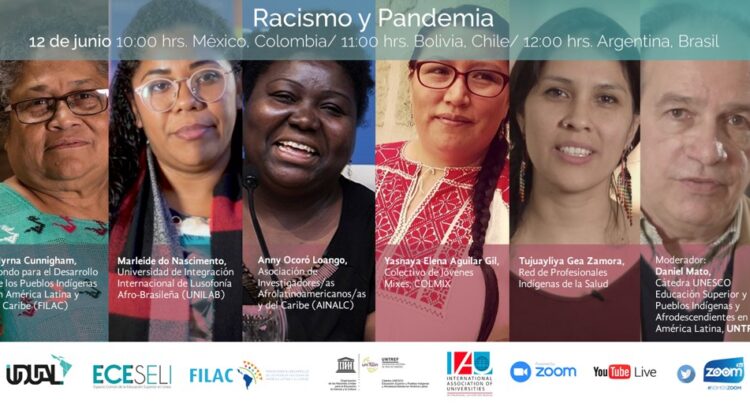
Webinar Racismo y Pandemia

Por: Unión de Universidades de América Latina y el Caribe (UDUAL), la Cátedra UNESCO Educación Superior y Pueblos Indígenas y Afrodescendientes en América Latina y el Fondo para el Desarrollo de los Pueblos Indígenas en América Latina y el Caribe (FILAC) y el Espacio Común de Educación Superior en Línea (ECESELI)

Viernes 12 de junio  9hs Centroamérica — 10hs Colombia/Ecuador/México/Perú — 11hs Bolivia/Chile/Paraguay/Venezuela — 12hs Argentina/Brasil/Uruguay
Expositoras:  Myrna Kay Cunningham Kain. Fondo para el Desarrollo de los Pueblos Indígenas deAmérica Latina y el CARIBE- FILAC. AnnyOcoró Loango. Asociación deInvestigadores/as Afrolatinoamericanos/as y del Caribe AINALC. Yasnaya Elena Aguilar Gil. Colectivo MixeCOLMIX.   Tujuayliya GeaZamora.  Redde Profesionales Indígenas de la Salud.   MarleideNascimento.  Universidade da Integração Internacional daLusofonia Afro-Brasileira – UNILAB. Moderador: Daniel Mato. CátedraUNESCO Educación Superior y Pueblos Indígenas y Afrodescendientes en AméricaLatina. Universidad Nacional de Tres de Febrero – UNTREF.

Racismo y Pandemia

La Unión de Universidades de América Latina y el Caribe (UDUAL), la Cátedra UNESCO Educación Superior y Pueblos Indígenas y Afrodescendientes en América Latina y el Fondo para el Desarrollo de los Pueblos Indígenas en América Latina y el Caribe (FILAC) y el Espacio Común de Educación Superior en Línea (ECESELI) invitan a toda la comunidad universitaria a participar en la serie de webinars sobre el COVID-19 y sus implicaciones sociales, económicas, de salud y educación en América Latina y el Caribe.

Participan:
– Myrna Cunnigham, Fondo para el Desarrollo de los Pueblos Indígenas en América Latina y el Caribe (FILAC)
– Marleide Nascimento, Universidad de Integración Internacional de Lusofonía Afro-Brasileña (UNILAB)
– Anny Ocoró Loango, Asociación de Investigadores/as Afrolatinoamericanos/as y del Caribe (AINALC)
-Yasnaya Elena Aguilar Gil, Colectivo de Jóvenes Mixes (COLMIX)
-Tujuayliya Gea Zamora, Red de Profesionales Indígenas de la Salud

Moderador:
Daniel Mato, Cátedra UNESCO Educación Superior y Pueblos Indígenas y Afrodescendientes en América Latina, UNTREF

12 jun 2020 10:00 AM en Ciudad de México

Fuente de la reseña: Equipo de Ove
Comparte este contenido:

Más de la mitad de los niños y jóvenes venezolanos emigrados a Colombia están fuera del sistema educativo

América del Sur/ Colombia/ 26.05.2020/ Fuente: www.bolsamania.com.

Unos 260.000 de los 460.000 venezolanos menores de edad emigrados a Colombia y que tienen necesidades escolares están fuera del sistema educativo a pesar de los «gigantescos» esfuerzos de las autoridades colombianas por integrarlas, según un informe de la Organización de Naciones Unidas para la Educación, la Ciencia y la Cultura (UNESCO).

En concreto, algo más de 198.000 menores migrantes ya están inscritos, de los cuales un 79 por ciento corresponde a los ciclos de educación primaria y secundaria, según consta en el estudio ‘El derecho a la educación bajo presión: Principales desafíos y acciones transformadoras en la respuesta educativa al flujo migratorio mixto de población venezolana en Colombia’, en el que también ha participado el Consejo Noruego para los Refugiados (NRC).

La comunidad venezolana emigrada a Colombia –1,8 millones, según datos de la ONU– es en su mayoría una población joven, por lo que el acceso a oportunidades de educación y formación sería clave para su desarrollo personal y para el aprovechamiento de todo su potencial. La UNESCO advierte de que, al margen de la escuela, los niños y jóvenes quedan fuera también de ayudas importantes, como podrían ser los servicios de comedor.

El informe constata que la tasa de alfabetización de la población que emigró en la corriente más reciente es menor que la de flujos anteriores, ya que mientras que entre 2012 y 2015 el 91,4 de los migrantes sabía leer y escribir, el dato es del 86 por ciento si se tiene en cuenta los años 2016 y 2017. Entre la población colombiana, la tasa de alfabetización ronda el 92 por ciento.

LASTRES PARA LA INCLUSIÓN

Colombia ofrece de forma gratuita la mayor parte de su oferta educativa, pero la UNESCO también apunta en su estudio que puede haber otros costes indirectos que limiten el acceso a la educación, por ejemplo transporte, uniforme, alimentación y material.

Asimismo, detecta carencias en materia de infraestructura y recursos educativos disponibles, situaciones de hacinamiento en las escuelas, falta de acceso a servicios de agua y saneamiento en algunas regiones. También hay falta de personal, tanto por las dificultades administrativas para ampliar las plantillas como por los límites para que los profesores venezolanos puedan ejercer en Colombia.

Los investigadores confirman «obstáculos» precisamente tanto en el reconocimiento de título como en la equiparación de niveles educativos, hasta el punto de que se han detectado casos de niños y adolescentes que solo pueden acudir como observadores a las clases, sin certificar por tanto los cursos realizados.

El 89 por ciento de los venezolanos asegura que no ejerce su profesión porque carece de los permisos necesarios, bien sea de índole educativa o laboral, según las encuestas realizadas en Bogotá, Barranquilla, Medellín, Cúcuta y Cali y que figuran en el informe publicado este lunes.

En el lado contrario, el de los progresos, el estudio destaca el desarrollo y aplicación de sistemas de información que permiten reforzar la vigilancia a la población migrante, desde el Sistema Integrado de Matrículas (SIMAT) a la incorporación del apartado ‘país de origen’ en el registro de datos administrativos.

CORONAVIRUS

La pandemia de coronavirus «hace visible la situación de especial vulnerabilidad en la que se encuentran las personas en situación de movilidad», señala la UNESCO, que hace hincapié también en los efectos colaterales que puede acarrear el cierre de centros educativos para detener la propagación de la enfermedad COVID-19.

Por este motivo, la organización considera clave que, en contextos como el actual, se pueda contar con información diferenciada sobre personas migrantes, solicitantes de asilo, refugiadas y retornadas. «Es fundamental para responder adecuadamente a la situación actual de emergencia», apunta.

Fuente de la noticia: https://www.bolsamania.com/colombia/noticias/sociedad/venezuela–mas-de-la-mitad-de-los-ninos-y-jovenes-venezolanos-emigrados-a-colombia-estan-fuera-del-sistema-educativo–7512126.html

Comparte este contenido:

México: Unesco reconoce al sector educativo mexicano frente al Covid-19

América del Norte/México/17-05-2020/Autor y Fuente: www.telesurtv.net

El 80 por ciento de los docentes del país continúa comunicándose con sus alumnos y alumnas.

La Organización de las Naciones Unidas para la Educación, la Ciencia y la Cultura (Unesco) reconoció la labor de México para garantizar el funcionamiento de los centros educacionales en el país en medio de la pandemia causada por la Covid-19.

Al respecto, el representante de la Unesco en el país Frédéric Vacheron Oriol aseguró que la experiencia de esa nación en materia de aprendizaje a distancia “debe ser compartida en el ámbito regional e internacional”.

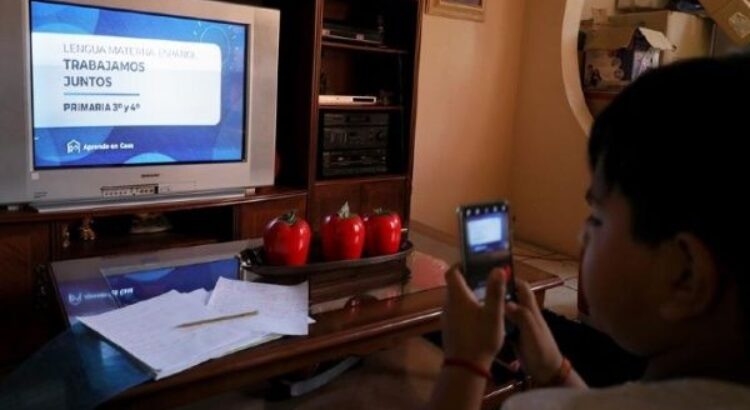
En video mensaje enviado al secretario de Educación Pública, Esteban Moctezuma Barragán, dijo que al revisar la estrategia Aprende en Casa, implementada por la Secretaría de Educación Pública (SEP) para prevenir la propagación del nuevo coronavirus, quedó clara la capacidad de adaptación de quienes integran el Sistema Educativo Mexicano para llevar con éxito el ciclo lectivo en curso.​​​​​​​

Esteban Moctezuma Barragán

@emoctezumab


Felicito con toda mi admiración y respeto a las maestras y maestros hoy en su día.

Su compromiso y vocación para mantener el vínculo con nuestras niñas, niños y jóvenes para que continúen su aprendizaje es ejemplar.

Todo México las y los queremos mucho

Ver imagen en Twitter
575 personas están hablando de esto
Vacheron resaltó que en México 36.5 millones de estudiantes de educación inicial, preescolar, primaria, secundaria, educación media y superior, acceden a servicios educativos en plataformas como la radio, televisión o internet, como complemento de las actividades escolares regulares y con el apoyo de sus maestras y maestros.

Afirmó que la Unesco reconoce las acciones del Gobierno para enfrentar la situación provocada por la pandemia, así como la utilidad de estrategias educativas emergentes como Aprende en Casa, para mantener el aprendizaje de sus estudiantes.

Fuente e Imagen: https://www.telesurtv.net/news/unesco-mexico-educacion-distancia-coronavirus-20200515-0015.html

Comparte este contenido:

COVID-19 is exacerbating the problem of educational inequity in Nigeria

Africa/ Nigeria/ 12.05.2020/ Source: nairametrics.com.


The Coronavirus pandemic (COVID-19) has no doubt adversely affected the global economy. It has forced many businesses to temporarily shut down and governments across the world to place a restriction on movement while exempting providers of essential services who are to strictly observe social distancing rules while providing services as a way to contain the spread of the virus.

Unfortunately, the educational sector is a part of the receiving end. According to UNESCO, an estimated 1.725 billion learners have been affected as a result of school closures, representing about 99.9% of the world’s student population as of April 13th, 2020.

Embracing technology: To cushion the effects of the pandemic, the world is embracing technological innovations. Virtual interactions are increasingly adopted to replace face-to-face engagements and limit the total disruption to many sectors. UNESCO has recommended the use of distance learning programmes, open educational applications, and platforms by schools and teachers to reach learners remotely.

These could include integrated digital learning platforms, video lessons, Massive Open Online Courses (MOOCs), and broadcast through radio and television. The success of these recommendations hinges on the use of high-technology or low-technology solutions, which are based on the reliability of local power supply, internet connectivity and digital skills of teachers, students, parents, and caretakers.

But every student can’t afford this: As pleasant as this solution is, it is said that students from under-served low-income communities will be left out and unable to access learning during this period. In Nigeria, many states have embarked on airing school lessons on radio and television and this is highly commendable.

Non-governmental Organizations (NGO) like Teach for Nigeria, are partnering with government agencies to facilitate implementation and adoption. For example, in Ogun state, Teach For Nigeria is working with the government to deliver classes on TV and have deployed online capacity building workshops for teachers on programming using Scratch (a block-based visual programming language and website targeted primarily at children). This is in a bid to develop skills for STEM education. However, inadequate resources for deployment to under-served communities remain a challenge.

Poverty is a major factor: As stated by the World Poverty Clock, the nation currently has about 50% of her population living in poverty, with many of the citizens struggling to afford three square meals, especially at this time, despite the palliative measures by the government. This means that there are a lot of students who do not have access to either radio or television, coupled with the issue of erratic power supply. Such students also have no internet access nor educational technological resources, a situation that is creating a gap in their academic progress for as long as this pandemic persists.

Obviously, COVD-19 is magnifying the educational inequity in Nigeria as only those with access to digital learning resources will keep learning in the comfort of their homes while those without access (the majority) are left behind.

This learning crisis is widening the social gaps instead of narrowing them. Students are now being disadvantaged by the pandemic. In the future, this gap will show up as weak skills in the workforce, thereby making it less likely for this category of young people to get well paid and satisfying jobs. When this happens, these young people will become nuisances in the society, championing courses that aren’t noble just to make ends meet. This reminds me of a saying by late Chief Obafemi Awolowo (a Nigerian nationalist and statesman) which goes thus:

“The children of the poor you failed to train will never let your children have peace”

COVID-19: Leapfrogging Educational Inequity in Nigeria

We must act now: Now is the time to bridge the gap of educational inequity by ensuring adequate funding of the education sector. The effect of the pandemic is just one out of many implications of educational inequity, we don’t know what awaits us in the future, so it is highly important that we provide an equitable and inclusive learning environment for the students to ensure continuity in learning for all, irrespective of their socio-economic background. One of the palliative measures that can be adopted includes a public-private partnership with non-profits and other government agencies who are working to salvage the situation. Such efforts can be supported through the provision of funds at this critical time. We should not forget that education is the bedrock of every society as education is the solution to whatever problem we might have.

Based on this, it is suggested that portable solar radios be provided to each family especially in remote places. This will ensure continuity in learning for the majority of learners who are unable to access digital learning resources during this period. Also, teachers need to be trained on how best to deliver radio lessons. Such training can be done using virtual platforms. Sincere appreciation goes to the teachers working assiduously in delivering lessons on radio despite the short notice and lack of training for such context because teaching in a conventional four-walled classroom is quite different from teaching on radio and so it is important to know how best to carry it out so as to achieve best results. This wakeup call will definitely propel us to keep ruminating on other solutions at bridging the gap of educational inequity during this period and making it happen by all means.

Let us remember that whatever the problem is, education remains the solution. The future is in our hands to decide, let us join hands together to make the world a better place through quality and inclusive education.
Source of the notice: https://nairametrics.com/2020/04/18/covid-19-is-exacerbating-the-problem-of-educational-inequity-in-nigeria/
Comparte este contenido:

Countries around the world are reopening their schools. This is what it looks like

Por: Melissa Wiley.

  • Coronavirus lockdown measures have partially or fully closed schools for more than 90% of the world’s student population across 186 countries and territories, according to UNESCO.
  • After closing schools to prevent the spread of the coronavirus, a handful of countries like Denmark and Japan have started reopening them.
  • New safety measures range from keeping windows open for ventilation to spacing desks six feet apart and resuming classes for students of a certain age.
  • Here’s a look at some countries and provinces that have reopened schools so far.

Some schools in China began reopening in March, though many remain closed.

Students wearing face masks use hand sanitisers at an entrance to a school in Shanghai, China, as senior high school and senior middle school students in Shanghai return to campus following the coronavirus disease (COVID-19) outbreak, April 27, 2020. cnsphoto via REUTERS ATTENTION EDITORS - THIS IMAGE WAS PROVIDED BY A THIRD PARTY. CHINA OUT. - RC2TCG9XS0LW
Students are slowly returning to school in China with hygiene measures put in place.
Image: REUTERS

In late January, China instituted a lockdown for the 11 million residents of Wuhan, where the novel coronavirus outbreak originated. Fifteen other cities soon followed, and at its peak, China’s quarantine extended to 20 provinces and regions, according to the Wall Street Journal. Due to lockdown measures, some 200 million students transitioned to online learning in February, the Washington Post reported.

On March 18, China reported no new local coronavirus cases for the first time since the outbreak and has gradually lifted restrictions in the weeks since.

While schools in nine mainland provinces had reopened for graduating students as of early April, according to the South China Morning Post, UNESCO’s data shows that most schools remain closed in larger regions. High school seniors in Beijing, Shanghai, and Guangzhou only just returned to school on April 27 to prepare for their college entrance exams.

BBC reported that China’s Ministry of Education is requiring that students have their temperatures checked at school entrances and that they display a «green» code of health via China’s smartphone health code program.

Taiwan reopened schools on February 25 after extending winter break by ten days.

Pupils sit in desks with yellow dividers, set up as a measure against the coronavirus disease (COVID-19), at Dajia Elementary school in Taipei, Taiwan March 13, 2020. REUTERS/Ann Wang - RC2YIF9PKWT4
In Taiwan, China, pupils have been sitting with plastic dividers, to stop the spread of germs.
Image: REUTERS/Ann Wang – RC2YIF9PKWT4

After learning of the coronavirus outbreak, Taiwan took swift action to contain its spread.

Taiwan never officially closed schools but did extend winter break by 10 days in February in order to disinfect education facilities, distribute medical supplies, and implement new procedures for schools with confirmed coronavirus cases.

Schools now conduct temperature checks, and some have employed plastic tabletop desk partitions as an added security measure.

Schools in Japan reopened in early April for the new school year.

Children attend the entrance ceremony of an elementary school, following the outbreak of the coronavirus disease (COVID-19), in Nagoya, Japan, in this photo taken by Kyodo April 6, 2020. Mandatory credit Kyodo/via REUTERS ATTENTION EDITORS - THIS IMAGE WAS PROVIDED BY A THIRD PARTY. MANDATORY CREDIT. JAPAN OUT. NO COMMERCIAL OR EDITORIAL SALES IN JAPAN. - RC2RYF9IDEED
In Japan, 40% of schools have reopened.
Image: REUTERS

On February 27, Prime Minister Shinzo Abe urged elementary, middle, and high schools across Japan to close beginning March 2 until the start of the new school year in early April to prevent the spread of the virus.

Abe did not issue specific guidance for universities, most of which were on spring break as they follow a separate semester system.

On March 24, Japan announced that it would not extend its school closure recommendation, leaving the decision of when and whether or not to reopen to local municipalities based on the number of coronavirus cases in the area. The Ministry of Health also released guidelines for school reopening which include opening windows to ventilate classrooms, maintaining physical distance, checking temperatures daily, and wearing face masks.

«The circumstances of each area is different, and it will be much more effective to judge based on the actual ground situation rather than dictating a policy measure nationwide,» Education Minister Koichi Hagiuda told the Straits Times.

To date, about 40% of schools have reopened, according to UNESCO.

This could be due in part to the national state of emergency that Abe announced on April 16 following a rise in new infections. The state of emergency gives leaders of Japan’s 47 prefectures, or administrative regions, the authority to request school closures and ask residents to stay home. Abe has indicated that he will extend the state of emergency past its May 6 expiration date, Bloomberg reported.

On April 15, Denmark became the first European country on lockdown to reopen its schools, beginning with children in daycare and grades 1 through 5.

Parents with their children stand in a queue waiting to get inside Stengaard School following the coronavirus disease (COVID-19) outbreak north of Copenhagen, Denemark, April 15, 2020. Ritzau Scanpix/Bo Amstrup/via REUTERS ATTENTION EDITORS - THIS IMAGE WAS PROVIDED BY A THIRD PARTY. DENMARK OUT. NO COMMERCIAL OR EDITORIAL SALES IN DENMARK. - RC2Y4G9RKE0S
Students in Denmark are adhering to social distancing measures.
Image: via REUTERS

Denmark’s youngest students returned to school earlier this month as part of Denmark’s plan to gradually reopen the country following a decline in the rate of new infections.

While classes have resumed, schools have placed desks six feet apart and staggered student arrivals, among other measures, in order to adhere to social distancing guidelines still in place.

Denmark announced its first lockdown measures on March 11 before the country reported any coronavirus deaths and closed schools on March 16. For the time being, high schools and universities remain closed.

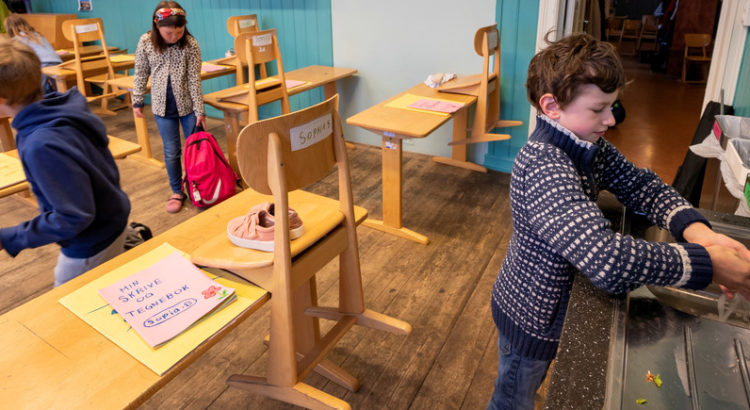
Norway began reopening its kindergartens on April 20, followed by primary schools for children in grades 1 through 4 on April 27.

Children stay in line at Vikasen school, as it reopens after few weeks, due to the coronavirus disease (COVID-19) outbreak, in Trondheim, Norway April 27, 2020. NTB Scanpix/Gorm Kallestad via REUTERS ATTENTION EDITORS - THIS IMAGE WAS PROVIDED BY A THIRD PARTY. NORWAY OUT. NO COMMERCIAL OR EDITORIAL SALES IN NORWAY. - RC2XCG90F6GI
In Norway, schools are encouraged to divide classes into groups of no more than 15 students.
Image: via REUTERS

Norway closed schools on March 12 and, like Denmark, has sent its youngest students back to class ahead of older pupils due to a decline in the rate of coronavirus transmission.

«Together we have taken control of the virus, therefore we can open up society little by little,» Prime Minister Erna Solberg said during a news conference in early April.

To encourage social distancing, the government has urged schools to divide classes into groups of no more than 15 and have children wash their desks daily, among other precautions. Upper schools and universities remain closed until further notice.

Germany reopened high schools on April 20 to high school seniors.

Students of a vocational school for pharmacy technicians participate in class on the first school day after a five-week shutdown due to the spread of the coronavirus disease (COVID-19) in Munich, Germany April 27, 2020. REUTERS/Andreas Gebert - RC2VCG93UW53
In Germany, Chancellor Merkel, advised that schools give priority to graduating students when reopening gradually.
Image: REUTERS/Andreas Gebert – RC2VCG93UW53

Select high schools across Germany reopened earlier this month so that seniors could take their final exams.

Most schools and daycares across Germany’s 16 states have been closed since mid-March during which time the country has achieved «fragile intermediate success» in reducing the spread of the virus, Chancellor Angela Merkel said earlier this month.

As part of Germany’s plan to gradually lift its lockdown following, Merkel recommended that schools begin the process of reopening on May 4, giving priority to graduating students.

Comparte este contenido:

UNESCO COVID-19 Education Response – Education Sector issue notes – Issue note n° 7.1 School reopening – April 2020

Introduction

As a preventive measure to curb the further spread of the COVID-19 pandemic, schools, universities and other education institutions have closed in most countries, affecting almost 90% of the global student population. While Member States work to ensure the continuity of learning through alternative delivery modalities, in parallel, they need to start anticipating and preparing for school reopening.

Ministries of Education (MOEs), in consultation with Ministries of Health, Social Affairs and other key public and private institutions, are in charge of planning for school reopening, prioritizing the safety and protection of learners, teachers and other personnel, as well as their health – physical, mental and psychosocial, well-being and social relationships. Back-to-school strategies need to focus on assessing and ensuring the readiness of the education system for school reopening; the continuity of learning; and, system resilience to anticipate and deal with future crises. MOEs will also need to anticipate and prepare for additional challenges resulting from the direct and indirect consequences of COVID-19 and prolonged social isolation, on both the education system and on the school community. These include increased risk of dropout, the exacerbation of existing and new inequalities, or the loss of education personnel.

Despite the great challenges presented by this crisis,the situation also offersthe opportunity to rethink the overall purpose, role, content and delivery of education in the long term, and prepare education systems to deal with current and future crises through comprehensive and inter-sectoral approaches and by tapping into collective experience and practices from around the world.

Descargar; https://reliefweb.int/sites/reliefweb.int/files/resources/75890.pdf

Comparte este contenido:

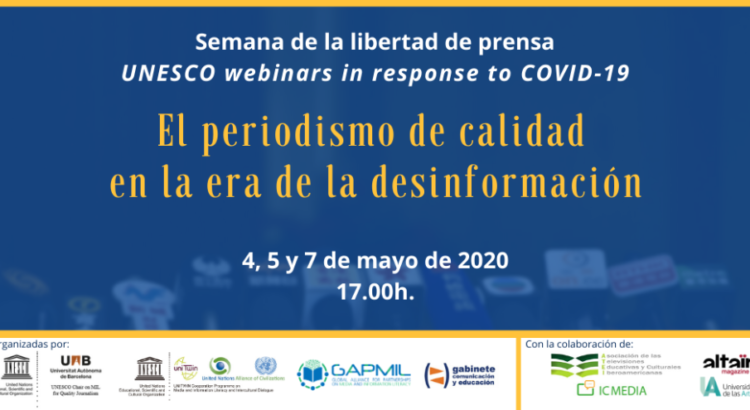
UNESCO webinars en respuesta al coronavirus: El periodismo de calidad en la era de la desinformación

Aika Educacion/Kelly Robledo

La expansión del coronavirus ha provocado una crisis mundial que trasciende el sector sanitario. Esta pandemia trae consigo también una explosión de desinformación conocida como infodemia: una epidemia de rumores que en contextos como el actual, ocasiona pánico y promueve conductas inadecuadas en la sociedad. Frente a esto, ¿cuáles son los retos a los que se enfrentan la libertad de prensa, el periodismo de calidad y los derechos a la información y a la alfabetización mediática? En este contexto se organizan los UNESCO webinars: El periodismo de calidad en la era de la desinformación.

Estas jornadas digitales se enmarcan en el Día Mundial de la Libertad de Prensa, a conmemorarse este 3 de mayo, fecha establecida hace 27 años por la UNESCO. La iniciativa de crear un espacio de diálogo y debate sobre cómo informar en tiempos de coronavirus es impulsada por la Cátedra UNESCO de Alfabetización Mediática y Periodismo de Calidad y el Gabinete de Comunicación y Educación de la Universidad Autónoma de Barcelona. Además, cuenta con la colaboración de la Asociación de Televisión Educativa Iberoamericana (ATEI), la Universidad de las Artes de Ecuador, Altaïr Magazine e IcMedia.

El evento se desarrollará las fechas 4, 5 y 7 de mayo a las 17:00 horas (España), mediante la plataforma Zoom. Cada día se abordará una temática específica con académicos y profesionales de la industria, expertos en el campo. Así, en la primera jornada se desarrollará la mesa La libertad de los periodistas en estado de alarma. Para dialogar sobre las cuestiones en torno, los invitados son Martín Caparrós, periodista y escritor; Mar Abad, co-fundadora de Yorokobu; y Pere Ortín, director de Altair Magazine. Santiago Tejedor, profesor y director del Departamento de Periodismo y Ciencias de la Comunicación de la UAB, será quien modere el panel.

La mesa Servicio público audiovisual en el horizonte del coronavirus, a desarrollarse el día 5, estará conformada por Emelina Fernández Soriano, profesora titular de Comunicación Audiovisual de la Universidad de Málaga y expresidenta del Consejo Audiovisual de Andalucía; María Eugenia Mosquera, historiadora y directora general de ValeTV, Venezuela; Urbano García Alonso, periodista y director general de Corporación Extremeña de Medios Audiovisuales, España (CEXMA); y Alfonso Morales Fernández, jurista, doctor en Comunicación y presidente del Consejo de Administración de TeleMadrid. La moderación estará a cargo de José Manuel Pérez Tornero, catedrático de Periodismo de la UAB.

Finalmente, el día 7 de mayo se cerrarán las jornadas con la mesa La alfabetización mediática en tiempos de coronavirus. En ella participarán Ramiro Noriega, rector de la Universidad de las Artes (Ecuador); Marta Pellico, directora de ICMedia; Manuel Pinto, catedrático de Comunicación de la Universidad do Minho (Portugal); y Laura Cervi, investigadora de la UAB. La decana de la Facultad de Comunicación de la UAB, María José Recoder, moderará las intervenciones.

Para participar de los webinars, es necesario completar este formulario. Luego recibirá por correo electrónico los enlaces correspondientes para conectarse a cada una de las mesas. El programa completo se puede consultar desde aquí.

Comparte este contenido:
Page 23 of 152
1 21 22 23 24 25 152
OtrasVocesenEducacion.org