África/Sudáfrica/Noviembre de 2016/Autor: Ben Morken/Fuente: Marxist
RESUMEN: Esencialmente, la lucha de los jóvenes de hoy refleja la crisis del sistema capitalista que no puede ofrecer ningún camino para las masas. La lucha amarga es un punto de inflexión para la sociedad sudafricana, que ha visto surgir durante la última década las contradicciones de clase. Los estudiantes y la intelligentsia son un barómetro sensible del estado de ánimo en la sociedad y sus luchas hoy son una anticipación de lo que está por venir. Demuestran que hay una cólera y una frustración profundas en la situación actual.
Essentially, the struggle of the youth today reflects the crisis of the capitalist system which cannot offer any way forward for the masses. The bitter struggle is a turning point for South African society which has seen class contradictions rising over the past decade. The students and intelligentsia are a sensitive barometer of the mood in society and their struggles today are an anticipation of what is to come. They show that there is deep anger and frustration at the current state of affairs.
A crisis of the regime
Starting off as a movement against tuition fees and for free education, the movement has gone way beyond these immediate issues. The violent crackdown and the arrogance of the government has politicised and radicalised the movement. The intensity and sweep of the protests, in turn, have captured the attention of all classes. As the situation unfolds on a daily basis, the government seems increasingly paralysed and does not know how to proceed. The ground is shifting beneath its feet and it wields no authority over the movement.
This inability to rule in the old way is a signal of an approaching revolutionary crisis. The traditional support base has grown disillusioned with the ANC which has been presiding over all the cuts and attacks against the workers and the youth since taking power in 1994. This is reflected in the violent crackdown of the government against the movement. It shows the increasing inability of the ANC to exercise its traditional function for the ruling class of holding back the mass movement. The bourgeoisie on the other hand, does not have an alternative to the ANC. This has plunged it into a profound crisis.
Consumed by infighting, the government is completely out of touch with the situation. This is evident in its latest attempt to “resolve” the crisis. President Zuma created a task team which initially consisted of ministers of the Security Cluster – Defense, Justice, Police, Correctional Services and State Security. This speaks volumes of the government’s approach to the protests. Zuma has belatedly included the ministers of Finance, Communication, Housing and Social Development after a call by the ANC. But this only adds to the inept and clumsy manner in which the government is handling the issue.
The militarisation of the campuses is actually having the opposite effect of its intended purpose, because it only pours fuel on the fire. The ruling class is split and lacks the necessary internal cohesion to respond effectively. The regime is in a deep crisis, which has been caused by the rising tide of the class struggle. The student movement is exacerbating this crisis.
Social origins
The student protests themselves have their roots in the upsurge of the class struggle of the recent period. It is part of a broader process, which has taken place over the last few years, in which the masses have again and again taken to the road of mass struggle in search of solutions to the social and economic crisis they face. Over the last decade there have been waves of mass struggle which have taken various shapes and forms. These struggles, especially in the period between 2009-2012, saw an explosion of strikes which battered the political landscape and ushered in a period of political realignment.
The capitalist policies carried out by the African National Congress and the militant response by the workers resulted in the former mass liberation movement beginning to fracture along class lines. The turning point was the Marikana massacre which saw the ANC responsible for apartheid era atrocities against striking poor black workers. Huge class contradictions have since emerged between the ANC leadership which has the joined the ranks of the ruling class, and the working class masses that supported it for decades. The crisis in the Tripartite Alliance, the splits in the trade union movement, the emergence of forces to the left to the ANC, as well as a number of community based organisations, are products of this process.The student protests are the latest phase in this line of development.
On the one hand we the leadership of the ANC and its allies, which have joined the capitalist club, mostly backed by the older generation of the former liberation movement. On the other hand, we have the new generation of youth that is bearing the brunt of the capitalist crisis and the consequences of the 1994 “transition”. The outcome of those negotiations between the leaders of the black elite and the traditional white capitalist class resulted in a deal in which the ANC leaders were allowed to form the government while the economy was kept in the hands of the capitalists. What we are currently witnessing are the natural consequences of that deal.
Under capitalism, the great wealth which is created by the South African working class is appropriated by the capitalists. An anarchic and crisis ridden system which relentlessly pursues profits for the few cannot be reconciled with the basic material needs of the masses. This is a generation disillusioned with the results of capitalists democracy, which has not given them much aside from a prospect of a life of unemployment and constant attacks on living standards. And now they are fighting back.
A new generation of fighters
Protests over tuition fees are not a new phenomenon. As part of the general upsurge in the class struggle, they have been ongoing at the poorer black universities for a number of years. These protests were largely left to fester so long as they were confined to universities such as TUT, UWC, CPUT and Fort Hare. But with the current upheaval at Wits, UCT, Rhodes, etc, the protests have spread to the middle class. This is an indication of the deteriorating material conditions of the masses.
The most militant layer of the protests consists of the so-called “born free” generation, i.e, those born after 1994. This fresh layer of youth is unshackled from the politics of the liberation era and only know the convulsive period we live in now. Outraged by the effects of the crisis of capitalism and galvanised by the local and international fightback by the masses, the youth have taken to the road of struggle.
Thrown into the cauldron, the fresh layers show enormous militancy and heroism but the lack of experience also places many obstacles before the movement. In the initial stages it is only natural that the movement goes through a period of confusion. But in order to succeed and to take the struggle to a higher level it necessary to overcome these weaknesses.
In their fight against the state for free education, the students have shown enormous bravery and sacrifice. The scenes of daily battles at all the universities across the country show the determination and revolutionary zeal of the youth. But the demands of the students have not been met despite a month of intense struggle. This shows that courage and determination alone are not sufficient to win. Had this been the case, capitalism would have been overthrown decades ago. What is needed is a correct programme, correct tactics and a truly fighting leadership.
The student leaders
When the student protests erupted in October 2015 they immediately took the form of a mass movement. The key reason for this was the intervention of the South African Students Congress (SASCO) which was involved from the beginning and provided an important national framework for the movement. Within a week, students began to mobilise not only on their own campuses but also between universities. This mobilisation was then coordinated at a national level. Marches and mass demonstrations were held on consecutive days in Cape Town, Johannesburg and Pretoria to protest at parliament, Luthuli House and at the Union Buildings respectively.
The mass character of the movement came as a shock to the government. Within two weeks the size and increasing militancy of the movement forced the government to announce a freeze in tuition fees in a desperate attempt to put a lid on the protests. This is an important lesson. It was the scale of the protests and the threat it posed to the system that forced the government to retreat.
This year, however, the SASCO leadership has scandalously declined to support and organise the students. On many campuses some SASCO leaders have even spoken against the students and have protected the government. This goes against the whole purpose of SASCO, which was set up by the students to represent them and to fight for good quality and free education. Together with another traditional organisation, the South African Union of Students (SAOS), the SASCO leaders are often seen as being in cahoots with the government. Many of the student leaders are seen as using the movement as a stepping stone to advancing their own political careers.
It is clear that the aim of the concessions to the movement last year was purely to buy time for the government. But while the government was preparing a counterattack over the past year the student leaders at some universities began to shut the movement down. The mass based character and vital coordination between universities was broken and replaced by an atomised movement wherein the numerous demands were fought on a campus-by-campus basis. This false dichotomy which was created between local and national demands led to the atomisation of the movement.
Over the past year, universities across the country have become a hotbed of activity. Protests against a lack of accommodation, financial exclusion, the curriculum, institutional culture and outsourcing of university workers cropped up at almost all universities. But everywhere it lacked the mass character and necessary coordination of last year. Instead of linking up the demands centrally and waging a national struggle against the government and the system as a whole, the movement began to fracture into its different tendencies. The consequence of this was that when the movement erupted again it lacked the nationally coordinated struggle of last year.
This has had very serious consequences for the movement. The actions – or rather, the inaction – of the student leaders has only assisted the government in tiring out and isolating the students. This could lead to the defeat of the movement. Apart from exceptional cases such as at Wits University, the protests have by-passed the official Student Representative Councils at universities.
Organisation
This is a healthy reaction towards the actions of the student leaders, but it does not solve the problems of the movement. The solution to bad leadership is to find better, committed and selfless leaders. The only way to ensure this is to make the leadership structures as democratic and accountable as possible with the right to recall of any leader who fails to carry out the mandates of the students in an acceptable way.
The pitfalls of the atomising of the movement have been apparent. Instead of speaking with one voice, the fractured movements began to speak past each other. This has made the protests more disjointed and the demands less clear. The government and the hostile media have used this incoherence to distort and misrepresent the demands of the students.
The lack of a national and mass based movement also led to the isolation of different groups from the broader student body. Meanwhile the smaller core of the movement, which was radicalised under the crackdown, began to employ tactics such as the burning of libraries, stoning of cars, and other similar actions. This provided the perfect pretext to the state to further isolate student leaders and crack down on the protests. The disconnection between the advanced layers of the students and the wider student base only serves to isolate and fracture the movement, making it easier for the state to clamp down on the protests. This could open the road for a counter-attack by the ruling class.
The lack of national organisations and mass oriented tactics is a clear weakness which the movement must attempt to overcome. It is not possible to fight the centralised capitalist state machine with disunity and disorganisation. The way forward is to build on the best methods of the movement last year: democratic mass student assemblies where everyone is allowed to speak freely and give their opinion. Only in this way can the movement build the necessary momentum and draw in the necessary forces to proceed. These assemblies should choose delegates to a national student congress where all the demands could be taken up on a central basis. The only way to proceed is with maximum unity and organisation. All methods of disunity and atomisation will only mean that it will be easier to isolate the individual groups of protesters and thereby weaken the movement as a whole.
A political struggle
The lack of a national coordination also leads to a political weakness. While the demand for the abolition of university fees is still at the centre of the struggle, this does not exhaust the question of a programme.
Of course, the movement is not uniform but contradictory. The specific conditions and demands vary from one campus to another. The conditions and dynamics at Wits, Rhodes, Stellenbosch and UCT are different from the traditionally black universities like TUT, CPUT, UWC, VUT, etc. This in itself is not a problem. The different layers of society always come to revolutionary conclusions on the basis of their own concrete situations. The key is, however, is to link up the struggles by generalising the local and individual demands into a programme which can unify the struggles on a national scale and draw in new layers. The more localised the coordination of the movement remains, the harder it is to develop such a programme.
While the movement was initially sparked by the raising of tuition fees, the demands have gradually expanded to areas such as as tuition funding for poorer students, reduction of the university managers’ incomes, an end to outsourcing, raising government funding for higher education, cancellation of student debt as well as racial inequality issues. But these demands are not centralised and also don’t quite reflect the real stage at which the movement is at. The violent crackdown of the police and the coordinated efforts of the bourgeoisie to crush the movement has pushed the movement far beyond the initial aims and demands towards a direct struggle against the Zuma government. The demand for the fall of the Security Cluster and the Minister of Education would help focus the movement and would find a wide echo amongst wide layers of the working class. But the demands of the movement, insofar as they exist, mainly reflect the initial phases of the movement.
The working class
While the youth can play an important part in the class struggle, they cannot directly influence economy or the key levers of power in society. As we have stated above, the student protests are part of the broader class struggle, which in turn is a result of the crisis of capitalism. Due to their role in the large scale production process, the workers are central to any action to fight the capitalist system. The limitations of the movement to purely a student strike can be seen in the current protests. While they have succeeded in disrupting the normal functioning of the universities, they have had no effect on the functioning of the economy. The mines, banks, supermarkets and factories are all running normally. It is therefore crucial for the student movement to find ways of linking up with broader layers of the workers and the poor.
Last year, the movement led straight to a campaign against outsourcing at the universities. This instinctive turn of the students toward the working class was a huge step forward. Significant victories were won at a number of universities. It is necessary expand this method, broaden the scope of the campaign and raise the level of the movement.
The student struggle must be linked up with the struggles of the working class as a whole by developing a systematic approach to the workers. Firstly, the main demands of the workers, including an end to labour brokers, a living wage and an end to service delivery cuts, should be a key part of the students’ programme. This should be accompanied by student delegations being sent to all the big factories and big enterprises to appeal to the workers.
A revolutionary leadership
Those who oppose the struggle of the youth on the grounds that they do not have a clear programme should explain where such a programme should come from. It is a fact that of all the organisations which were built to represent the South African masses, none of them has managed to serve their purpose in this struggle.
The ANC leadership which dominates the government has been the main perpetrator of attacks against the youth and the working class in the past period. All of its infighting factions are completely out of touch with the daily day life of the masses. The “Communists” have also joined the government as cabinet ministers and are complicit in the relentless assault on the material conditions of the workers and students. The General Secretary of the “Communist” party as a Cabinet Minister of Higher Education is actively fighting against the demand for free education! The distance between the mass of youth and the youth wings of organisations such as the ANC Youth League has grown into an abyss.
The EFF leaders have been the only ones to support the movement, but Julius Malema has been seen as using the movement for his own narrow means. His recent flirtations with capitalist elements from the DA and the Mantashe wing of the ANC as well as his watered down programme for the latest local elections has undermined the EFF amongst the most advanced youth.
The trade unions have also not tried to link up the struggles of workers and students. The right wing leaders of COSATU participated in a low-key march on 14 October to the Chamber of Mines. But they have not provided a clear programme to take the movement forward. In fact, the march was reduced to simply “appealing” to the mining bosses to provide funds toward higher education! This was a classic example of the COSATU office bearers taking the steam out of the situation and effectively trying to demobilise the students. As for the left wing of the trade union movement – in particular NUMSA – it has only given the minimum of support. Although it has supported the students in words, it has not done anything to help the movement overcome its weaknesses in practice. It has also not mobilised in anyway against the violent crackdown of the security forces and the apartheid era tactics used by the state.
For the past three years, NUMSA has talked about setting up a socialist party. Should this materialise, it would change the whole political landscape. Its leaders are missing a golden opportunity. The conditions for launching a fighting party of the working class are extremely favourable. The presence of the most radical layers of the youth on the streets is clear confirmation of this. The South African masses are taking to the road of struggle, but they do not have a revolutionary leadership to unify their struggles and aim them at the real cause of all of their problems – the capitalist system.
Fight for Socialism
Since 1994 enrolments at universities have more than doubled. In order to offer loans to poor students, the National Students Financial Aid Scheme (NSFAS) was established. Since then NSFAS has provided assistance to more than 1.4 million. But while the enrolment at universities has grown exponentially, funding to higher education has decreased as the government has tried to cap a growing budget deficit. In the period from 2000 to 2012 state funding for higher education declined in real terms by 1.1% of GDP. The proportion of GDP spent on higher education in 2015 has dropped to 0.7% which is low by international standards. And in order to mitigate the shortfall, universities have increased tuition fees.
At the same time, the burden on students increased from 24% to 31%. At the end of 2012 student debt increased from R2.6 billion to R3.4 billion. The NSFAS also ran into a crisis. The crisis of youth unemployment and the inability to pay back the loans meant that outstanding debt to NSFAS has grown to nearly R20 billion. Youth unemployment increased to 55% which means that many new graduates could not be absorbed into the labour market. The so-called “skills shortage” which is needed in the economy is therefore the result of the workings of capitalism. Enormous human potential goes to waste because the system cannot make optimal use of it. So what started out as initiatives to reform the system have run into the laws of the capitalist system. The crisis has once again exposed the limits of reformism.
The demands of the students and of the working class are in direct conflict with the private ownership of the means of production. All the wealth of society is in the hands of a small minority, the capitalist class. Yet all this wealth is created by the working class. It is therefore a prime necessity for the working class to put an end to this state of affairs by taking the ownership of the economy out of the hands of the capitalist class. The Freedom Charter states: “The People must share in the country’s wealth! The mineral wealth beneath the soil, the banks and monopoly industries shall be transferred to the ownership of the people as a whole!” Only by expropriating the capitalists will it be possible to put the huge resources of the country to use for the whole of society and not the privilege of the few.
Fuente: https://www.marxist.com/south-africa-the-fight-for-free-education-and-the-lessons-of-the-student-movement.htm





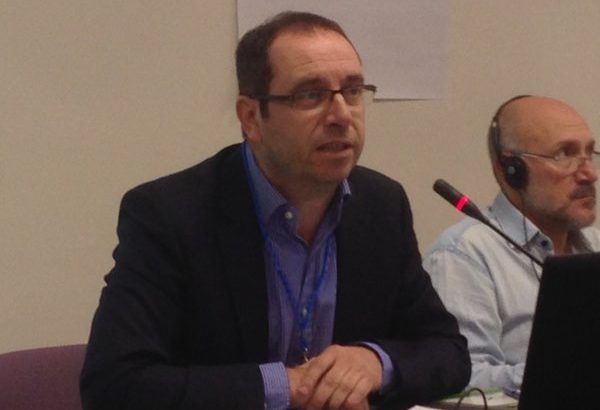
 Si el docente y blogger más influyente del Reino Unido habla de Twitter como «el único lugar donde los docentes pueden alzar su voz», ¿qué tiene que decir esto sobre la condición de la profesión docente y los sindicatos de la educación? Howard Stevenson, director de investigación de la Universidad de Nottingham, ha analizado hoy estas y otras amenazas y oportunidades durante una presentación ante el Consejo Ejecutivo de la IE (IE) titulada «Changing unions in challenging times» (El cambio de los sindicatos en tiempos difíciles).


 Users Today : 160
 Total Users : 35506279
 Views Today : 179
 Total views : 3633121